
Key takeaways
- Good jobsite security is layered: fencing and a single gate slow intruders down, lighting and cameras make them visible, and live monitoring stops them.
- Equipment records matter as much as locks. Serial and PIN numbers, marking, and GPS tracking make stolen equipment traceable.
- Stage materials and schedule deliveries to reduce what sits exposed overnight and on weekends.
- Cameras should cover the gate, the staging area, and the fence line, and someone should be watching when the site is closed.
- Re-check the list at every phase change. A site in framing has different gaps than a site in grading.
Security measures vs. a security plan
This article is a checklist of measures. If you haven't yet assessed risk, mapped access points, and assigned responsibilities, start with our step-by-step construction site security plan, then use this list to confirm each control is actually in place. Most teams run the plan once at preconstruction and walk this checklist at mobilization and at every phase change. For how these measures fit together across a whole project, see our construction site security solutions.
Perimeter and access control
1. Continuous fencing and posted signage
A fence doesn't stop a determined thief, but it removes the easy walk-in and forces an intruder to climb, cut, or drive through a gate, all of which take time and draw attention. Use continuous temporary fencing with privacy screening where materials are visible from the road, and check it daily for cut panels and gaps under the fabric. Post "No Trespassing" and "Video Monitored" signs at the gate and at regular intervals along street frontage; signage adds deterrence and documents that the area is restricted.
2. One controlled vehicle gate
Every extra opening is another route in and out that cameras and people have to watch. Limit the site to a single vehicle gate where possible, plus a separate pedestrian gate if needed, and lock both with hardened padlocks or chain that resists bolt cutters. Keep the gate closed during working hours when no deliveries are expected, and assign someone to open and lock it each day.
3. Visitor and subcontractor sign-in
On a busy site, strangers blend in. A sign-in process for visitors, vendors, and subcontractor crews tells you who was on site and when, which matters both for theft investigations and safety. Use a sign-in sheet or app at the gate, require badges or hard-hat stickers for approved workers, and escort visitors.
4. Key and equipment access control
Keys left in machines or hung on an unlocked board inside the trailer are one of the most common enablers of equipment theft. Keep all equipment keys in a locked key box with a sign-out log, and assign one person per shift to check them back in. Where equipment uses common keys, consider aftermarket locks or keypad ignitions so a single key doesn't start every machine of that brand.
Equipment and materials protection
5. Immobilizers and GPS tracking
Stolen heavy equipment is rarely recovered. In the National Equipment Register's 2016 report, only 21% of equipment reported stolen that year was recovered. Install immobilizers or battery disconnects on high-value machines such as skid steers, backhoes, and loaders, and add GPS trackers with geofence alerts so you are notified when a machine moves after hours. For more tactics, see how to prevent construction site theft.
6. Serial-number inventory and marking
If you can't prove what was stolen, police can't flag it and insurers can't pay it. Keep a current inventory of every machine, attachment, generator, and power tool with serial or PIN numbers, photos, and purchase records. Engrave or paint company identifiers on tools and small equipment in more than one spot, including a hidden location, so resale is harder and recovered items can be identified.
7. Lock-up and secure containers
Hand tools, copper wire, fixtures, and appliances are small, valuable, and easy to resell. Store them in locked steel conex containers with shrouded lock boxes that protect the padlock from cutting. Position containers where cameras and lighting cover the doors, and keep an end-of-day lock-up routine that someone signs off on.
8. Stage materials away from the fence and road
Material stacked against the fence line invites a quick grab from a vehicle parked outside. Designate a staging area set back from the perimeter, ideally in the interior of the site and within camera view, and park equipment in a tight group with buckets lowered.
9. Time deliveries to reduce overnight exposure
Materials delivered Friday afternoon sit unprotected all weekend. Coordinate with suppliers so deliveries arrive close to when crews will install them, and schedule high-value items such as wire, appliances, and HVAC units early in the week. When an early delivery can't be avoided, lock it up the same day or place it under dedicated camera coverage.
Lighting
10. Light the gate, staging area, and perimeter
Darkness gives intruders time to work unseen and makes camera footage less useful. Aim lighting at the gate, containers, staging area, and equipment park, and avoid fixtures that shine directly into camera lenses and cause glare. On sites without permanent power, a solar lighting trailer can cover dark areas.
Surveillance and monitoring
11. Cameras aimed at the gate, staging area, and fence line
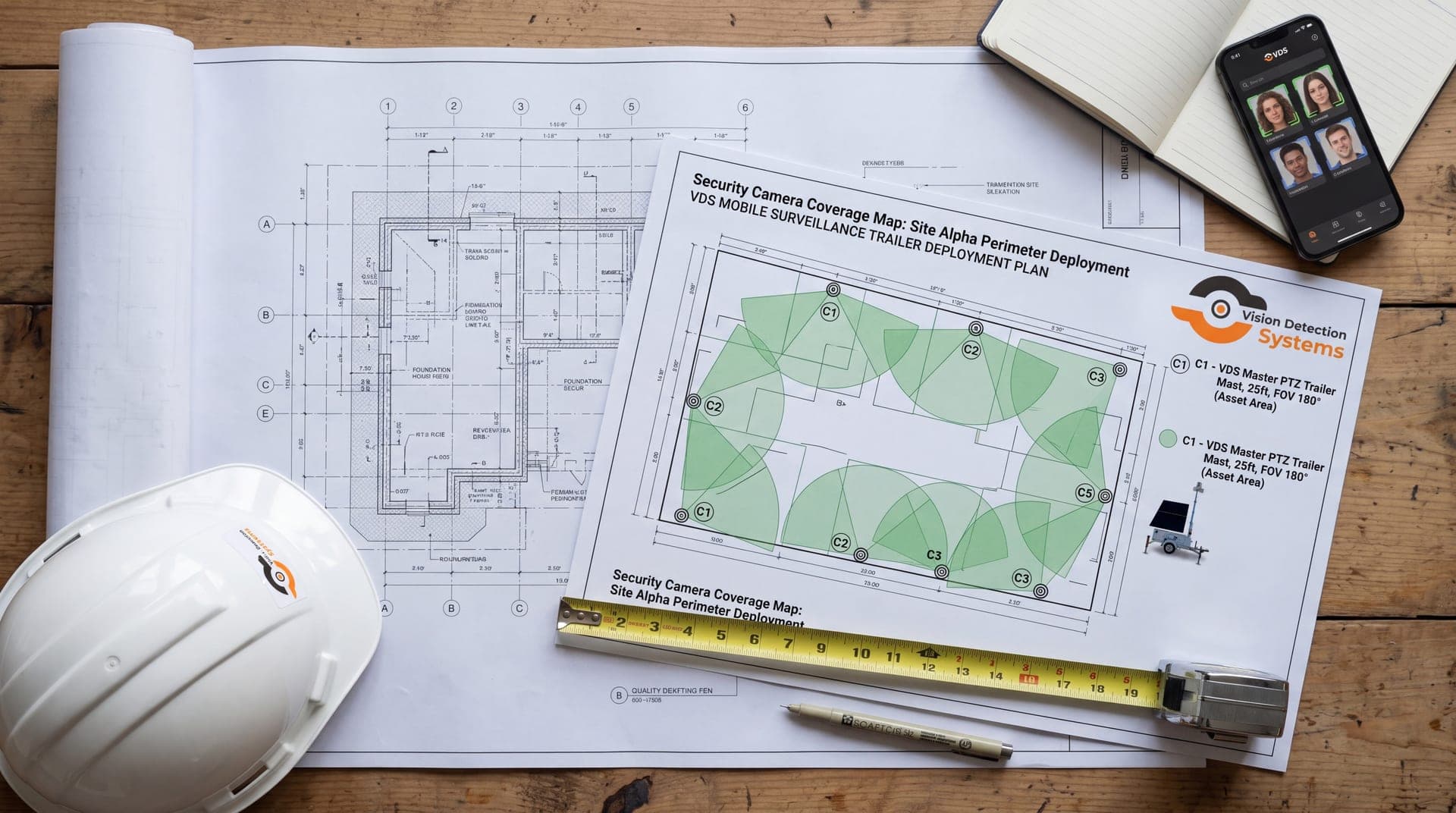
Cameras placed for a wide view of "the site" often capture nothing useful. Prioritize three coverage zones: the gate, where every vehicle enters and exits; the staging and equipment areas, where the value is; and the fence line, where intruders cut in. Our construction site camera placement tips go deeper, and you can compare options in our guide to the best construction site security cameras.
12. Live monitoring instead of recording only
A camera that only records tells you what happened on Monday morning, after the loss. With live remote video monitoring, trained operators review alerts when the site is closed and can act while an intruder is still on the property. AI detection that filters out wind, animals, and headlights keeps operators focused on real events; see how to reduce false alarms in video analytics. Compare approaches in our overview of construction site monitoring.
13. License plate recognition at the gate
Most large thefts require a truck and trailer, and that vehicle has to pass through or near the gate. License plate recognition logs plates of vehicles entering and leaving, which gives investigators a searchable record and a strong lead after an incident. Position the LPR camera at a controlled angle where vehicles slow down, such as just inside the gate, and pair it with an overview camera.
14. Live talk-down and police dispatch
Most trespassers leave when they realize they're being watched. A monitored system with speakers lets an operator issue a live warning that references what the intruder is wearing or doing, which is far more convincing than a recorded siren. If the person doesn't leave, the operator contacts police with a verified description.
15. Secure video systems and data retention
Cameras and recorders connected to the internet are network devices, and weak ones can be taken offline or accessed by the wrong people. Choose systems with encrypted transmission, changed default credentials, and controlled user access; our cybersecurity approach outlines what to look for. Set a retention period long enough to cover the time it takes to discover a loss, which on a large site can be days; see how long security cameras should keep footage.
People and procedures
16. After-hours and weekend inspections
Some problems, like a cut fence panel or an unlocked container, only show up on a walk-through. Have a superintendent or designated person walk the site at close each day to confirm gates, containers, and equipment are secure, and schedule periodic weekend checks on higher-risk sites. Log each inspection with photos of anything needing repair.
17. Relationships with neighbors and local police
Neighbors see the site when your crew doesn't. Introduce the project to adjacent businesses and residents, share a contact number for reporting suspicious activity, and let them know which after-hours activity is expected. Ask the local police department about adding the site to patrol routes and give them an emergency contact list and gate code or key access plan.
18. Phase-based security review
The risks on a site change as the project moves from grading to framing to finishes. Early phases concentrate heavy equipment; later phases fill buildings with copper, appliances, and fixtures that are easy to carry out. Re-walk this checklist at every phase change and after any incident, and move cameras, lighting, and containers to match the new layout. Revisit your security plan at the same time.
Incident response
19. Incident reporting and evidence export
When something does happen, speed and documentation decide whether you recover anything. Write down who calls police, who notifies the owner and insurer, and who exports video, then practice it. Export clips with original timestamps before retention overwrites them, and keep a record of who handled the footage. Our incident reporting workflow and guide to security camera footage as evidence walk through each step. NER recommends that owners submit lists of stolen equipment with PIN or serial numbers to law enforcement, their insurers, and NER as soon as a theft is discovered.
20. Insurance documentation
Claims move faster when the paperwork already exists. Keep your equipment inventory, security measures, inspection logs, and incident reports in one shared folder that the project manager can send to the carrier. Ask your broker what security measures your builder's risk or equipment policy expects, and record any conditions in writing. See how construction site security cameras affect insurance for more detail.
Why these measures are worth the effort
Equipment theft alone carries a large price tag. The National Equipment Register's 2016 theft report noted that annual estimates of the cost of equipment theft range from about $300 million to $1 billion, with most estimates around $400 million. That figure covers equipment only, not stolen materials and tools, schedule delays, rental replacements, or deductibles.
Printable summary table
| # | Measure | Category | Owner | When / phase |
|---|---|---|---|---|
| 1 | Continuous fencing and signage | Perimeter & access | Superintendent | Mobilization; daily check |
| 2 | Single controlled vehicle gate | Perimeter & access | Superintendent | Mobilization |
| 3 | Visitor and sub sign-in | Perimeter & access | Site admin / gate lead | Daily, all phases |
| 4 | Key box and sign-out log | Perimeter & access | Equipment manager | Mobilization; daily |
| 5 | Immobilizers and GPS tracking | Equipment & materials | Equipment manager | Before equipment arrives |
| 6 | Serial-number inventory and marking | Equipment & materials | Equipment manager | Mobilization; update on delivery |
| 7 | Locked containers with lock boxes | Equipment & materials | Superintendent | Mobilization |
| 8 | Staging away from fence and road | Equipment & materials | Superintendent | Each phase change |
| 9 | Delivery timing | Equipment & materials | Project manager | Ongoing, peaks at MEP and finishes |
| 10 | Lighting on gate, staging, perimeter | Lighting | Superintendent | Mobilization; each phase change |
| 11 | Cameras on gate, staging, fence line | Surveillance & monitoring | Security lead / vendor | Mobilization |
| 12 | Live monitoring after hours | Surveillance & monitoring | Security lead / vendor | All phases |
| 13 | LPR at the gate | Surveillance & monitoring | Security lead / vendor | Mobilization |
| 14 | Talk-down and police dispatch | Surveillance & monitoring | Monitoring provider | All phases |
| 15 | Cybersecurity and retention settings | Surveillance & monitoring | IT / security lead | Setup; review quarterly |
| 16 | Close-of-day and weekend inspections | People & procedures | Superintendent | Daily / weekly |
| 17 | Neighbor and police contacts | People & procedures | Project manager | Mobilization |
| 18 | Phase-based security review | People & procedures | Project manager | Every phase change |
| 19 | Incident reporting and evidence export | Incident response | Project manager | Written at mobilization; used per incident |
| 20 | Insurance documentation | Incident response | Project manager / risk | Policy start; after any incident |
How VDS supports construction site security
Vision Detection Systems covers several items on this checklist with one self-contained unit. Our mobile surveillance unit puts a 5MP PTZ and three 8MP wide-angle cameras on a 22 ft telescopic mast (30 ft available), runs on a 900W bifacial solar array and dual-SIM 4G/5G cellular, and needs no site power, internet, trenching, or permits for temporary placement, so it can be positioned over the gate, staging area, or fence line and moved as the site changes.
- Detection: AI person, vehicle, loitering, object, and license plate detection.
- Response: a 24/7 US-based SOC verifies activity, issues live talk-down, and dispatches police.
- Evidence: evidence-ready video with managed retention.
- Compliance: NDAA Section 889 compliant hardware.
On-site setup takes one person under 20 minutes, and most sites go from signed quote to live monitoring in about a week, on a rental or month-to-month or term subscription. Learn more about VDS for construction sites, or get a site coverage plan.
Sources
- National Equipment Register. 2016 Equipment Theft Report. ner.net