
Section 889.
Fully compliant.
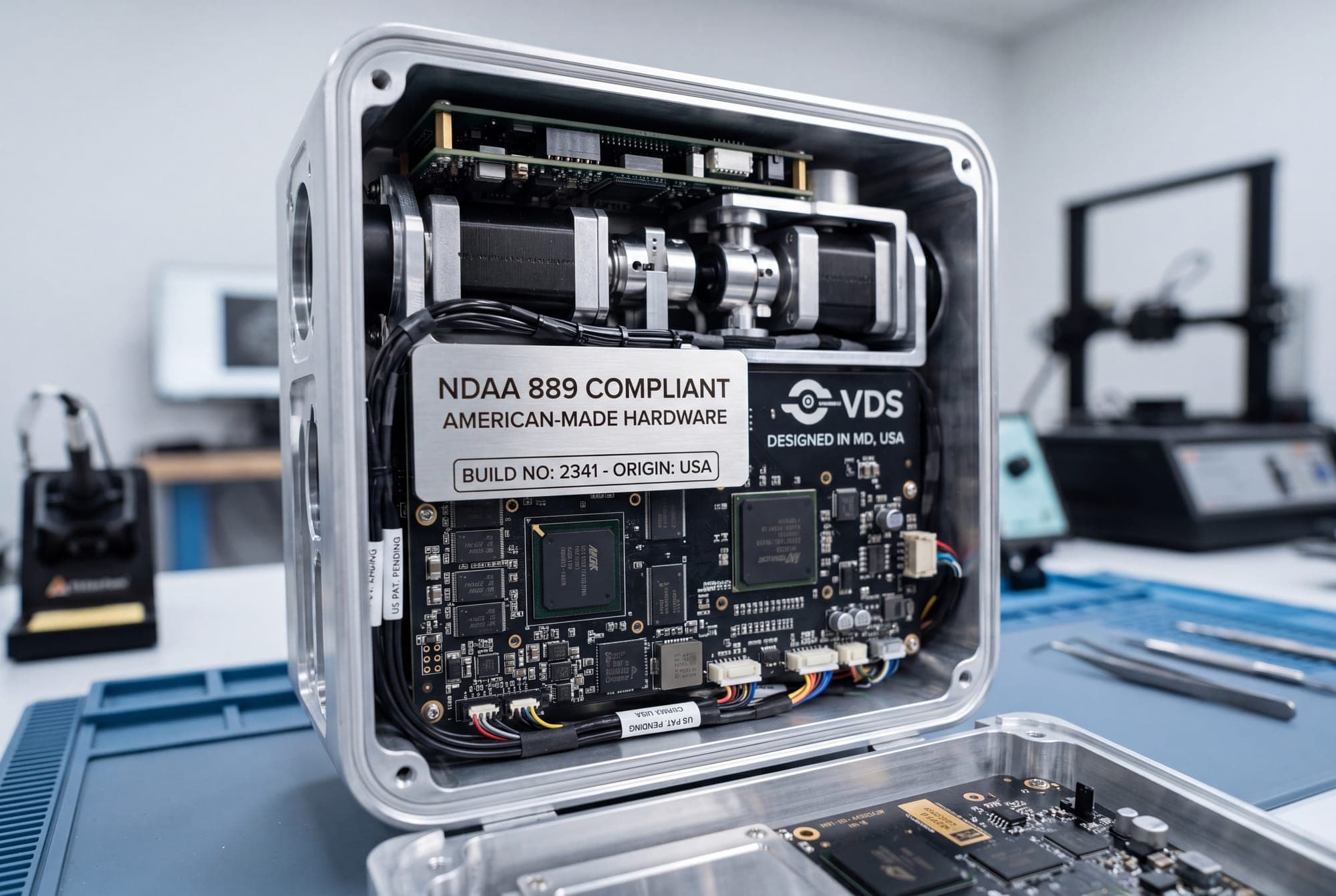
VDS hardware contains zero components from banned manufacturers — no Hikvision, no Dahua, under any brand name. Every camera, every trailer, every networking device — fully documented and procurement-ready.
What Section 889 actually prohibits.
Section 889 of the FY2019 National Defense Authorization Act has two parts, and the second one surprises people. Part A (effective August 2019) bars federal agencies from buying telecommunications and video surveillance equipment from the covered manufacturers below. Part B (effective August 2020) goes further: agencies may not contract with any company that uses covered equipment in its own operations — even on systems unrelated to the contract.
In practice the standard reaches well past federal buyers: federal contractors must comply to stay eligible, and many state, municipal, and utility procurement policies mirror the federal rule.
Zero banned components.
VDS designs and assembles its hardware in Pikesville, Maryland, and selects every component against the Section 889 standard from the first sourcing decision — not as an afterthought. Video and telemetry data stays on US-based infrastructure, encrypted in transit (TLS 1.3) and at rest (AES-256).
How to verify any vendor.
Use this checklist on every surveillance vendor you evaluate — including us. A compliant vendor will answer all five without hesitation.
- 01
Ask for a signed Section 889 letter — covering both parts
A compliant vendor will put it in writing. The letter should address Part A (the equipment itself contains no covered components) and Part B (the vendor does not use covered equipment in its own operations). A letter that only mentions one part is incomplete.
- 02
Ask for component-level attestation, not just final assembly
“Assembled in the USA” is not the same as compliant. The camera sensor, SoC, and networking silicon inside determine compliance. Ask where the cameras, radios, and storage components are actually made and by whom.
- 03
Watch for white-labeled equipment
Covered equipment is frequently resold under other brand names. If the vendor did not design and build the hardware themselves, ask who the OEM is and get that name in the attestation.
- 04
Ask where the video data lives
Procurement reviews increasingly extend to the data path. Ask where video is stored, in what jurisdiction, and how it is encrypted in transit and at rest.
- 05
Ask who runs the software and the monitoring
A vendor that builds its own hardware, writes its own software, and staffs its own monitoring floor can attest to the whole chain. A vendor assembling third-party pieces can only attest to the pieces they chose.
Procurement FAQ.
What is NDAA Section 889?
Section 889 of the FY2019 National Defense Authorization Act prohibits US federal agencies from procuring telecommunications and video surveillance equipment made by certain manufacturers deemed national security risks (Part A, effective August 2019), and from contracting with companies that use such equipment in their own operations (Part B, effective August 2020).
Which manufacturers does Section 889 ban?
The statute names Huawei, ZTE, Hytera, Hangzhou Hikvision, and Dahua, including their subsidiaries and affiliates. For video surveillance specifically, Hikvision and Dahua are the two that matter most — and their equipment is widely resold under other brand names, which is why component-level attestation matters.
Does VDS use any banned components?
No. Every VDS camera, trailer, and networking component is sourced from NDAA-compliant manufacturers. We do not use Hikvision or Dahua components under any brand name, and we maintain a full bill of materials available for procurement review.
Does Section 889 apply outside federal agencies?
The statute binds federal procurement, but its reach is wider in practice: federal contractors must comply with Part B, and many state, municipal, and utility procurement policies mirror the federal standard. Buying compliant equipment keeps every one of those doors open.
Can I get a compliance letter?
Yes. VDS provides a signed NDAA 889 compliance letter and component attestation for every product upon request.
Where is VDS hardware manufactured?
All VDS hardware is designed and assembled at our facility in Pikesville, Maryland using US-sourced and allied-nation components.
Where is my video data stored?
All video and telemetry data is stored on US-based AWS infrastructure, encrypted in transit (TLS 1.3) and at rest (AES-256). Data is never replicated outside the United States.
Need the paperwork?
Request a signed NDAA compliance letter and full component attestation for your procurement team.