
Why civil sites are different
A building project has a footprint, a fence line and a place to mount a camera. A civil project often has none of those. The site may be a corridor that stretches for a long distance, a large open grading area, or a series of short work segments that change every week. Crews finish one section and move to the next, and equipment follows them.
That creates several problems at once.
- No permanent structure to hold cameras or lighting.
- No power or network connection near the work.
- Assets spread over a large area.
- Many access points, since a corridor can be entered from almost anywhere.
- A staging area that changes as the work advances.
The general approach in our general contractor site security guide applies, but civil work needs more flexibility than most.
What needs protecting
Start by listing assets and how they would be lost. The common targets on civil sites are fairly consistent, though the details vary by region and project.
| Asset | Common risk | What helps |
|---|---|---|
| Fuel tanks and equipment | Siphoning, tank theft | Cameras and lighting on the fuel area |
| Heavy equipment | Theft, joyriding, vandalism | Parking in a monitored staging zone |
| Attachments and tools | Theft from cabs and boxes | Lockable storage within camera view |
| Copper, pipe and fittings | Theft of stockpiled material | Lay-down areas in camera view |
| Survey stakes and traffic devices | Removal or damage | Periodic checks, area coverage |
| Trailers and job offices | Break-ins | Cameras on entry points |
For fuel in particular, see diesel fuel theft prevention, which covers where theft usually happens and how to make it harder.
Consolidate where you can
One of the most useful steps on a civil project costs very little. Park equipment and store materials in one or two staging areas at the end of each shift, instead of leaving them where the work stopped. A single, well-lit and well-watched staging zone is far easier to protect than machines scattered along a corridor.
This takes discipline from the crew, so build it into the end-of-shift routine. Assign someone to check that keys are removed, fuel caps are locked, and tools are in storage. Without it, even the best cameras end up covering an empty area while the equipment sits somewhere else.
Controlling access across an open boundary
A corridor project cannot be fenced end to end in any practical way, so access control focuses on the places that matter. Fence or barricade the staging area. Use a single gate for vehicles and keep it locked outside working hours. Post signs at entry points so that anyone who walks in cannot claim they did not know the site was monitored. Keep a log of who is authorized to be on site after hours, such as a fuel supplier or a night crew, so a monitoring team can tell an expected visitor from an intruder.
Lighting helps at the staging area and the gate. Light that comes on when someone approaches makes a stranger visible to the camera and to anyone nearby, and it signals that the site is being watched.
Power and connectivity without a building
Most civil sites cannot rely on a utility connection or a nearby building. Generators add fuel to manage and noise to deal with, and trenching a cable for a project that will move is rarely worth it. Solar-powered units with cellular connectivity avoid both, as covered in our guide to construction site cameras without Wi-Fi.
When you evaluate a self-powered unit, ask about the battery reserve for cloudy stretches, how the video link behaves in weak coverage, and how the mast handles wind. The practical limits of each matter more on an open site than on a sheltered one.
Placing cameras on an open site
Open ground gives cameras long sight lines but also wide areas to cover. A few principles help.
- Cover the staging area first. It holds the most value in the smallest space.
- Watch the entry route. If vehicles use a specific haul road or gate, put a camera where it can see them arrive.
- Use height. A higher mast sees over equipment and stockpiles that would otherwise block the view.
- Zoom for detail. A PTZ camera can zoom in to read a plate or identify a person once something is detected.
- Plan for relocation. Place units where they can be moved without reworking the setup.
Our guide to surveillance trailer site selection goes through the choice of position, including ground conditions and line of sight.
Monitoring that matches the work schedule
A civil crew works days, and most thefts happen when no one is there. Recording video from those hours is useful for an investigation, but it does not stop anything. Monitoring that is active after the crew leaves can verify an alert, speak to the person through a loudspeaker and call for help while the event is in progress.
A 2019 systematic review of 76 studies found that actively monitored camera systems were associated with about a 15% reduction in crime, while passive recording-only systems showed no significant effect. Monitoring is where the benefit tends to come from.
Decide who is called, in what order, and what each person is supposed to do. Put it in the construction site security plan so the superintendent, the owner and the monitoring team work from the same sheet.
How VDS fits
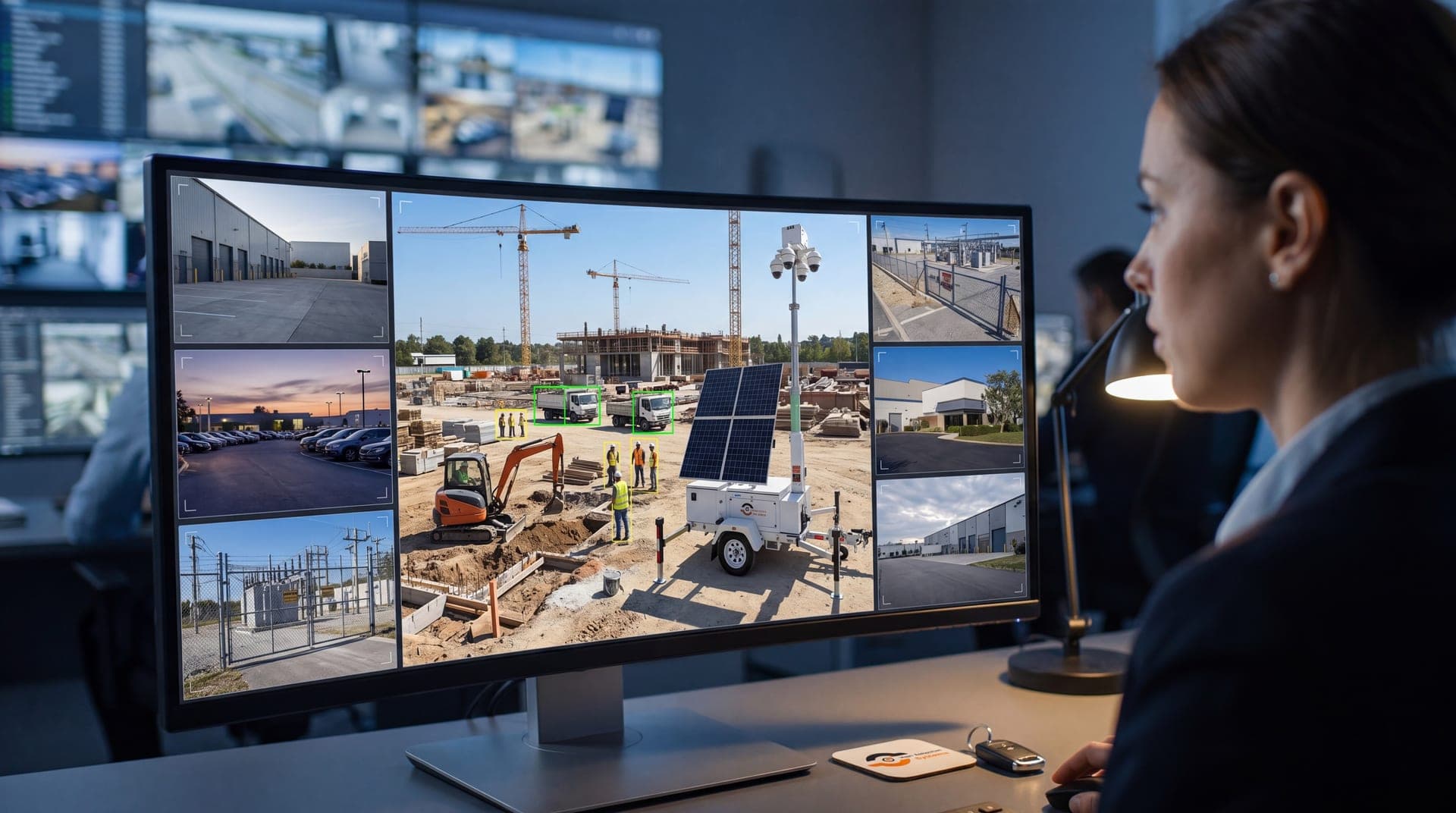
VDS builds solar-powered mobile surveillance trailers that need no site power, internet or trenching. Each unit carries a 5MP PTZ camera with 25x optical zoom and three 8MP wide-angle cameras on a 22 ft telescopic mast, with a 30 ft mast available. A 900W bifacial solar array charges an 11.8 kWh LiFePO4 battery bank with reserve for 3-5 consecutive cloudy days, and dual-SIM 4G/5G cellular carries the video.
AI detection identifies people, vehicles, loitering, objects and license plates. Our 24/7 US-based security operations center verifies events, uses live talk-down through a loudspeaker, and can dispatch police with video. Most deployments go from signed quote to live monitoring in about a week. Setup takes one person under 20 minutes, which makes relocation practical as the project advances. See the mobile surveillance unit or talk to our team.
Sources
- Piza, E. L., Welsh, B. C., Farrington, D. P., & Thomas, A. L. (2019). CCTV surveillance for crime prevention: A 40-year systematic review with meta-analysis. Criminology & Public Policy, 18(1). onlinelibrary.wiley.com