
What builders risk is meant to do
Builders risk is property coverage for a structure under construction and, depending on the form, materials and some equipment connected to the work. It is not a substitute for general liability, and it does not usually cover a contractor's own tools and machinery unless the form says so. Those boundaries are exactly where site theft disputes start, so confirm what is inside and outside the definition of covered property.
Do not assume that your project is covered in the way a colleague's last project was. Forms, endorsements, sublimits and exclusions differ. Ask for a plain summary and then read the actual policy.
Where security shows up in the policy
Security can appear in three places. The first is the application, where an underwriter may ask about fencing, lighting, cameras, monitoring and guard presence, especially on larger or higher-risk projects. The second is the conditions section, where some forms attach requirements or warranties to coverage, or treat theft with a separate deductible or limit. The third is the claim itself, where the carrier will want evidence of what was taken, when and how.
Not every policy includes all three. Your job is to find out which apply to you. Ask your broker directly whether any security conditions or theft sublimits exist and where in the document they sit.
Questions to ask your broker
Bring a short list. It makes the conversation concrete and gives you a written record.
- How does the policy define theft, and are there exclusions such as unexplained loss or inventory shortage?
- Is there a separate deductible or sublimit for theft of materials?
- Are stored materials off site or in transit covered, and under what conditions?
- Does the policy require any specific security measures, and what happens if they lapse?
- What proof of loss is expected after a theft, and what is the notice deadline?
- Does adding monitoring or other measures mid-project need to be reported?
The right answers depend on your project, so treat these as prompts and not as a promise of any particular outcome.
How the roles divide on a project
On many projects the owner buys builders risk and the general contractor is responsible for site conditions, but contracts allocate this differently. Subcontractors may carry their own equipment coverage and often bring tools that the project policy does not cover. If everyone assumes someone else secured the site, nobody did.
Settle three things in writing before mobilization. Who provides and pays for site security, who holds the camera footage and logs, and who contacts the carrier after a loss. Our post on general contractor site security goes into how responsibility tends to be divided in practice.
What good documentation looks like
A claim is easier to support when records exist from before the loss. Useful records include delivery receipts, material takeoffs, dated photos of stored materials, a site plan showing storage and camera locations, and incident logs. After a loss, add a police report number, a list of what is missing and footage from the relevant period.
| Document | Why it helps | Keep it |
|---|---|---|
| Delivery receipts and takeoffs | Establishes what arrived and what should be on site | With project records |
| Dated storage photos | Shows condition and quantity before a loss | In shared project folder |
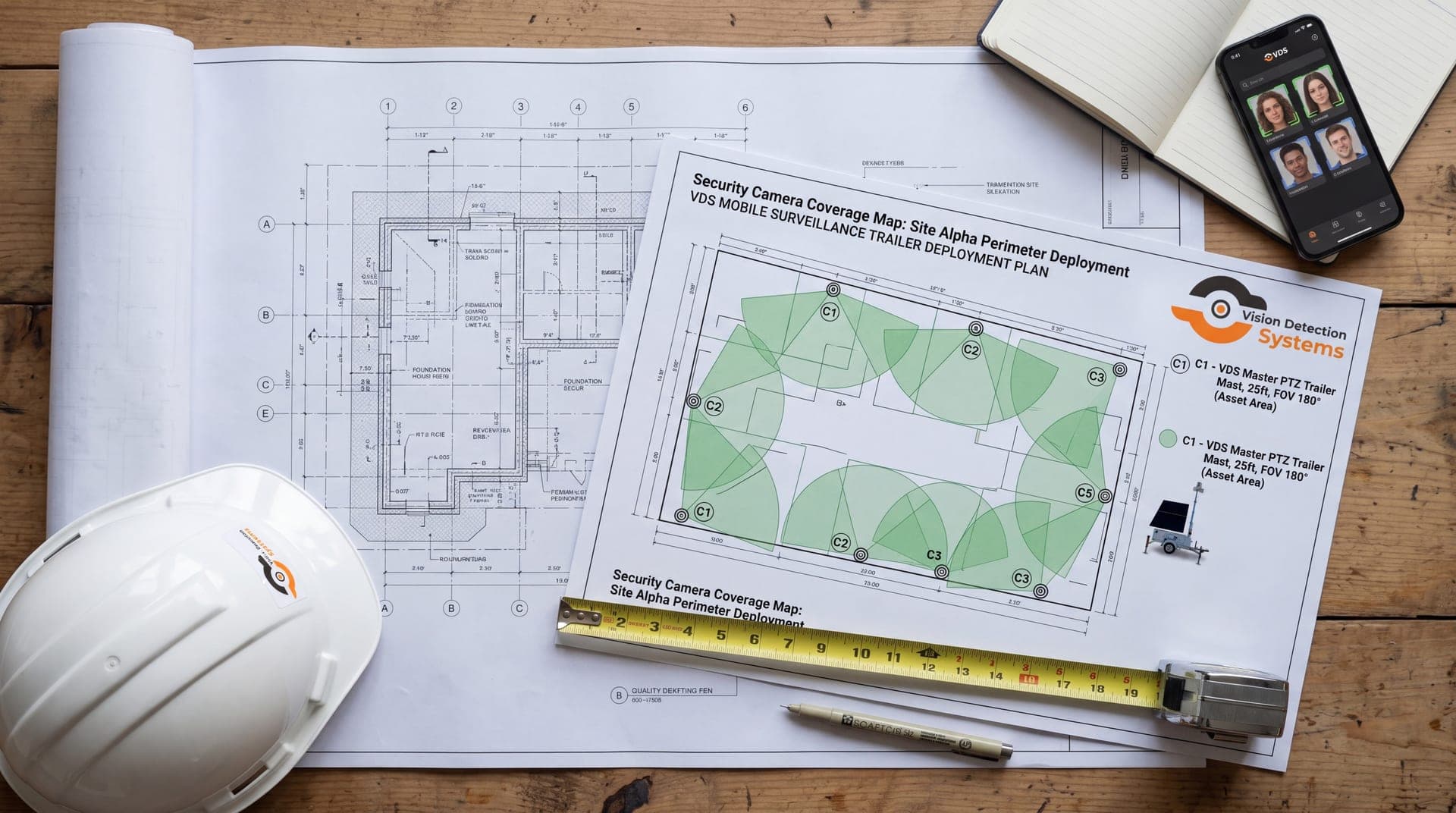
| Site plan with camera views | Shows what is covered and what is not | With the security plan |
| Incident log | Records events, times and who responded | Updated daily |
| Exported footage with notes | Supports the timeline of a loss | Original plus working copy |
For the footage steps, see post-incident video review steps.
Building security into the plan
A written plan helps both operations and underwriting. It states where fencing, lighting and cameras go, how deliveries are staged, who has access and what happens when an alert fires. Our construction site security plan and security checklist can be adapted to a project. For the insurance angle in particular, read construction site security cameras and insurance.
Keep the plan current as the project moves through phases. Early on, risk centers on excavated materials and equipment. Later, finished fixtures, copper, appliances and cabinets become the targets, and the building itself may offer more places to hide a theft.
Phases change the risk profile
Builders risk exposure is not constant. During site work and foundations, the targets are fuel, equipment, rebar and fill. During framing, lumber and fasteners are exposed, and weather damage becomes a bigger share of losses. At rough-in, copper, wire and fixtures arrive and the structure begins to hold valuable material behind doors that may not lock yet. At finish, appliances, cabinets, flooring and HVAC equipment are the attractive items, and many people have keys or access.
Review your security plan at each of these transitions, and ask your broker whether the policy changes in any way as the building closes in or reaches completion. Some forms have conditions tied to occupancy or to the stage of work, and you should know where those lines fall before you cross them.
Handling a loss when it happens
When theft is discovered, the order of operations matters. Make the area safe and stop further loss, then report to police and obtain a report number. Preserve any footage immediately, since automatic overwrite can erase it. List what is missing with quantities and, where possible, receipts. Notify your broker within the time the policy sets, and keep a record of every call and message.
Do not repair or replace anything in a way that destroys evidence before the carrier has had a chance to respond, unless safety requires it. Keep copies of everything you send, and expect follow-up questions about security measures that were in place at the time.
Where VDS fits
VDS supplies solar-powered mobile surveillance units that need no site power, internet or trenching, so coverage can start with the site rather than waiting for utilities. Each unit has a 5MP PTZ with 25x optical zoom and three 8MP wide-angle cameras on a 22 ft telescopic mast. AI detection flags people, vehicles and loitering, and a US-based 24/7 security operations center verifies events and responds with live talk-down through a loudspeaker before police dispatch with video. Most deployments go from signed quote to live monitoring in about a week. Learn more about remote monitoring, or talk to our team about your project. Whether any of this affects your policy is a question for your broker.