
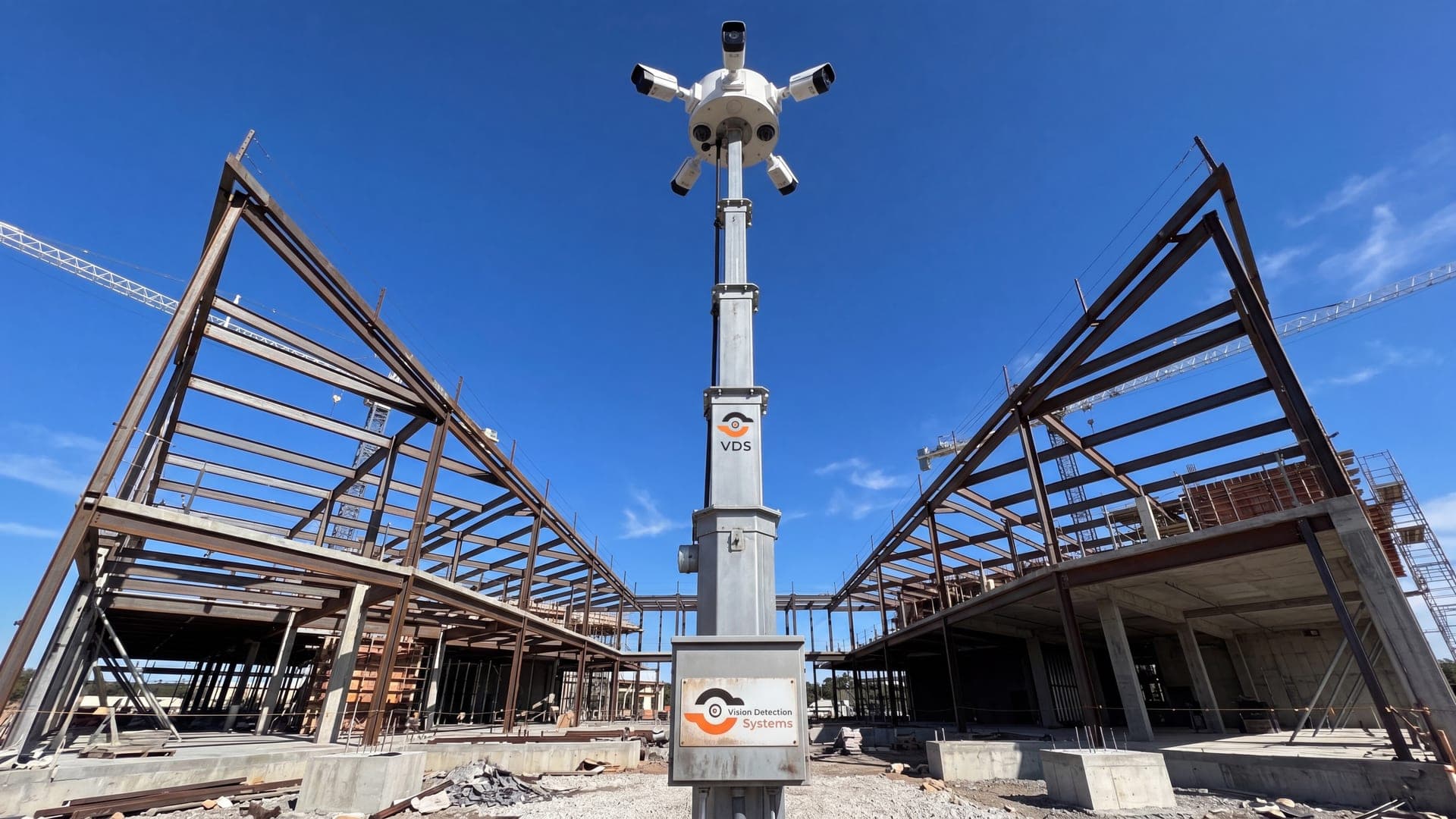
These eight placement principles are drawn from real construction site deployments across multiple industries and project types.
Tip 1: Start With Access Points, Not the Interior
Every vehicle or person entering your site must pass through an access point. These locations are mandatory for camera coverage—if you have only one camera, it should cover the primary vehicle entrance.
What access point cameras need to capture:
- Vehicles approaching the gate (license plate, vehicle type and color)
- The driver and any passengers (facial detail if possible)
- The time and date of entry and exit
- Whether gate/barrier position is authorized or forced
Position access point cameras to capture vehicles from the front on approach and from the rear on exit. Two cameras per lane—one facing each direction—provides complete documentation. If budget allows only one camera per access point, position it on the approach side to capture plates and driver on entry, when theft risk is highest.
Tip: Mark every access point on a site map before placing any cameras. Construction sites often have multiple informal entry points created over time—fence gaps, removed sections, unlocked secondary gates—that bypass the primary monitored entrance.
Tip 2: Cover Material and Equipment Storage First
After access points, material storage and equipment staging areas are the highest-value camera locations. Construction theft is almost always targeted—thieves come for specific materials (copper wire, lumber, HVAC equipment) or specific machines (generators, compressors, skid steers). Knowing that, coverage of storage zones is more important than general perimeter surveillance.
Camera positioning for storage areas:
- Position to capture the approach to stored materials, not just the materials themselves
- Overlap fields of view so there's no unmonitored approach angle
- Maintain at least 2–3 cameras covering each major storage zone if the zone is large
- Ensure night-vision capability is effective for the full depth of the storage zone
A camera that shows materials being removed after the fact is useful for insurance claims. A camera that shows someone approaching storage—before they take anything—enables real-time intervention.
Tip 3: Use Overlapping Fields of View
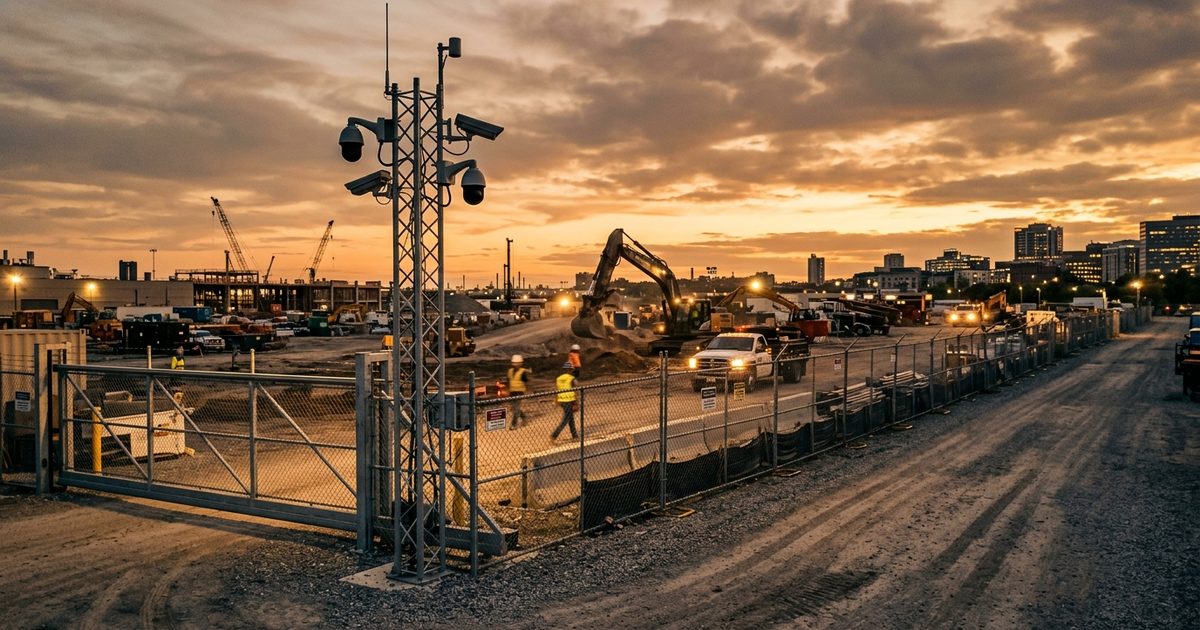
Single-camera coverage of any area creates blind spots. Experienced thieves identify these and operate in them. Overlapping coverage—where two or more cameras share coverage of the same zone from different angles—eliminates the blind spot problem and provides multiple footage angles for incident investigation.
| Coverage Approach | Blind Spots | Evidence Quality |
|---|---|---|
| Single camera, wide angle | Significant at edges and directly below camera | Single angle only |
| Two cameras, overlapping | Minimal—only directly below each camera | Two angles for most of zone |
| Three cameras, overlapping from corners | Near-zero for the covered zone | Multiple angles for entire zone |
For mobile surveillance trailer deployments, position trailers at corners rather than along the middle of a fence line. Corner placement gives cameras the longest sightlines along two perimeter segments simultaneously, maximizing the coverage per camera.
Tip 4: Account for Height and Angle
Camera height determines the balance between coverage area and detail quality. The practical range for construction site surveillance is 8–20 feet:
- 8–12 feet: Best for facial recognition and license plate detail. Vulnerable to obstruction by construction equipment, vehicles, and materials. More susceptible to vandalism.
- 12–18 feet: Good balance of coverage area and usable detail. Less vulnerable to obstruction and vandalism.
- 18–25 feet: Maximum area coverage, but facial detail degrades and license plates are hard to read from steep angles. Best used for general scene overview, not identification.
Construction sites complicate height decisions because the landscape changes constantly. A 12-foot camera mounted in month 1 may be blocked by a wall at month 3. Build phase-based repositioning into your coverage plan from the start.
Note: Mobile surveillance trailers with telescoping mast systems can adjust height from 20–30 feet, which is ideal for construction sites where the right height changes with phases. Fixed mounting heights commit you to a specific coverage geometry for the duration.
Tip 5: Light the Dark Zones or Use Low-Light Cameras
Most construction theft happens at night or in the early hours before dawn. Camera coverage is only effective if the cameras can capture usable footage in low-light conditions.
Options for low-light coverage:
Infrared (IR) cameras use IR LEDs to illuminate a scene invisibly. Most commercial security cameras include IR, but range varies dramatically—from 30 feet for low-end units to 150+ feet for professional cameras. Verify the IR range matches your required coverage distance.
Color night vision cameras use larger sensors and wider apertures to produce color footage in very low light without IR. Color footage is more useful for identification than IR, which produces black-and-white images. Requires some ambient light (streetlights, site lighting).
Supplemental site lighting improves camera performance and provides its own deterrent effect. Lighting key zones (material storage, access points) with motion-activated LED fixtures reduces reliance on camera IR range and produces better footage quality.
Tip: Test your camera coverage at night, after initial deployment, before assuming the system is ready. Low-light performance under real conditions often differs from specifications. Walk the site at 2 AM and verify the monitors show usable footage from every camera.
Tip 6: Position Cameras to Cover Each Other
Camera tampering is a real threat on construction sites. A camera that can be disabled without being detected creates a coverage gap that sophisticated thieves exploit intentionally.
Design your camera layout so each camera is visible in the field of view of at least one other camera. When a camera goes offline or is physically tampered with, the monitoring center can see the tampering event on the adjacent camera and respond immediately.
This principle also applies to the surveillance trailer itself. Position the trailer where it's visible from at least one camera, and where tampering or theft of the trailer would be captured.
Tip 7: Plan for Construction Phase Changes
A camera system perfectly designed for site grading and foundation work may become largely ineffective once structural framing begins. Walls block sight lines, equipment staging areas move, new risk zones emerge as materials are delivered.
Effective construction site camera coverage is managed dynamically through the project lifecycle:
- Site plan review: Before deployment, review the construction phasing plan and identify how coverage requirements change at each major milestone
- Phase transition reviews: Schedule camera repositioning reviews at foundation completion, framing completion, rough-in completion, and pre-opening
- Flexible mounting: Use mobile surveillance trailers rather than fixed mounting wherever possible—they can be repositioned without new infrastructure
For a 12-month construction project, expect camera positions to be meaningfully adjusted three to five times as the site evolves. A provider who deploys equipment and doesn't revisit positioning isn't providing effective coverage for the full project.
Placement assumes the right hardware. Compare the types of construction cameras before you buy, and see the options for jobsite cameras with no Wi-Fi if the site has no power or internet yet.
Tip 8: Document Your Coverage Map
Create and maintain a written coverage map showing each camera's field of view, the zones it covers, and the blind spots. This document serves three purposes:
- Operational reference: Monitoring center operators know exactly what each camera covers and what to expect in each frame
- Coverage gap identification: A written map makes blind spots visible before incidents occur, rather than discovering them in footage review after the fact
- Evidence management: After an incident, the coverage map tells investigators which cameras could have captured specific locations and time periods, focusing footage review on the cameras most likely to have relevant footage
Your mobile surveillance deployment from VDS includes an engineered coverage plan that maps every camera's field of view before equipment arrives on site. Contact the team to discuss placement planning for your specific site.