
Why damaged sites are vulnerable
A storm changes a site in ways that undo its security. Fences blow down. Doors and windows are broken or boarded up. Lighting and alarms lose power. Residents and employees leave, so the usual passive surveillance of people coming and going disappears.
Responders are stretched thin. Police and emergency services are busy with life-safety calls, and patrols may be reduced or redirected. Private security may also be limited. That creates a window when a damaged property is exposed and few people are watching.
The people who take advantage are not only organized thieves. Opportunistic trespassers, scavengers and curious visitors also enter damaged buildings, which creates theft, vandalism and injury risks. Open structures with weakened floors or exposed utilities are dangerous for anyone who walks in, including the owner who is liable.
What needs protecting
The list depends on the property, but typical priorities include:
- Building contents, inventory and equipment left in damaged structures.
- Recovery equipment, generators, pumps, dumpsters and supplies brought on site.
- Scrap and metals exposed by damage, including copper wiring and HVAC components.
- Vehicles, fuel and tools used by repair crews.
- The site itself, to keep unauthorized people out of unsafe areas.
Sites also change quickly. Debris removal, demolition, tarping and rebuilding all alter the layout, so coverage needs to adapt. Our broader guide to disaster recovery site security covers phases of recovery in more detail.
Power and network are the first problem
Normal camera systems depend on building power and a wired or wireless network. After a storm, both are often down. A generator can power cameras, but it needs fuel and attention, and a network still has to carry the video.
A solar-powered cellular unit avoids both issues. It generates its own power and sends video over the mobile network. That does not guarantee service, because cellular networks can also be damaged or congested after a major event, so check coverage on the site and ask a provider what happens when the signal drops. Our guide to cameras without WiFi or power lists what to check, and the piece on temporary security cameras explains how short-term deployments differ from permanent ones.
What a fast deployment looks like
Speed matters, but so does getting the placement right. A sensible approach:
- Walk the site, with safety first. Identify entry points, the most valuable contents and any hazards.
- Choose placement so that cameras see the access points and the assets, with some distance from debris or unstable structures.
- Check cellular coverage and sun exposure at the chosen spot.
- Set detection zones and hours, then confirm who should be called when something is verified.
- Test the view and the audio before leaving.
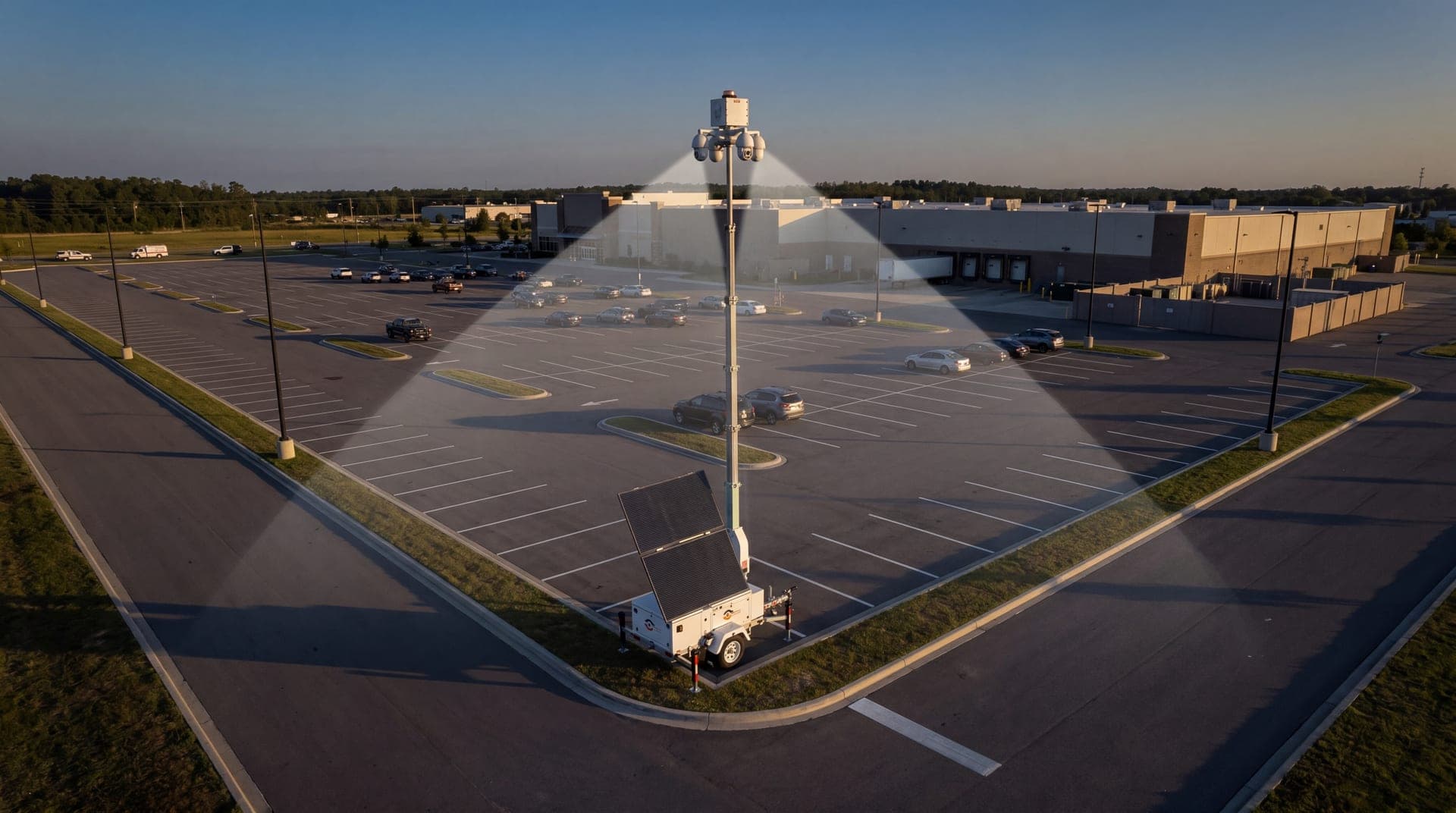
A trailer-mounted unit can often be towed in and set up by one person, which makes it easier to deploy where trucks and crews are busy. Keep the unit away from debris that could be moved by equipment and make sure site workers know what it is.
Monitoring and response during recovery
Recovery sites have an unusual rhythm. Crews work during the day, then the site goes quiet. Detection should be tuned to that schedule, alerting on people and vehicles in restricted areas outside work hours.
A monitored response typically goes like this. AI flags a person. A trained operator verifies the video. If it is a trespasser, the operator speaks through a loudspeaker and asks them to leave. If they do not, the operator escalates to your security partner, site manager or police with video. Our article on live talk-down audio explains why a spoken warning often works.
Cameras do the watching so people, yours or your security partner's, can handle verified incidents. That is useful after a disaster, when staff time is scarce and priorities are urgent.
Rules about recording, audio and police response vary by state and local conditions during emergencies, so confirm requirements with counsel.
Document everything
Insurance claims and police reports depend on records. Footage helps establish what happened and when. Our guide to security camera footage as evidence explains how to export, preserve and share clips properly.
Beyond camera records, keep a log of damage, repairs and stored contents. Photograph conditions before cleanup where it is safe. Save timestamps, names of workers on site and any incident reports. Ask your insurer which documentation they need and whether any security measures are required for coverage.
Coordinating with crews and contractors
Recovery sites are crowded with people who are supposed to be there. Give the monitoring team a list of authorized crews, work hours and vehicles, and update it as contractors change. Tell workers where cameras are and why, so equipment is not moved or blocked during cleanup. When a verified alert comes in, everyone should know who calls whom, and who is allowed to approach the site.
Vacant and abandoned properties after the event
Some damaged buildings stay empty for months. Owners wait on insurance, permits or contractors, and the property becomes a target as time passes. For those cases, the principles in our vacant property security guide apply. Plan for longer-term coverage, regular checks and a clear process for who responds.
Quick reference
| Situation | Risk | Approach |
|---|---|---|
| Damaged building, no power | Entry, theft, injury | Solar cellular unit at entry points |
| Debris cleared lot | Equipment and material theft | Relocatable unit covering equipment area |
| Closed business, stock inside | Looting, trespass | Monitored view of doors and loading area |
| Staging yard for repairs | Tool and fuel theft | Gate view and after-hours detection |
| Long-term vacant site | Squatting, scrap theft | Ongoing monitoring and periodic review |
How VDS fits
VDS builds solar-powered mobile surveillance trailers that need no site power, internet or trenching. Each unit has a 5MP PTZ camera with 25x optical zoom and three 8MP wide-angle cameras on a 22 ft telescopic mast (30 ft available). A 900W bifacial solar array charges an 11.8 kWh LiFePO4 battery bank with reserve for 3 to 5 consecutive cloudy days, and dual-SIM 4G/5G cellular carries video.
AI detects people, vehicles, loitering, objects and license plates. A 24/7 US-based security operations center verifies events, responds with live talk-down through a loudspeaker, then dispatches police with video. Most deployments go from signed quote to live monitoring in about a week, and on-site setup takes one person under 20 minutes. See our disaster recovery solutions, the mobile surveillance unit, or talk to our team.