
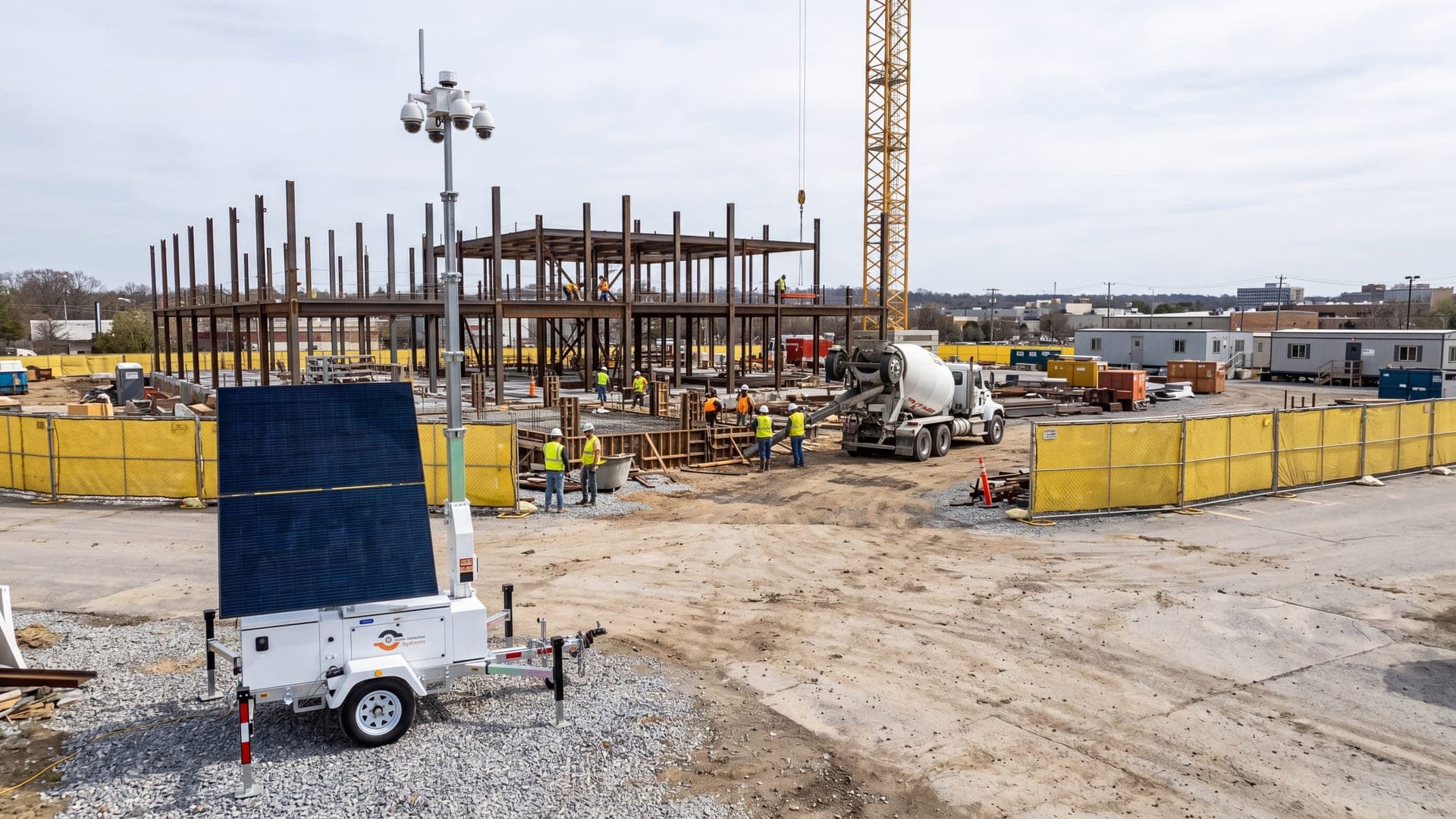
When temporary cameras make sense
Permanent systems assume a building, a network and years of use. Many security needs have none of those. A building under construction has no finished power or network. An event lasts a weekend. A vacant property may sit empty for months before it sells. A disaster recovery site changes weekly. In each case the risk is real, but the timeline is short or uncertain, so a fixed installation either takes too long or costs more than the situation justifies.
Temporary does not mean low-grade. The same questions apply as with any system: what are you protecting, from whom, at what hours, and what happens when something is detected. The difference is that the equipment has to arrive fast, run without site infrastructure and leave without trace.
The main options
| Option | Best for | Power | Connectivity | Watch for |
|---|---|---|---|---|
| Mobile trailer | Large open sites, yards, lots, construction | Solar and battery, or generator | Cellular | Needs a place to park and tow access |
| Mobile tower | Fixed spots needing height, such as a lot or a laydown area | Solar, battery or generator | Cellular | Smaller footprint than a trailer, less equipment on board |
| Pole or wall-mount kit | Small areas with a structure to attach to | Site power or a battery pack | Site network or cellular | Needs something to mount on and a power source |
| Portable battery camera | Very short tasks, single views | Battery | Cellular or local storage | Limited run time and coverage |
| Existing cameras reconnected | Sites with cameras but no working network | Site power | Cellular gateway | Quality depends on what is already installed |
Our comparison of a mobile security tower and a trailer goes deeper on the first two, and the mobile security cameras guide gives a wider overview.
Power for a site with no outlets
Power decides whether a temporary camera is truly independent.
- Solar with batteries. Panels charge a battery bank, and the bank runs the cameras overnight and through cloudy stretches. This avoids fuel and refueling visits. Look at battery reserve, not just panel size, since the reserve determines how long the system lasts without sun.
- Generator. Dependable for high loads, but it needs fuel, refueling visits and noise tolerance. A generator that runs out of fuel at 3 a.m. takes the cameras with it.
- Temporary utility connection. Convenient when available, but it ties the cameras to a power source that can be switched off, shared or unplugged.
- Battery packs. Good for a day or two on a single camera. They do not suit weeks of unattended operation.
See our article on security cameras without WiFi or power for how off-grid systems are built.
Connectivity without a network
Cellular is the usual answer for temporary sites. A cellular modem sends video to the cloud and to a monitoring center without needing a site network. Two SIMs from different carriers give a backup if one signal drops. Check signal at the actual placement, because coverage that is fine at the road can be poor at the back of a lot.
Think about how much video you intend to send. Continuous high-resolution streaming from many cameras can strain a cellular link. Systems that record locally and send events and clips on demand use the connection more efficiently.
Monitoring turns cameras into protection
A camera that only records helps you find out what happened. It does not stop it. A 2019 systematic review of 76 studies found that actively monitored camera systems were associated with a crime reduction of about 15 percent, while passive recording-only systems showed no significant effect. Temporary sites are often unattended, which makes monitoring more important, not less.
Options include your own staff, a security partner or a remote monitoring provider. With AI detection, the cameras flag people and vehicles in areas that should be empty and an operator verifies the event. If something is wrong, the operator can speak through a loudspeaker and call the right contact or police. Cameras do the watching so people, yours or your security partner's, handle verified incidents. Our remote monitoring page explains the model.
Rent or buy
| Factor | Rent | Buy |
|---|---|---|
| Duration | Short, uncertain or seasonal | Long-term or continuous |
| Upfront commitment | Low | Higher |
| Moving between sites | Provider handles logistics | You handle it |
| Maintenance | Usually the provider | You |
| Changing needs | Add or return units | Stuck with what you own |
| Total cost | Compare over your real timeline | Compare over equipment life |
Do not decide on the monthly figure alone. Count setup, relocation, monitoring and maintenance on both sides. Our guides to mobile surveillance trailer rental and to using trailers at events cover the practical details.
Questions to settle before choosing
- How long will you need coverage, and how sure are you of the end date?
- Where will the unit stand, and is the ground suitable?
- Does the site have sun, or is it shaded by buildings and trees?
- Is there cellular signal at that spot?
- Who watches the cameras overnight and on weekends?
- Who is responsible for moving, repositioning and removing the equipment?
- Do you need to meet any equipment standards, such as for public-sector work?
Where VDS fits
VDS mobile surveillance units are solar-powered trailers designed for sites without infrastructure. Each has a 5MP PTZ camera with 25x optical zoom and three 8MP wide-angle cameras on a 22 ft telescopic mast, with a 30 ft mast available. A 900W bifacial solar array charges an 11.8 kWh LiFePO4 battery bank with reserve for 3 to 5 consecutive cloudy days. Dual-SIM 4G/5G cellular keeps it connected, so no site power, internet or trenching is needed.
Hardware is NDAA Section 889 compliant, and our 24/7 US-based security operations center verifies events, speaks to people on site through a loudspeaker and dispatches police with video. Rental, month-to-month and term subscriptions are available. Most deployments go from signed quote to live monitoring in about a week, and setup takes one person under 20 minutes. See the rental options and the mobile surveillance unit, then talk to our team.
Sources
- Piza, E. L., Welsh, B. C., Farrington, D. P., & Thomas, A. L. (2019). CCTV surveillance for crime prevention: A 40-year systematic review with meta-analysis. Criminology & Public Policy, 18(1). onlinelibrary.wiley.com