
What talk-down audio is
Most security cameras are passive. They record, and you review the footage after a loss. Talk-down adds a speaker, and with it the ability to act during an incident. The person on site hears a voice and learns two things at once: they have been seen, and someone is dealing with it.
That second point is what separates audio deterrence from a sign or a camera dome. A sign says cameras might be watching. A voice says they are.
Live voice versus recorded messages
There are two ways to use a speaker. Many sites use both, with the recorded message as an automatic first layer and a live operator as the second.
| Live voice | Recorded message | |
|---|---|---|
| Who speaks | A person watching the video | A stored clip, triggered by a rule or an alert |
| Specificity | Can describe clothing, vehicle, location | Generic wording only |
| Response to the person | Can answer, repeat, escalate | None |
| Staffing | Needs a monitoring team | No one needed |
| Risk | Depends on operator training | Easy to learn and ignore over time |
| Best for | Active threats, after hours, high-value areas | Low-risk zones, a first warning, daytime reminders |
Recorded messages have a weakness that is easy to overlook. People who hear the same message repeatedly tend to stop reacting to it, and anyone who tests a site once learns that nothing follows the recording. A live voice does not have that problem.
Why a live operator works
A live voice works because it is specific. "You in the gray hooded sweatshirt by the blue truck, you are on camera and police are being notified" is hard to dismiss. The person knows they are individually seen, and that the message is not a loop.
An operator can also read the situation. A delivery driver who took a wrong turn and a person cutting a fence need different responses. A live voice can be polite to the first and firm with the second, and can decide to call police for the second without waiting.
This fits what research on camera systems found about monitoring generally. The 2019 review of 76 studies associated actively monitored systems with about a 15% reduction in crime, while passive recording-only systems showed no significant effect. Talk-down is one of the ways a monitored system acts on what it sees. For more on that evidence, see do security cameras deter crime.
Where talk-down fits
Audio deterrence suits places where trespass is the main concern and where people can be addressed before they do damage:
- Construction sites and material yards after hours, where a short warning often ends a visit.
- Parking lots and overflow lots, especially at night.
- Vacant buildings and lots, where no one else is around to notice.
- Utility, solar and telecom compounds with fences that can be approached from many sides.
- Event perimeters and temporary sites with no fixed infrastructure.
It fits less well where ambient noise is high, where the camera is far from the person, or where the property line sits close to homes and a loudspeaker would be a constant nuisance. Placement matters. A speaker facing the area you want to protect and away from neighbors is a better choice than one aimed at the street.
What it cannot do
Talk-down is not a guarantee. Some people ignore it, and some are intoxicated or determined. An operator cannot physically stop anyone. The value of the system is in what follows. If the person stays, the operator should be able to call police with a verified description and live video.
It also depends on detection. If analytics do not flag a person at the fence line, nobody speaks. And it depends on the camera view: an operator cannot address someone they cannot see. Our piece on event-based and live video monitoring covers how alerts reach operators in the first place.
Audio, recording and the law
Playing a message through a speaker and recording sound are different activities, and the law treats them differently. Many states have rules about recording audio conversations that are stricter than their rules for video, and some require notice or consent from the people recorded. Rules vary by state, and they can also differ for workplaces, public areas and residential neighbors.
Before you add microphones or any audio recording, confirm your plan with counsel. If you only use a speaker to talk out and do not record sound, you may avoid many of those questions, but confirm that too. Local noise ordinances can also limit loudness and hours. Our overview of business security camera laws is a starting point, not legal advice.
Practical steps that help in any state:
- Post clear signage that the property is monitored.
- Keep a written policy on when audio is used and who may use it.
- Train operators to stay factual and calm, and to avoid threats.
- Log each use, including time, what was said and the outcome.
Questions to ask a provider
- Is the voice live, recorded or both, and who speaks?
- Where is the monitoring team, and what hours do they cover?
- What triggers an operator to speak, and what do they say?
- What happens if the person does not leave?
- How is each talk-down logged?
- Is audio recorded, and if so, how is that handled under state law?
How VDS delivers talk-down
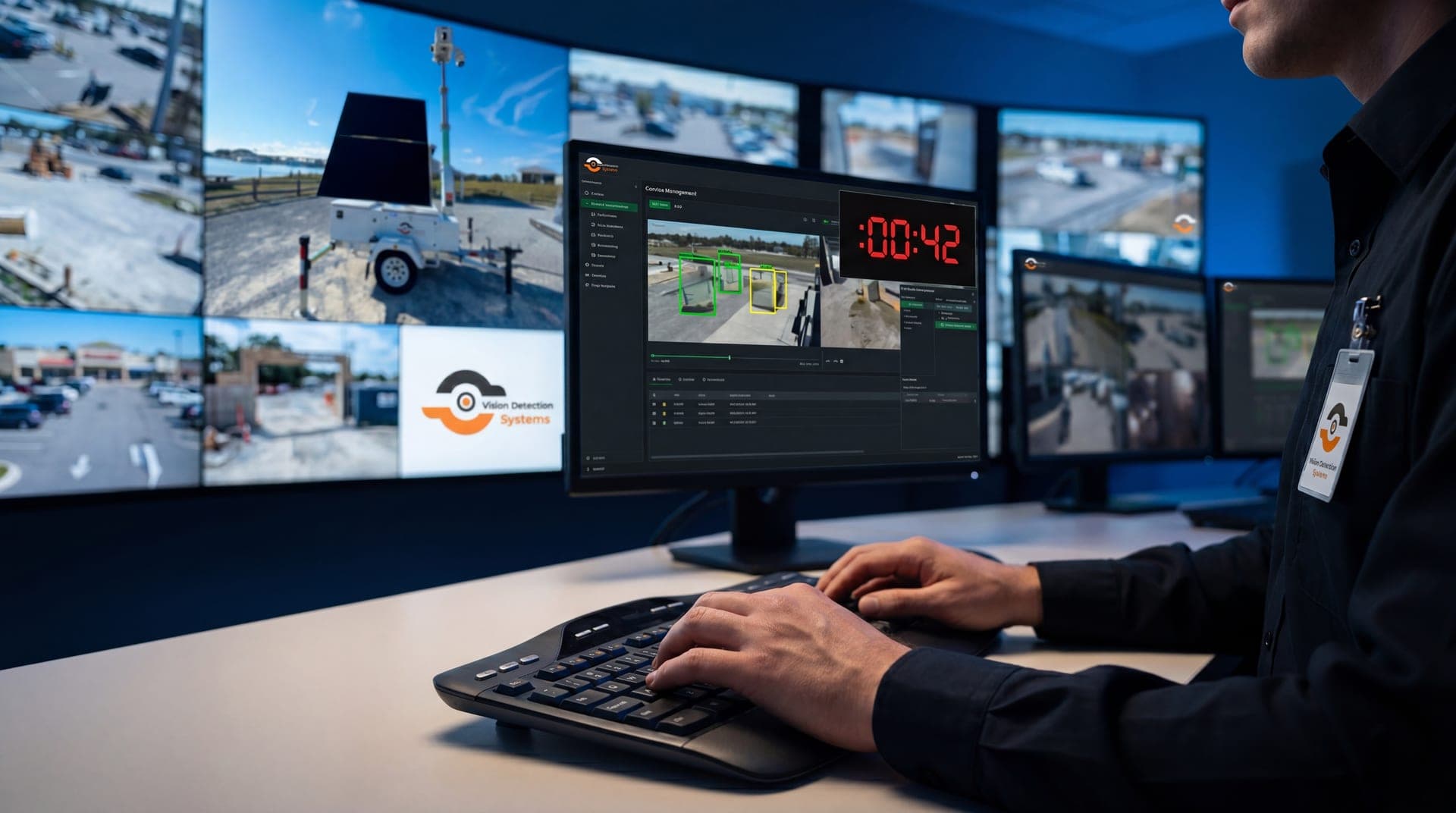
VDS monitors from a 24/7 US-based security operations center. When AI detection flags a person or vehicle, operators verify the event, respond with live talk-down through a loudspeaker, and, if needed, dispatch police with video. Cameras do the watching so people, yours or your security partner's, handle verified incidents.
The speaker and cameras can sit on a mobile surveillance unit that runs on solar power and cellular, so it works at sites with no power or internet. See remote video monitoring or talk to our team about your site.
Sources
- Piza, E. L., Welsh, B. C., Farrington, D. P., & Thomas, A. L. (2019). CCTV surveillance for crime prevention: A 40-year systematic review with meta-analysis. Criminology & Public Policy, 18(1). onlinelibrary.wiley.com