
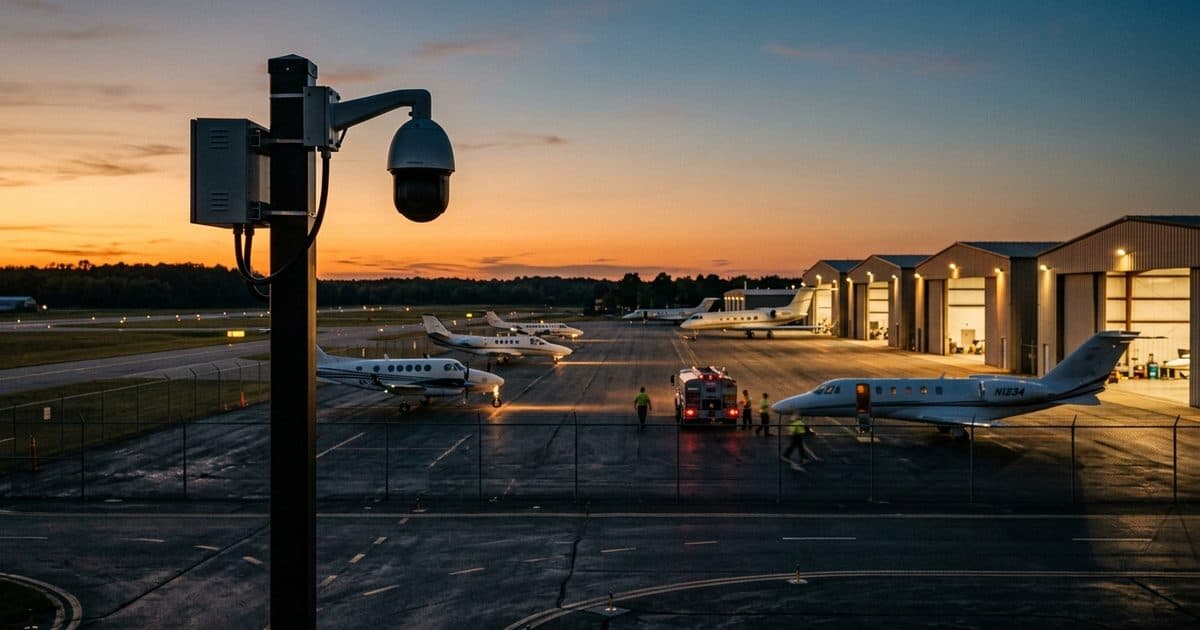
Know who sets the rules
An airport is not an ordinary commercial property. Areas near the airfield are governed by airport security programs, tenant agreements and federal requirements that vary by facility. Who may install cameras, where they may be mounted and what must be reported can all depend on the airport operator and on state and local rules.
Before you plan anything, find out:
- Who owns the yard and who is responsible for its security.
- Whether the airport requires approval for equipment, mounting or power.
- What reporting or notification duties apply when someone enters a restricted area.
- Whether any existing airport cameras or access control already cover the area.
Confirm these with the airport operator and your counsel. The rest of this guide applies once those answers are clear.
What is in the yard
Ground support equipment, often called GSE, includes the vehicles and gear that serve aircraft on the ramp: tugs, tractors, loaders, baggage carts, stairs, service trucks and fuel or deicing vehicles. Cargo areas hold freight, pallets, containers and trailers waiting to move.
Both are valuable and easy to move. Vehicles and equipment can be stolen or damaged. Tools, batteries, parts and fuel are common targets. Freight is its own concern, and our articles on truck yard cargo theft security and airport perimeter security cameras describe the patterns on similar sites.
Perimeter fencing, generically
A good fence is the foundation, but it needs maintenance and honest evaluation.
- Height and condition. Check for gaps at the bottom, damaged sections and places where ground has washed out.
- Climb and cut points. Corners, gates and sections near roads or tree lines are common weak spots.
- Clear zones. Keep vegetation and stored material away from the fence so neither blocks views nor provides a step.
- Gates. Use controlled entry, and keep unused gates locked and checked.
- Lighting. Even, glare-free lighting helps people and cameras. Avoid shadows along the fence.
A fence tells honest visitors where to stop. It does not tell you that someone is inside. That is the job of detection. Our guide to perimeter intrusion detection systems explains the options in general terms, and critical infrastructure physical security describes how layers fit together.
Access control and gate records
Many yards have a gate that is open during work hours and unmanned at night. Whoever has a badge, a code or a friend can enter. Keep a record.
Cameras at the gate can capture vehicles and plates when angle, lighting and shutter speed are right. For fast vehicles, a shutter speed of 1/1000s or faster and a camera angle within roughly 15 to 30 degrees of the lane help produce a readable plate. The point is to know what entered and left, and when. Privacy, retention and sharing rules vary by state, so confirm your approach with counsel.
Quick reference
| Layer | What to check | Generic control |
|---|---|---|
| Perimeter | Gaps, climb points, clear zone | Fence maintenance and lighting |
| Detection | Fence-line and yard entry | Analytics, thermal or radar, per airport approval |
| Access | Who and what enters | Controlled gate with vehicle and plate capture |
| Yard | Equipment, tools, fuel | Wide coverage plus zoom camera |
| Response | Verified intrusion | Talk-down, notification and police with video |
Video that gets watched
A camera nobody watches helps you after the fact. A systematic review of closed-circuit television studies found that actively monitored systems were associated with a larger crime reduction than passive recording-only systems, which showed no significant effect. For a yard that is quiet most nights, live monitoring is the reason the cameras earn their place.
A monitoring team can verify an event on video, speak through a loudspeaker and, if needed, contact police with video. At an airport, your notification list will likely include airport operations or security, so agree on the sequence in advance. Your own staff or your security partner then handle verified incidents. The article on the security camera incident reporting workflow offers a template for documenting what happened, and after-hours security for businesses covers the overnight hours in general.
Coordinate with the people who already watch the airfield
Airports have their own security staff, procedures and sometimes their own cameras. A private yard system works best when it complements those, not duplicates or conflicts with them. Share your response plan with airport operations in advance, agree on who calls whom, and test the contact list. Confirm any requirements with the airport operator and your counsel.
Temporary and tenant yards
Not every yard is permanent. Construction projects, seasonal cargo surges and equipment staging create temporary areas that may not have fencing, power or network. A self-powered trailer with cellular connectivity can cover such an area, provided the airport allows it. Raise this early, because approvals for placement can take longer than the installation. Our aviation industry page describes how monitored video is used around airfields.
Review the plan on a schedule
Yards change. Equipment is added, gates move and tenants come and go. Review fence condition, lighting, camera views and contact lists at least once a year and after any incident or change in layout. Walk the yard at night with the people who respond to alerts, and check that the plan still matches what is on the ground.
How VDS fits
VDS builds solar-powered mobile surveillance trailers. Each unit carries a 5MP PTZ camera with 25x optical zoom and three 8MP wide-angle cameras on a 22 ft telescopic mast (30 ft available). A 900W bifacial solar array charges an 11.8 kWh LiFePO4 battery bank with reserve for 3 to 5 consecutive cloudy days, and dual-SIM 4G/5G cellular carries the video. No site power, internet or trenching is needed.
AI detection covers people, vehicles, loitering, objects and license plates. Our 24/7 US-based security operations center verifies events, uses live talk-down through a loudspeaker, then dispatches police with video. Hardware is NDAA Section 889 compliant. Most deployments go from signed quote to live monitoring in about a week, and on-site setup takes one person under 20 minutes. Rental, month-to-month and term subscriptions are available. See the mobile surveillance unit, talk to our team, or call (410) 401-1986.
Sources
- Piza, E. L., Welsh, B. C., Farrington, D. P., & Thomas, A. L. (2019). CCTV surveillance for crime prevention: A 40-year systematic review with meta-analysis. Criminology & Public Policy, 18(1). onlinelibrary.wiley.com