
Why are vacant buildings such attractive targets?
Scale is part of the answer: there is a lot of empty inventory to choose from. ATTOM reported that roughly 1.4 million US residential properties, about 1.3 percent of the housing stock, sat vacant in late 2025, with another 222,318 properties in the foreclosure process in Q3 2025. Commercial vacancies, paused developments, and estate properties add to that total, and every one of them shares the same basic vulnerability.
That vulnerability is predictability. An occupied building has witnesses: lights that turn on, cars that come and go, neighbors who notice a stranger at the side door. A vacant building offers the opposite signal. Once a property reads as empty, anyone watching it knows that nobody will interrupt them tonight, tomorrow, or next week.
The risks then compound each other. A broken window that goes unrepaired invites entry. Entry leads to stripped wiring or unauthorized occupancy. Open access and accumulated debris raise fire risk. Each unaddressed incident advertises that no one is paying attention, which invites the next one. The goal of a vacant property security program is to break that cycle at the first step, before the building develops a reputation as an easy mark.
The insurance vacancy clause problem: the 30 to 60 day countdown
Many owners discover their biggest vacant-building risk only after a loss: the policy itself. Standard commercial property policies typically include a vacancy clause that changes coverage once a building has been empty, commonly for 30 or 60 consecutive days depending on the policy. After that window, insurers frequently exclude losses from vandalism, glass breakage, water damage, and theft, and may reduce payouts on other covered perils. In other words, the exact losses vacant buildings are most likely to suffer are the ones the policy may no longer cover.
The financial stakes are not abstract. The Hartford reports that burglary and theft are the most common small-business insurance claim, averaging around $8,000 per claim, and that more than 40 percent of small businesses will experience a claim within 10 years. For an owner whose vacancy clause has already been triggered, a similar loss can land entirely out of pocket.
The practical response has three parts. First, notify your insurer as soon as a building goes vacant and ask about a vacancy permit or vacancy endorsement that preserves coverage. Second, meet the conditions those endorsements usually attach: maintained utilities where required, documented periodic inspections, and evidence that the property is secured. Third, keep records. Dated photos, inspection logs, and monitored camera footage all help demonstrate that you met your obligations if a claim is ever contested. Buildings emptied suddenly, such as after storm or fire damage, deserve special attention because the vacancy clock can start while repairs are still being scoped; our guide to disaster recovery site security covers that scenario in depth.
Arson and fire: the risk that securing a building measurably changes
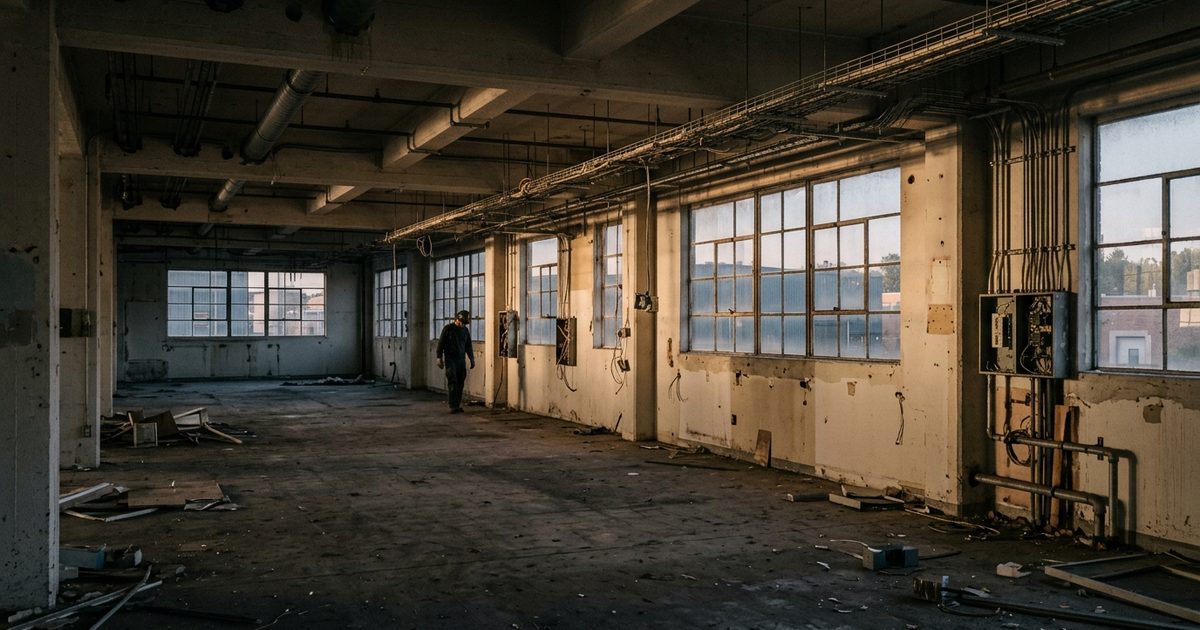
Fire is the vacant-building risk with the clearest data behind prevention. Beyond the U.S. Fire Administration loss figures cited above, a long-run NFPA analysis found that 57 percent of fires in unsecured vacant buildings were intentionally set, compared with 31 percent in vacant properties that were secured. Few security investments come with a before-and-after comparison that stark: securing the building roughly cuts the share of intentional fires in half.
Vacant-building fires are also disproportionately destructive. With no occupants to smell smoke and no working alarm to summon help, fires burn longer before discovery, and fire crews face added danger entering structures with unknown hazards. A fire that starts in an empty building can spread to occupied neighbors, turning a property problem into a community one and an owner's liability exposure into something far larger than the building's value.
Prevention is mostly discipline. Seal ground-floor openings, keep the exterior free of accumulated trash and dry vegetation, shut off utilities that are not required by your insurer, and remove flammable materials left behind by previous occupants. Then add detection: a monitored camera system spots the trespass that precedes most intentional fires, which means intervention can happen at the fence line rather than after the first flame.
Copper theft and fixture scrapping: stripping a building of its value
Scrappers can do damage wildly out of proportion to what they gain. Copper pipe, wiring, HVAC coils, and rooftop condenser units have scrap value in the hundreds of dollars, but removing them destroys walls, floods interiors when live plumbing is cut, and can leave a building needing a full re-wire and re-pipe before it can be sold or leased. A weekend of stripping can erase months of carrying-cost savings.
Empty buildings and paused job sites are especially exposed because the theft is quiet, repeatable, and low-risk when no one is watching. Thieves who find accessible mechanical rooms or rooftop units often return multiple times, and the same scouting patterns show up on idle construction sites, which is why the countermeasures overlap heavily with our guide on how to prevent construction site theft: control access points, remove or cage the highest-value targets, and make surveillance visible before the first visit, not after the third.
Deterrence research supports getting ahead of the problem. In a University of North Carolina at Charlotte study of 422 incarcerated burglars published in 2013, about 60 percent said the presence of an alarm would push them to a different target, and roughly 83 percent said they tried to determine whether an alarm was present before attempting a break-in. Offenders actively read a property's security posture. A vacant building that visibly announces cameras and monitoring gets skipped; one that announces neglect gets stripped.
Squatters and encampments: early detection, documentation, and a humane response
Unauthorized occupancy is the vacant-property issue that most demands both speed and care. Legally, time matters: the longer occupancy continues undetected, the more complicated removal becomes, since most jurisdictions require formal legal process rather than self-help once someone is living in a building. Practically, extended occupancy also compounds fire risk, sanitation issues, and property damage. Early detection, within days rather than months, keeps every option simpler.
Documentation is what turns detection into resolution. Time-stamped video establishing when entry occurred, how access was gained, and how long occupancy has continued gives police, courts, and insurers something concrete to act on. Our overview of using security camera footage as evidence covers the retention and chain-of-custody practices that keep that footage usable in a legal proceeding.
Handle the human side with the seriousness it deserves. People sheltering in a vacant building are often experiencing homelessness, and the goal is resolving the situation lawfully and safely, not treating people as a nuisance to be swept away. When monitoring detects occupancy early, owners can notify police promptly, engage counsel on the correct removal process, and coordinate with local homeless outreach services so that people are connected to shelter and support rather than simply displaced. That approach is both the right thing to do and the practical one: it resolves faster, reduces confrontation risk, and holds up better with courts and municipalities.
How do you actually secure a vacant property? A practical checklist
A workable vacant property security program layers physical, procedural, and technological measures:
- Harden the shell. Secure or board ground-floor doors and windows, repair breaches immediately, and control roof access via ladders and adjacent structures.
- Maintain the appearance of attention. Mowed grass, cleared mail and flyers, and prompt graffiti removal all signal that someone is watching the property.
- Manage utilities deliberately. Shut off water and gas unless your insurer requires maintained systems (sprinklered buildings often need heat to prevent freeze damage), and confirm requirements in writing.
- Inspect on a documented schedule. Walk the interior and exterior at least weekly or biweekly, photograph conditions, and log every visit for your insurance file.
- Add continuous monitored surveillance. Inspections cover moments; monitoring covers the other 167 hours a week. Visible cameras deter, and human-verified alerts catch what deterrence does not.
- Define an escalation plan. Decide in advance who gets called when activity is verified: the owner, the property manager, your security partner, or police, and in what order.
Periodic patrols and continuous monitoring are complements, not rivals; the comparison in remote video monitoring vs security guards breaks down when each layer earns its place and how they work best together.
Where monitored mobile surveillance fits for empty buildings
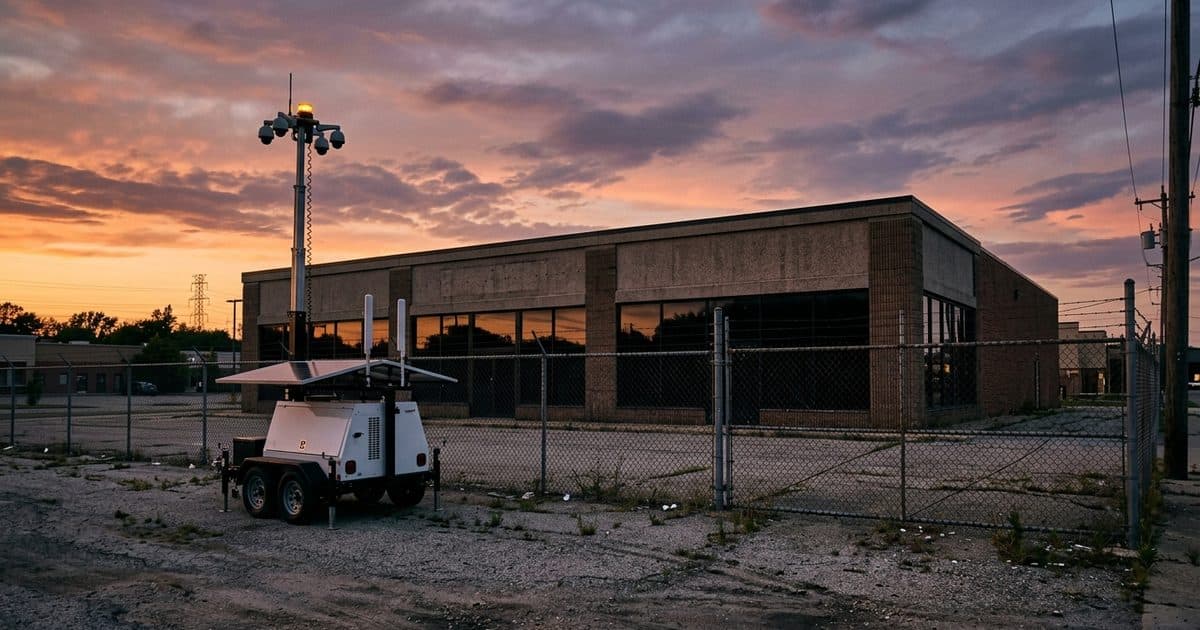
Vacant properties defeat conventional camera systems for a simple reason: the infrastructure is gone. Power may be disconnected, internet service canceled, and there is no IT closet, no electrician on call, and no tenant to reset a tripped breaker. This is the exact gap solar-powered mobile surveillance trailers were built for. A trailer arrives on a hitch, sets up in hours without touching the building's systems, and runs on solar power with battery reserves, streaming over cellular networks from sites with no utilities at all. When the property sells or re-leases, the unit leaves with no wiring to remove.
The monitoring layer is what makes the hardware matter. With 24/7 remote video monitoring, trained operators review AI-flagged activity, verify what is actually happening, and act on it: audio warnings that turn most trespassers around on the spot, and escalation with live video context when they do not leave. Verified alerts work as a force multiplier, so people, whether your own staff, your security partner's patrol, or local police, respond to confirmed incidents with real information instead of chasing blind alarms. For a building with no one inside, that verified human response is the difference between reviewing footage of a loss and preventing one.
Vacant does not have to mean vulnerable. The owners who come through a vacancy period unscathed are the ones who treat an empty building as an active responsibility: coverage confirmed with the insurer, shell hardened, inspections documented, and monitored surveillance watching the property every night that nobody else is.