
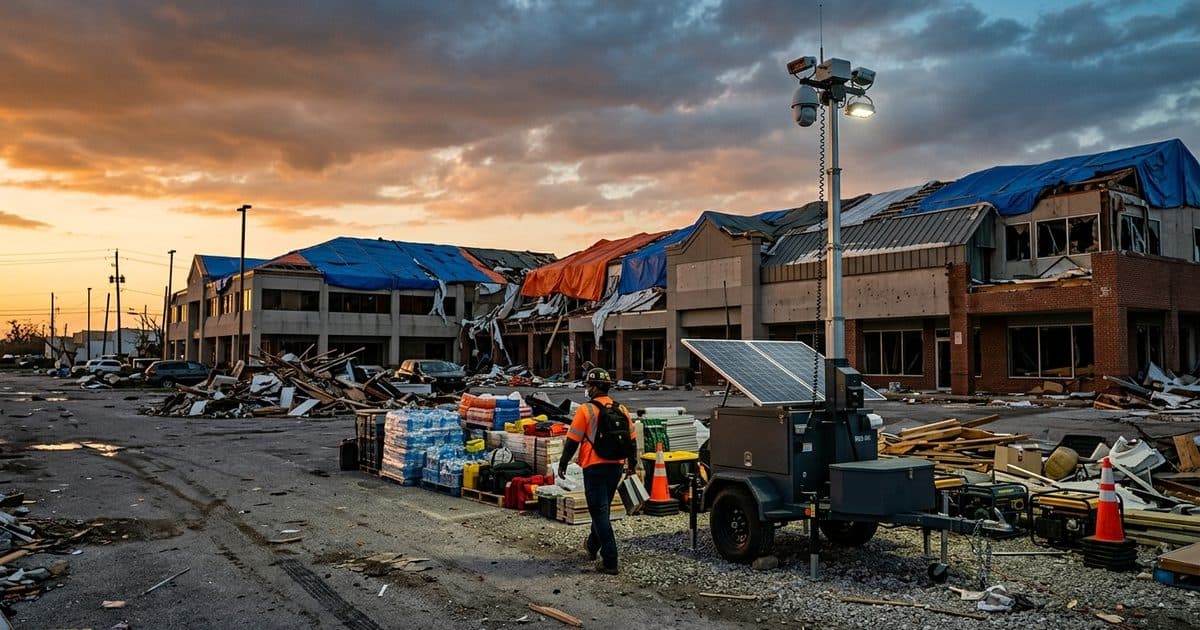
Disaster recovery and emergency staging sites share a hard condition that most security planning never accounts for: they appear with almost no notice, in places that were never built to be secured, at the exact moment the surrounding infrastructure has failed. A staging lot for debris removal equipment, a point of distribution handing out water and food, a base camp housing mutual-aid line crews — each one stands up in hours, holds high-value assets or critical supplies, and often has no fence, no lighting, no power, and no working network. That combination makes these sites an easy target during a window when the affected community can least afford another loss, and when emergency-management agencies and response contractors have the fewest resources to spare for guarding it. This is written with that context in mind — the goal of every recommendation below is to protect what a community and its responders depend on, not to treat an affected area as a security problem to be managed.
The Threat Landscape at Disaster Response Sites
The most common loss at a disaster site is theft from the staging area itself. Generators, fuel, pumps, chainsaws, and heavy equipment staged for the response are exactly the assets a working recovery effort can't do without — and exactly what disappears overnight from a lot with no fence and no one watching. A stolen generator or a drained fuel tank doesn't just cost money; it can stall the response for the people the site exists to help.
Points of distribution carry a different risk. A POD holding water, food, and relief supplies sits in an area where normal policing presence has thinned or vanished, road access may be limited, and the population nearby may be under real stress. Looting deterrence at a POD isn't about treating evacuees as suspects — it's about making sure the supplies staged for distribution actually reach the distribution line instead of being taken before doors open. The same logic applies to base camps housing utility mutual-aid crews and contractors, which hold trucks, materials, and lodging in unfamiliar territory with no existing security infrastructure to lean on.
Underneath all of it sits an accountability problem. FEMA reimbursement, insurance CAT claims, and debris-management contracts all depend on a defensible record — who was on site, when, and what happened. Without a timestamped log of activity and access, recovery organizations lose time and funding to disputes that better documentation would have closed immediately.
Why Standard Security Fails at a Disaster Site
Conventional security — fixed cameras, wired alarm panels, even a hired guard service — assumes conditions that a disaster removes first. It assumes grid power to run the cameras, a working internet or phone line to get the footage anywhere, and enough lead time to plan an installation or staff a post. None of those assumptions hold at a staging area that opened yesterday in a county where the utility grid is still down and cell towers are running on generator backup, if they're running at all.
| Requirement | Standard Security | Solar Mobile Surveillance |
|---|---|---|
| Power | Needs grid power or a dedicated generator and fuel supply | Fully solar-autonomous — no grid, no generator required |
| Connectivity | Needs a wired internet connection or working local network | Cellular or satellite backhaul, independent of local infrastructure |
| Setup time | Days to weeks for install, permitting, or guard staffing | Live and monitoring in under 20 minutes on arrival |
| Mobility | Fixed once installed; useless once the site relocates | Relocatable as the operation moves or a new site opens |
| Response | Passive recording, or a guard covering one point at a time | Live SOC verification and real-time audio warning on every alert |
The gap isn't a lack of security products designed for disaster response — it's that most security products were designed assuming stable infrastructure, and a disaster site is defined by the absence of exactly that. A camera system that needs an electrician and an ISP before it can turn on is protecting nothing during the days it takes to arrange either.
Tip: When a new staging area or POD is selected, treat security deployment as a parallel task to the site stand-up itself, not a follow-up step. A solar-autonomous unit that arrives with the first wave of equipment and lighting covers the highest-risk window — the first unguarded night — instead of arriving after the first loss already happened.
What a Coverage Plan Looks Like
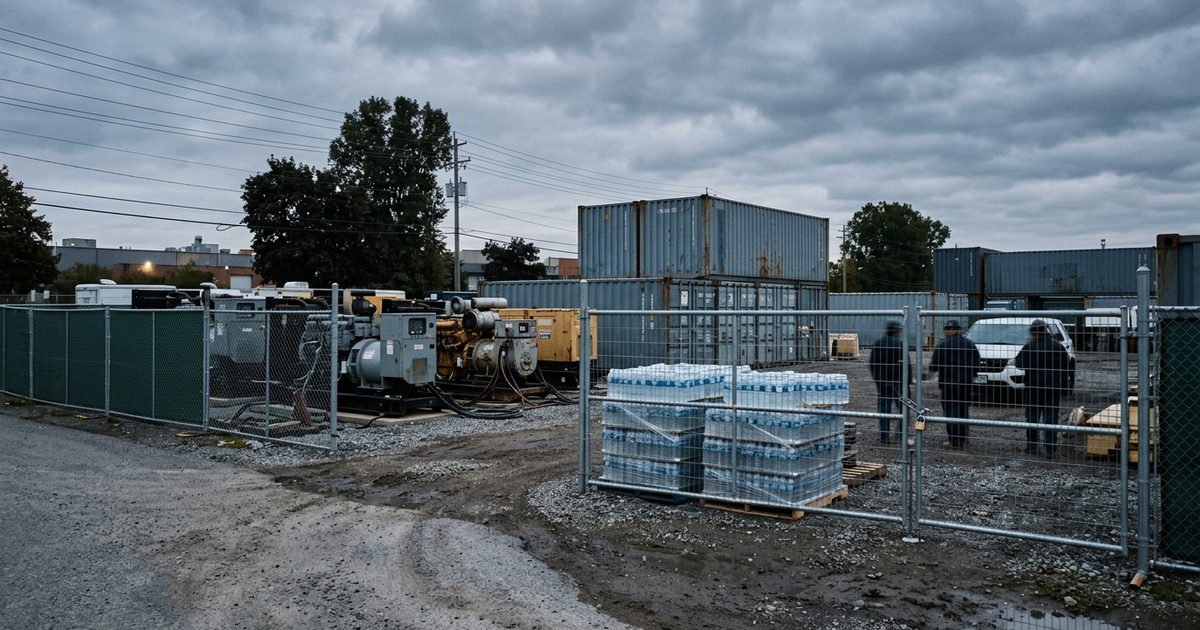
An effective plan matches coverage to how the site is actually used, and assumes it may need to move again within days:
- Staging and equipment lots: Elevated coverage across the full lot with object detection to flag movement near generators, fuel, and heavy equipment overnight, when no one is scheduled to be there.
- POD and distribution lines: Loitering detection around supply stores and distribution points, paired with visible presence and lighting that discourages both theft and disorder during operating hours.
- Site access points: License plate recognition at the entrance to a staging area or base camp logs every vehicle in and out, which supports both real-time access control and after-the-fact documentation for reimbursement claims.
- Perimeter and low-light areas: A lighting trailer paired with the surveillance unit extends both visibility and deterrence across a site with no existing lighting infrastructure — useful for base camps and staging areas operating well past dark.
The unifying requirement is that every part of this plan has to run without depending on anything the disaster may have taken away. A Mobile Surveillance Unit built on a solar kit and cellular backhaul meets that requirement by design — it's not a scaled-down version of a permanent system, it's built for sites that don't have permanent infrastructure to scale down from.
Live Monitoring: A Response Without a Guard Force
Standing up a guard force at a disaster site competes directly with the response itself for scarce personnel, vehicles, and lodging — resources better spent moving supplies and running crews. Live remote monitoring solves the same problem without that trade-off.
Remote video monitoring routes every camera alert to a SOC operator who verifies it in real time, rather than producing footage that only gets reviewed after a loss. When an alert flags movement near the fuel storage at 3am, the operator confirms whether it's a legitimate crew member or an intrusion, then responds: a live audio warning through the unit's speaker, which alone clears most people off a site, followed by escalation to on-site security or law enforcement with time-stamped footage when it's a genuine threat. That verified-response model covers an entire staging area or POD continuously, rather than wherever one guard happens to be standing, and it scales the same way across a multi-site operation — one SOC covering every staging area, base camp, and POD an agency or contractor stands up, at the same standard, without hiring and training a security team for each location.
It also solves the accountability problem directly. Every alert, verification, and escalation is logged with a timestamp, and gate LPR ties vehicle access to a plate and a time. That record is what turns a disputed reimbursement claim or an insurance CAT investigation into a straightforward review instead of a drawn-out argument — the documentation already exists because the monitoring system generated it as a byproduct of doing its job.
Rapid Deployment That Matches How Disasters Move
Disaster response doesn't run on an installation schedule. A staging area can be selected in the morning and holding equipment by evening; a POD can open for three days and close as soon as supply routes normalize; a base camp can relocate twice in a single mutual-aid deployment as crews move between affected counties. Security coverage that takes longer to plan than the site exists for isn't coverage — it's a project that never catches up.
A relocatable, solar-autonomous approach is built around that pace. A unit deploys to a new staging lot the same day it opens, shifts to a POD when distribution begins, and relocates again when the operation moves to the next county — all without trenching, conduit, or waiting on a utility crew that has its own disaster to respond to. This is the same operating model VDS applies to public safety deployments and event and temporary sites, where the common thread is a location that needs real security fast, without the infrastructure a permanent installation assumes. It's worth noting this isn't a downgraded version of permanent security — a border or perimeter operation facing the same infrastructure gap sees the same benefit; see how the same approach applies to border and perimeter security.
For agencies and contractors operating under federal or state contracts, sourcing matters too — VDS equipment is built to meet NDAA-compliant sourcing requirements, which keeps procurement straightforward for FEMA-adjacent and government-contracted response work.
Common Mistakes in Disaster Recovery Site Security
- Waiting for a "permanent" security plan before deploying anything. Sites that stand up in hours don't have time for a security plan that takes weeks. Deploy coverage with the first wave of site setup, not after the first loss.
- Assuming grid power or internet will be available. The most common reason security systems fail at disaster sites is that they were specified for stable infrastructure. Solar and cellular independence isn't a nice-to-have here — it's the baseline requirement.
- Under-covering staging and equipment lots. Generators, fuel, and heavy equipment are high-value and highly mobile targets, and they're often the least-covered part of a site because attention goes to the POD or the camp entrance instead.
- Treating documentation as an afterthought. FEMA reimbursement and insurance CAT claims depend on a clean record of site activity. A monitoring system that logs every alert and every vehicle in and out builds that record automatically; one that doesn't leaves reimbursement to memory and paperwork.
- Planning for one site instead of a moving operation. Staging areas, PODs, and base camps relocate as an operation develops. A fixed installation gets left behind; a relocatable unit moves with the mission.
Disaster response sites are a proving ground for a simple idea: security should ask nothing of a site that a site has nothing left to give. No grid power, no fixed internet, no time for a lengthy install — and coverage that goes up anyway, protects the people and supplies the response depends on, and documents everything along the way. If you're standing up a staging area, POD, or base camp and need coverage in place before the next unguarded night, talk to our team or review related deployment case studies.