
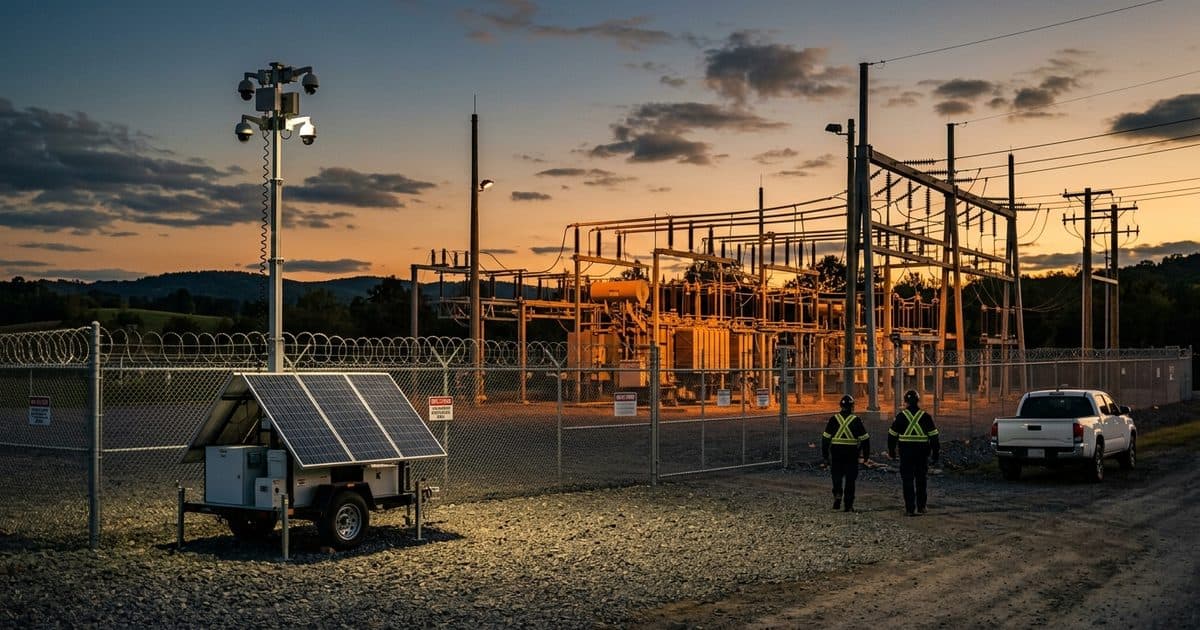
Why battery storage sites are a security problem
A typical storage site sits on a rural parcel or at the edge of an existing utility property. Nobody works there day to day. Technicians visit on a schedule, and the rest of the time the site depends on fencing, locks and remote telemetry.
That combination attracts the same visitors that other remote energy sites attract. Thieves look for copper, cable and anything that can be resold. Trespassers climb fences out of curiosity or to dump material. Vandals damage equipment because nobody is there to stop them. The difference with storage is the concentration of value and the electrical hazard. A person who cuts into an energized enclosure risks a serious injury, and damage to storage equipment can create a larger problem than the loss of the item taken.
Telemetry tells you when equipment misbehaves. It does not tell you who is standing next to it. Video fills that gap.
What to protect first
Start with a simple inventory of what a visitor could reach and what would hurt most if it were touched.
- Battery enclosures and containers, including doors, cable entries and vents.
- Inverters, transformers and switchgear, which hold copper and are expensive to replace.
- Cable runs and grounding, which are a common theft target on any energy site.
- The gate and access road, because every legitimate and illegitimate visit starts there.
- Spare parts and materials, especially during construction and commissioning when laydown areas are full.
Rank these by consequence, not only by resale value. An open enclosure door matters even if nothing is taken.
Perimeter first, then the equipment
The fence line is the cheapest place to stop a problem. Once someone is inside, response time shrinks. A good layout detects people before they reach the fence or while they are on it, and gives a monitoring team enough time to act.
Cameras with people and vehicle detection reduce the noise from animals, weather and vegetation. Adding a second sensing method, such as radar or thermal imaging, can help on long fence lines or in poor visibility. Both work in different ways and have different limits, so ask any provider how they handle false alerts, glare and fog. Our guides on perimeter intrusion detection systems and critical infrastructure physical security cover the options in more depth.
Lighting matters too. Many sites rely on infrared illumination for night video, which works well for detection and less well for color detail. If you need identifying detail at the gate, plan for it specifically.
Fire and smoke concerns, in general terms
Battery systems carry fire risk, and the site design, equipment standards and suppression systems are governed by codes, manufacturers and your insurer. Those requirements vary by state and by local authority. Confirm them with the local fire authority and your counsel. Nothing in a camera plan replaces them.
What video can add is a second set of eyes. A camera that can see the site at night, in rain and from several angles lets a monitoring team look at an alarm the moment it arrives and judge whether it is real. Cameras with fire and smoke analytics can flag visible smoke or flame, which can shorten the time between something starting and a person looking at it. Our article on fire and smoke detection cameras explains what these analytics can and cannot do, including how smoke, steam and dust can look alike on video.
Ask your provider three questions. What does the system send when it sees smoke. Who looks at it and how quickly. And what happens next, including who is called and in what order.
Monitoring and response
Cameras that only record are useful after the fact. At a remote storage site, the value is in catching the event while it is happening. A research review of closed-circuit television programs found that actively monitored systems were associated with a meaningful crime reduction while passive recording-only systems showed no significant effect.
A workable response chain looks like this:
- The camera or sensor detects a person, vehicle or smoke.
- A monitoring team verifies the event on live video.
- The team speaks to the person through a loudspeaker, if appropriate.
- If the person stays or the situation is serious, the team contacts police and shares video.
- Your staff or your security partner gets a clear report for follow-up.
That structure lets people, yours or your security partner's, handle verified incidents instead of chasing every alert. See live talk-down audio deterrence for how the audio step works.
Quick reference
| Concern | What to look for | Question for your provider |
|---|---|---|
| Fence line intrusion | People and vehicle detection with low false alerts | How are animals and weather filtered |
| Night visibility | Infrared or other low-light capability | Can I identify a vehicle at the gate at night |
| Smoke or flame | Fire and smoke analytics on live video | Who reviews the alert and how fast |
| Power and network | Independent power and cellular backup | What happens during a long cloudy stretch |
| Response | Verification, talk-down, police dispatch | Do you share video with responders |
Power and connectivity at a new site
Storage sites are often built before the permanent power and network are finished. That is when material is on site, crews come and go, and the fence may not be complete. A temporary camera system with its own power and cellular connection can cover that period. It can also stay as a second layer after commissioning. Our articles on solar farm security cameras and substation physical security describe similar sites and the lessons that carry over.
How VDS fits
VDS builds solar-powered mobile surveillance trailers. Each unit carries a 5MP PTZ camera with 25x optical zoom and three 8MP wide-angle cameras on a 22 ft telescopic mast (30 ft available). A 900W bifacial solar array charges an 11.8 kWh LiFePO4 battery bank with reserve for 3 to 5 consecutive cloudy days, and dual-SIM 4G/5G cellular carries the video. No site power, internet or trenching is needed.
AI detection covers people, vehicles, loitering, objects and license plates, and the platform includes analytics pages for fire and smoke. Our 24/7 US-based security operations center verifies events, uses live talk-down through a loudspeaker, then dispatches police with video. Hardware is NDAA Section 889 compliant. Most deployments go from signed quote to live monitoring in about a week, and on-site setup takes one person under 20 minutes. To talk through your site, contact our team, review the mobile surveillance unit, or call (410) 401-1986.
Sources
- Piza, E. L., Welsh, B. C., Farrington, D. P., & Thomas, A. L. (2019). CCTV surveillance for crime prevention: A 40-year systematic review with meta-analysis. Criminology & Public Policy, 18(1). onlinelibrary.wiley.com