
Start with an inventory you trust
Many utilities discover during an assessment that the site list is incomplete. Old wells, abandoned interconnects, easements and leased tower sites show up on maps but not in the security plan. Build the list from operations, GIS and finance records, then drive or fly the system to confirm it.
For each site, record what is there, who has keys or codes, who visits and how often, and what the nearest responder is. A site visited weekly by a technician has a different exposure than one visited quarterly. Our security site risk assessment template provides a general worksheet you can adapt.
Assess by site type
Different asset types raise different concerns. The sections below give prompts for each.
Treatment plants
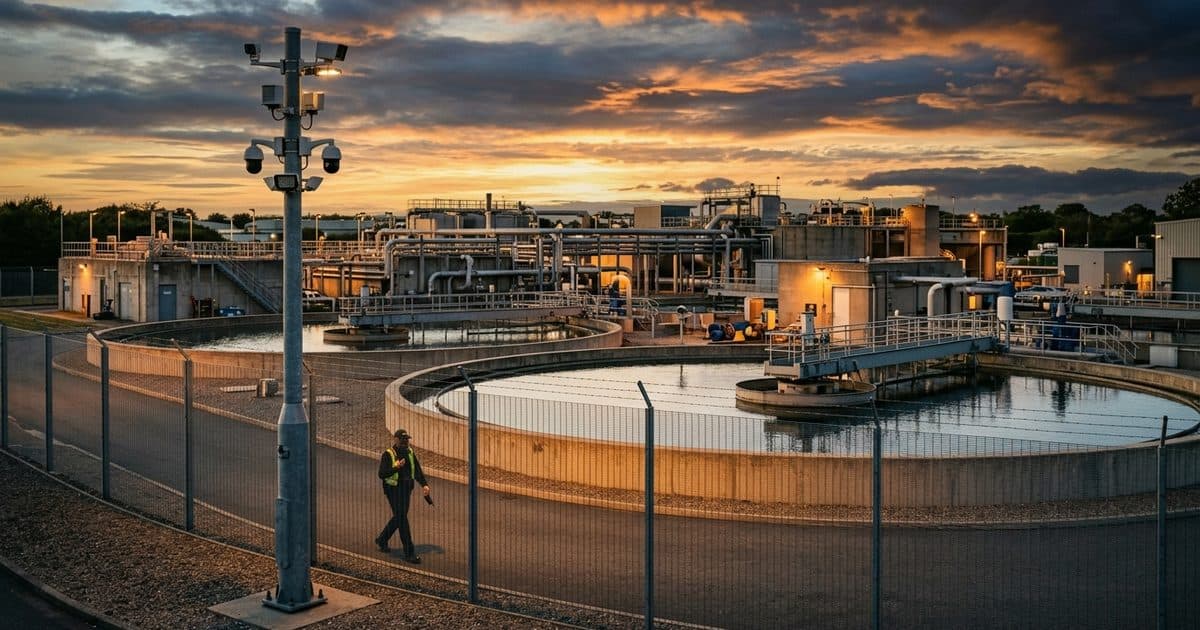
Plants are staffed but large. Walk the full boundary and look at where the plant meets roads, water, rail or wooded land. Check chemical storage, control buildings and intake structures separately, because they have different consequences. Review how deliveries are admitted and logged, and whether after-hours staff are alone on site. See our guide to water treatment security cameras for more on plants.
Storage tanks and reservoirs
Elevated tanks and ground reservoirs combine a physical structure with hatches, vents and ladders. Look at whether climb deterrents are in place, whether hatches and access points are locked and alarmed, and whether the base and fence line can be seen from a distance. Our article on water tower and reservoir security covers these in depth.
Wells and wellhouses
Wells are often small, remote and unlit. Check for intrusion detection on the building and the wellhead, how anyone would learn about a break-in, and whether the structure can be forced with common tools. Because many wells are alone on a rural road, response time is a major factor.
Pump and booster stations
Pump stations contain valuable equipment, such as motors, panels and wiring, and they affect pressure for large parts of the system. Many are in enclosures near roads or in easements, and they are visited rarely. Consider what happens if the site is disabled and how long it would take to notice.
Score the six areas at every site
Consistency matters more than precision here. A rough score applied the same way at forty sites beats a detailed analysis of three.
Use the same six prompts everywhere so the sites can be compared.
- Boundary. Is there a fence or wall, is it intact, and can it be bypassed?
- Access. Who controls keys and codes, and how are changes recorded?
- Lighting and sight lines. Can the site be seen at night from the road or by a camera?
- Detection. What would notice an intruder, and does it work at night and in weather?
- Communications. How does the site report an alarm, and what happens if the link is lost?
- Response. Who looks at an alert, how fast, and what do they do?
Camera view planning is its own task, so do not assume a site is covered just because a camera exists. Ask what that camera actually sees, at night.
Compare sites in one table
A simple matrix puts the sites on one page. Score each cell low, medium or high concern, then add a column for consequence.
| Site type | Typical exposure | Common weak point | Key question |
|---|---|---|---|
| Treatment plant | Large boundary, shared edges | Intakes and chemical areas | Can all sensitive areas be seen at night? |
| Storage tank | Hatches, ladders, base | Unalarmed access points | Would anyone know if a hatch opened? |
| Well | Remote, often unlit | No detection, slow response | How long before a visit finds a problem? |
| Pump station | Equipment value, pressure impact | Rare visits, small enclosure | What fails first if the site is disabled? |
Think about communications and power
Water systems also depend on a small number of sites that cannot be replaced quickly. A well field, a main pump station or a single storage tank may carry a large share of the system, and an outage there has effects far beyond the site. Mark these as critical in the inventory, and weigh them more heavily when ranking.
Many remote water sites have limited power and weak or no wired connectivity. That shapes what is practical. A system that depends on a landline or a single cellular carrier may fail when it is needed. Our article on security cameras without internet explains the options, and any camera should be able to report when it has been covered, moved or disabled.
Turn findings into a ranked list
Finish with a list of actions, not a binder. Hold a short review with operations, maintenance and management so that the people who will carry out the fixes agree with the ranking. A plan that operations did not help build tends to stall. For each finding, record the site, the gap, a proposed fix, who owns it and a target date. Sort by consequence and ease of access, and fix quick wins such as broken locks and lighting immediately. Record what was done and when, so the next assessment can show progress and not start from scratch. Where a fix will take months, such as new power or communications at a remote well, note an interim measure so the site is not simply left waiting.
Federal and state water sector guidance may apply to your system. Requirements vary by system and by state, so confirm what applies with counsel and your state regulator.
Where mobile coverage fits
For unmanned sites that rank high, a VDS mobile unit can add detection and verification quickly. It is a solar-powered trailer with a 5MP PTZ camera with 25x optical zoom and three 8MP wide-angle cameras on a 22 ft telescopic mast (30 ft available). AI detection flags people, vehicles and loitering, and a 24/7 US-based security operations center verifies events, speaks through a loudspeaker, and dispatches police with video if needed. There is no need for site power, internet or trenching, and the hardware is NDAA Section 889 compliant.
That helps while permanent upgrades are planned and funded. Read about the water and wastewater industry or see the mobile surveillance unit. To discuss particular sites, talk to our team.