
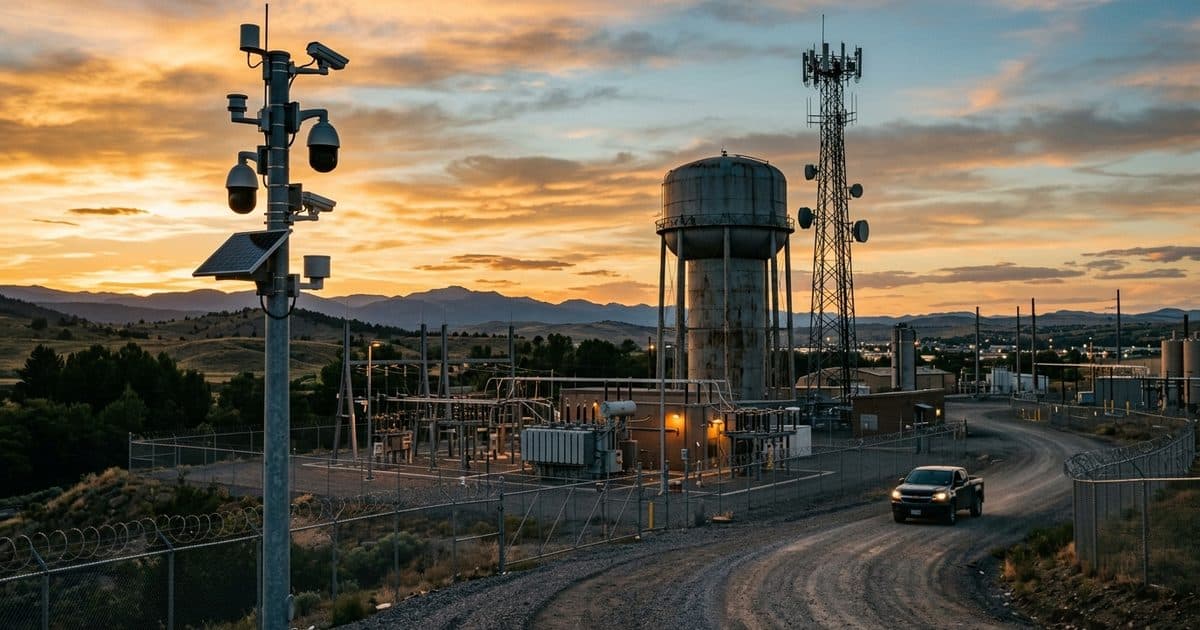
Why a checklist by layer
Single-product thinking causes most perimeter gaps. A site gets a fence, then a camera, then a sensor, and each purchase is judged alone. Layered thinking asks a different question about each function and accepts that no one layer is reliable by itself.
The goal is time. Each layer buys minutes between the first intrusion and the loss, and the response layer has to finish inside that time. For a broader view of the sector, see our overview of critical infrastructure physical security.
It also helps to separate what a layer does from what it looks like. A fence is a physical object, but its function is to delay. A camera is a device, but its function may be detection, verification or both. Writing the function next to each asset on a site plan shows quickly where one function is covered three times and another not at all.
Start with the site, not the equipment
Before walking the layers, write down three facts for every site. These decide how much each layer needs to carry.
- Consequence. What happens if the site is damaged or entered, to service, safety and cost.
- Access. How many ways in exist, including roads, rail, water, drainage paths and neighboring property.
- Time to notice. How long an incident could continue before a person finds out without any system.
A structured worksheet helps. Our security site risk assessment template covers the same ground in more detail. Sites with high consequence and a long time to notice get the most layers.
Layer one: detect
Detection answers one question: did something cross the line. It should work at night, in weather and without a person standing there.
- Is every approach, gate and corner inside the field of view of a camera or sensor?
- Does detection cover the full boundary, or only the front gate?
- Can the system tell a person or vehicle from an animal, a branch or blowing debris?
- Is there a way to learn that a camera or sensor has been blocked, covered or disabled?
- Are there blind spots behind buildings, equipment pads and tall vegetation?
Detection is a mix of technologies. Cameras with analytics, radar, thermal imaging and fence sensors each have trade-offs in range, false alerts and cost. Our guide to perimeter intrusion detection systems compares the common options.
Layer two: deter
Deterrence works on the decision to enter or to keep going. It is cheaper to stop someone at the fence than to remove them from the equipment.
- Is the boundary clearly marked, with posted warnings at gates and along the fence?
- Is lighting adequate at gates, corners and critical equipment, and does it work at night?
- Is it visible that the site is watched, such as camera housings, strobes or signage?
- Is there a way to speak to someone on site, in real time, through a loudspeaker?
Spoken warnings are one of the stronger deterrents because they show the person they have been seen. Our article on live talk-down audio deterrence explains how that works in practice.
Layer three: verify
Verification is the layer most often skipped. An alert is a claim, not a fact, and sending a responder to an unverified alert wastes their time and builds distrust in the system.
- Who looks at an alert, and how fast?
- Is video attached, so the reviewer sees what triggered it?
- Is someone available at 2 a.m. on a holiday, or does the alert wait in a queue?
- Can the reviewer tell the difference between an employee, a contractor and an intruder?
Our piece on video-verified alarm response explains why verified events get a better response than raw alarms.
Layer four: respond
Response is the plan for what happens next. It should be written down, tested and short enough to follow under stress.
- Who is called first, and who is called if they do not answer?
- What details does the responder get, such as location, a description and live or recorded video?
- Are gate codes, site maps and escalation contacts current?
- Is there a record of every event and what was done about it?
- Has the plan been tested with a real drill, including a night call to the people on the list?
Response also includes the people who are not security staff. Operations crews, contractors and neighbors may all see something. Give them a simple way to report it, and make sure the report reaches the same place as sensor alerts, so one person sees the whole picture.
Quick-reference table
| Layer | Question it answers | Typical gap | What to ask |
|---|---|---|---|
| Detect | Did someone cross the line? | Blind spots, front gate only | Show coverage on a site map, day and night |
| Deter | Do they stop? | No lighting, no warning | What do intruders see and hear on arrival? |
| Verify | Is it real? | Alerts with no reviewer | Who reviews, how fast, with what video? |
| Respond | Who acts? | Out-of-date contact lists | Walk through the last real incident step by step |
Where a mobile unit fits
Mobile units are useful when a fixed layer is missing or cannot be built quickly. A VDS unit is a solar-powered trailer with a 5MP PTZ camera with 25x optical zoom and three 8MP wide-angle cameras on a 22 ft telescopic mast (30 ft available). AI detection flags people, vehicles and loitering, and a 24/7 US-based security operations center verifies events, responds with live talk-down through a loudspeaker, then dispatches police with video if needed.
That puts detect, deter, verify and respond on one trailer, so people, yours or your security partner's, handle verified incidents. No site power, internet or trenching is needed, and the hardware is NDAA Section 889 compliant. Most deployments go from signed quote to live monitoring in about a week. Placement matters, so choose the vantage point with the whole boundary in mind. See the mobile surveillance unit details. To discuss specific sites, talk to our team.
Run the checklist
Walk each site once in daylight and once at night. Mark every layer as covered, partial or missing, then rank the missing layers by consequence. Fix the cheapest high-consequence gap first, and keep the sheet current. A perimeter plan is only as good as the last time someone checked it.
Three habits keep the checklist honest. First, test detection by having someone cross the boundary on purpose and see what is reported and how fast. Second, compare alerts with the actual incident log at least quarterly, looking for events that were never alerted. Third, assign each site a named owner, so a gap on the sheet has a person attached to it and not a department.