
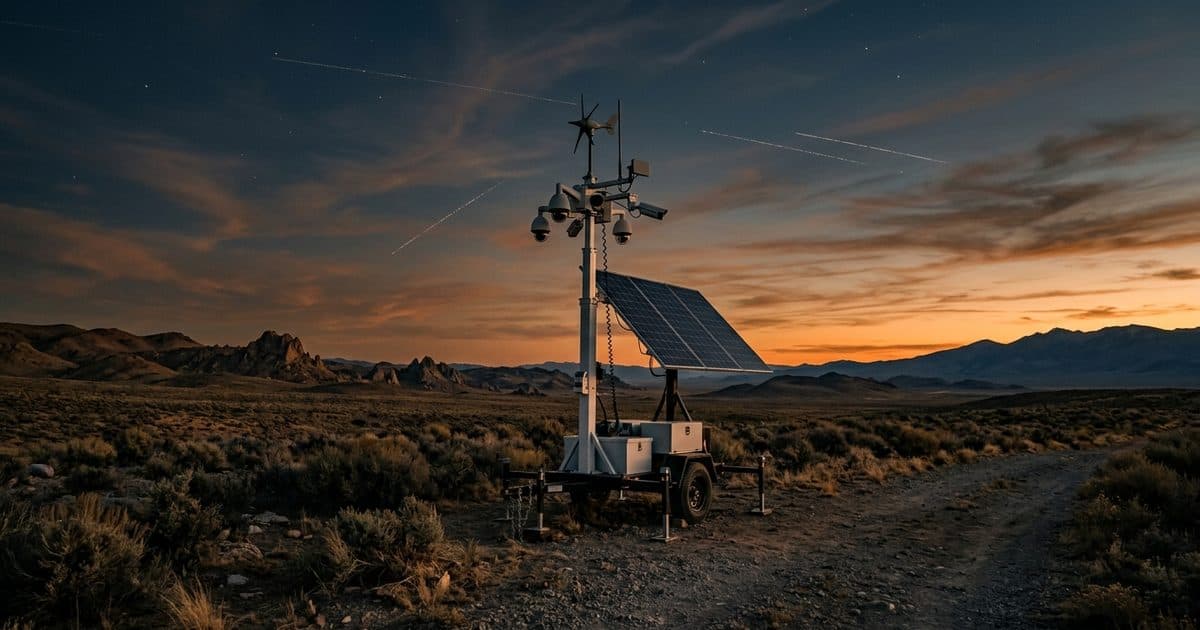
Why "no internet" is a commercial-site problem, not a trail camera question
Search for security cameras without internet and most answers describe consumer trail cameras writing to an SD card. That solves a hobbyist's problem. It does not solve a commercial one, because a card in a camera deters nothing, alerts no one, and leaves the site owner discovering a theft days later, sometimes with the camera itself gone.
Commercial sites need three things a memory card cannot provide: real-time detection, a way for a human to verify what tripped the alert, and escalation while the incident is still happening. All three require some form of backhaul, which is exactly what remote sites lack. The same FCC report found that about 28 percent of rural Americans and more than 23 percent of people on Tribal lands lack 100/20 Mbps fixed broadband. And the gap is not only a wired one: a legal-analysis summary of the same FCC report by Telecom Law Firm TLP puts the number of Americans lacking both 100/20 fixed broadband and 35/3 Mbps mobile 5G at roughly 45 million.
So the real question is not whether cameras can run without internet. It is how to assemble power, connectivity, and on-site intelligence so that monitoring works as if the site had fiber, even when the nearest utility pole is miles away.
Solar power: sizing the energy side of the stack
Every off-grid camera system is a small power plant first and a security system second. Panels must generate enough energy on a poor winter day to run cameras, illuminators, a modem or satellite terminal, and a recorder around the clock, and the battery bank must bridge the stretches when they cannot.
Two sizing principles do most of the work. First, design for your worst week of sun, not your average day: December solar yield at a northern latitude is a fraction of June's, and a system sized for summer will go dark in January. Second, build in battery autonomy, meaning days of runtime with no charging at all, so storms and short winter days do not interrupt coverage. Continuous recording, cold-weather battery behavior, and connectivity hardware all change the math, and our guide to solar security camera battery life works through those trade-offs in detail.
The connectivity choice feeds directly back into the power budget. A cellular modem draws relatively little; a satellite broadband terminal draws considerably more, which means satellite-primary sites need more panel and battery capacity than cellular-primary sites. Sizing power and backhaul together, rather than bolting one onto the other, is the difference between a system that runs through February and one that does not.
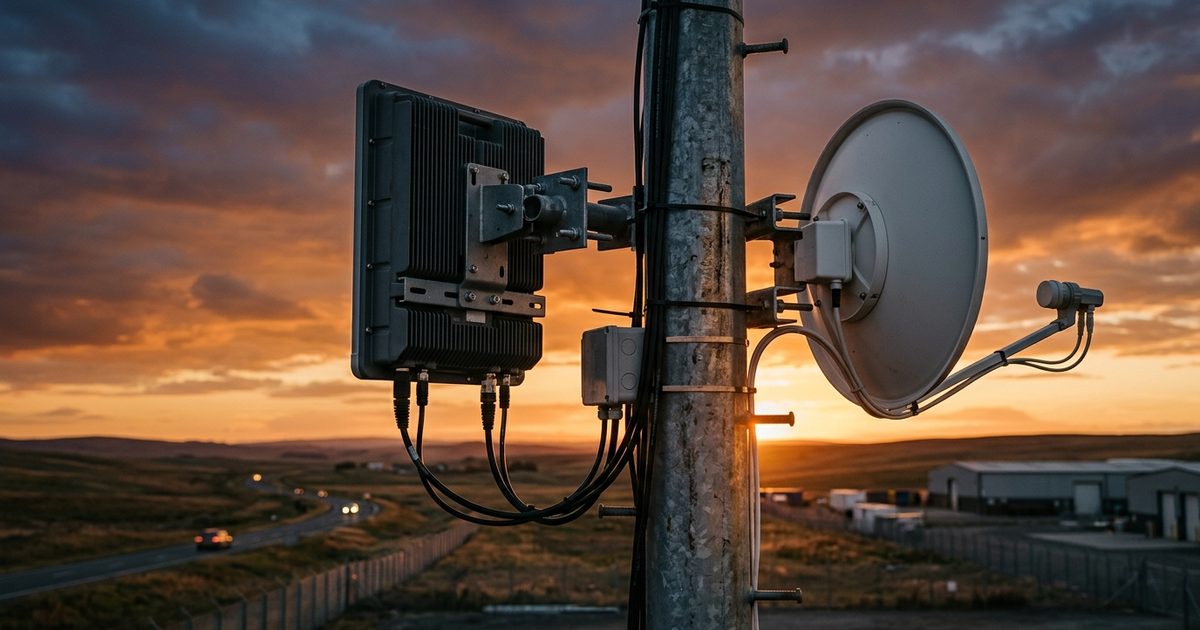
Cellular LTE and 5G: the default off-grid backhaul
For most remote commercial sites, cellular is the primary connection, and for good reason. LTE coverage reaches far beyond wired broadband, hardware is inexpensive and power-efficient, and upload capacity on a decent signal comfortably carries event clips plus on-demand live viewing. Where mid-band 5G is available, there is usually headroom for multiple continuous streams.
Getting cellular right at the site edge comes down to a few practices:
- Run a signal survey before deployment. Coverage maps are optimistic. Measure actual signal quality at the exact spot, at the height the antenna will sit, across more than one carrier.
- Use multi-carrier SIMs or dual modems. A connection that can fail over between carriers removes the single most common cause of off-grid downtime.
- Mount antennas high with clear line of sight. A mast-mounted external antenna routinely turns an unusable fringe signal into a workable link.
- Plan the data budget. Event-clip workflows sip data; continuous cloud streaming gulps it. Match the plan to the monitoring model so the system does not throttle mid-month.
Connectivity failures, not camera failures, cause most off-grid outages, which is why redundancy at this layer matters so much. Our breakdown of surveillance trailer uptime covers how layered failover keeps recording and alerting alive when a tower or carrier has a bad day.
Satellite: failover today, and the direct-to-cell era ahead
Satellite used to be the connectivity of last resort: high latency, low throughput, painful pricing. Low-earth-orbit broadband changed that. Modern LEO service delivers upload speeds and latency that support both clip upload and live operator viewing, which makes satellite viable as a primary backhaul at true dead zones, on islands, offshore-adjacent sites, and deep-rural land where no carrier reaches. Coastal and island security deployments increasingly run this way as standard practice.
The next shift is already regulatory reality. According to industry-body reporting from the GSMA, the FCC has approved the first supplemental-coverage-from-space service, satellite connectivity that talks directly to standard cellular devices, targeting more than 500,000 square miles of US cellular dead zones. Direct-to-cell bandwidth today suits messaging-class traffic rather than video, but the direction is clear: the boundary between "cellular site" and "satellite site" is dissolving, and surveillance systems built with modular backhaul will ride that transition without hardware swaps.
For system design now, the practical pattern is straightforward. Cellular-viable sites use satellite as automatic failover for alerting continuity. True dead zones use satellite as primary, with a larger power budget and a monitoring model tuned for a metered connection.
Edge AI and local recording: spend intelligence, not bandwidth
The most effective bandwidth tool in the stack is not a bigger antenna. It is deciding, on the site itself, what deserves to leave the site. Edge AI analytics run on the camera or a local processing unit, classify motion as human, vehicle, or irrelevant (weather, wildlife, vegetation), and forward only events that matter. Everything else stays local.
Recording follows the same split-brain design. Full-resolution continuous video writes to on-board storage, so complete forensic footage exists regardless of connection state, while the uplink carries only alert clips, operator-requested live views, and system health telemetry. If the link drops entirely, the site keeps recording and the backlog syncs when the connection returns. Nothing is lost; only immediacy is degraded.
This architecture is what makes monitored off-grid security economically sane. Streaming every camera to the cloud around the clock demands broadband the site does not have and a data plan nobody wants to fund. Uploading a handful of verified event clips per night works over a fringe LTE signal or a metered satellite plan.
Bandwidth math: live monitoring vs event-clip upload
Here is the planning arithmetic that determines what your connection actually has to carry. The figures below are illustrative rules of thumb for modern compressed video, not vendor specifications; verify against your camera's datasheet, and note that newer codecs such as H.265 roughly halve the bitrate of older H.264 streams at the same quality.
| Workload | Rough uplink demand | Works over |
|---|---|---|
| Continuous 1080p live stream, per camera | A few Mbps sustained upload | Strong LTE, 5G, or LEO satellite |
| Reduced-resolution substream for operator spot checks | Under 1 Mbps sustained | Moderate LTE and up |
| AI-verified event clip, 15 to 30 seconds | Small burst, uploads in seconds | Fringe LTE, metered satellite |
| Health pings and telemetry | Negligible | Nearly any link |
The takeaway: continuous streaming is a per-camera, sustained cost that multiplies fast, while event-driven monitoring is a per-incident, burst cost that almost any usable link can absorb. A four-camera site streaming continuously needs an order of magnitude more sustained upload than the same site running edge analytics with clip-based verification. That is why professional remote monitoring of off-grid sites is built around verified events, with live streaming reserved for the moments an operator actually needs eyes on the scene.
Where each connectivity stack fits
Pipelines and well pads. Long linear assets cross coverage that swings from solid LTE to nothing within a few miles, so cellular-primary units with satellite failover at the dead segments are the standard pattern. Our guide to oil and gas site security cameras covers the sector's specific threat profile.
Ranches and agricultural land. Gates, equipment yards, and fuel storage are usually far from both power and broadband. Solar-plus-LTE covers most properties; the deepest sections may justify a satellite-primary unit.
Islands and coastal sites. Undersea utility connections are rare and cellular from the mainland is unreliable, which makes solar power with LEO satellite backhaul the default rather than the fallback.
Solar farms. Ample power on site does not mean ample connectivity; construction-phase solar farms in particular combine high-value copper and panels with rural dead zones, a natural fit for cellular-primary mobile units.
Disaster zones. After a hurricane or wildfire, grid power and terrestrial networks may both be down for weeks exactly when sites are most exposed. Self-powered units with satellite backhaul restore surveillance before utilities return, a scenario we cover in depth in our guide to disaster recovery site security.
How monitored mobile surveillance puts the stack together
You can assemble panels, batteries, modems, terminals, and analytics yourself, but the integration is where off-grid systems succeed or fail. A mobile surveillance unit packages the whole stack, solar generation sized to the load, multi-path cellular with satellite options, edge analytics, and on-board recording, in a trailer that deploys in days with no trenching or utility hookups. Vision Detection Systems pairs those units with 24/7 human monitoring, so detections are verified and escalated in real time, and people, yours or your security partner's, handle verified incidents instead of chasing false alarms. For a site with no internet and no power, that combination delivers what the memory-card answer never could: someone watching, right now, from anywhere.