
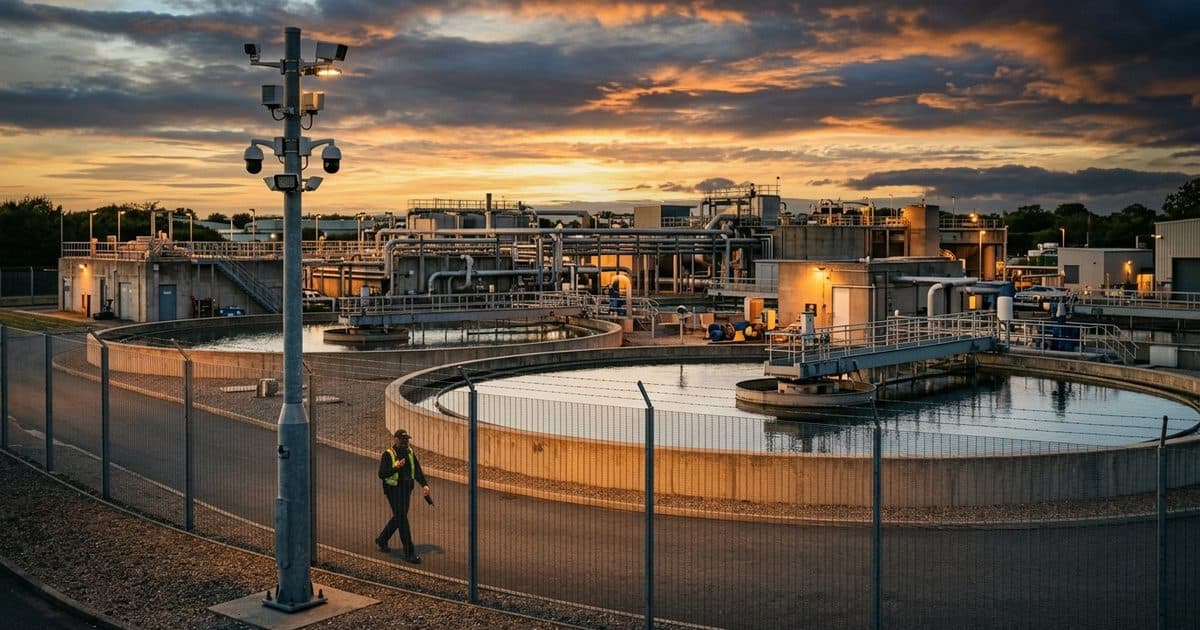
Water and wastewater utilities carry a security burden that most other industries don't: the asset itself is a public-health resource, the regulatory expectations are rising, and the physical footprint is enormous and mostly unstaffed. A treatment plant might get real attention from an operator's budget and staff. The lift station at the edge of the service area, the well head down a gravel road, and the finished-water tank on the hill rarely do — even though a breach at any of them is the same category of incident. This post covers the threat landscape specific to water and wastewater utilities, why fixed CCTV fails across a system this spread out, what a coverage plan for the plant and the remote sites actually looks like, how live monitoring changes the response, and what compliance and deployment look like for a public-sector utility.
The Threat Landscape at Water & Wastewater Utilities
The threat that sets water utilities apart from almost every other vertical is contamination risk. Unauthorized access to a treatment process, a chemical storage area, or a finished-water storage tank isn't primarily a theft concern — it's a public-health concern, and it demands the same urgency whether the person at the fence is a curious trespasser or something worse. A recorded clip reviewed the next morning does nothing to prevent that kind of incident; only detection tied to immediate, verified response does.
Perimeter breach and trespass compound the problem because so much of a utility's physical footprint sits in open, low-traffic ground. Fence lines around plants, reservoirs, and storage tanks often run for hundreds of yards through terrain with no natural surveillance, where a cut fence panel or a climbed gate can go unnoticed for an entire shift.
Then there's the theft dimension. Remote pump and lift stations hold exposed copper wiring, motors, and control equipment, and they're some of the least protected infrastructure a utility owns — unstaffed by design, often unlit, and sometimes miles from the nearest responder. It's the same pattern that's driven a wave of theft at electrical substations and cell sites: unattended equipment with resale-value copper, sitting behind a chain-link fence and nothing else. If your utility has already looked at coverage for substation copper theft, pump stations and lift stations deserve the identical scrutiny.
Vandalism adds a steady drag on maintenance budgets, but the bigger shift is regulatory. America's Water Infrastructure Act (AWIA) risk and resilience assessment requirements, along with growing EPA expectations, are pushing utilities toward documenting physical security measures and monitoring at their facilities — pressure that's straightforward to address at one flagship plant and genuinely hard to meet across thirty or forty remote sites with no existing infrastructure.
Why Fixed CCTV Fails Across a Water System
A fixed camera system can absolutely work at a treatment plant — there's power, there's connectivity, and there's usually staff on site during the day. The failure mode is everywhere else. Pump stations, well fields, and remote tanks were never wired for security because wiring them means trenching conduit or running new power drops to sites the utility visits maybe once a month, and that cost rarely clears the budget line until after an incident.
| Capability | Fixed CCTV | Solar Mobile Surveillance |
|---|---|---|
| Central plant | Workable — power and connectivity already exist | Adds live-verified coverage over tanks and chemical storage during elevated-risk periods |
| Remote pump stations & well fields | Requires new power and connectivity runs — rarely funded | Solar and cellular — deploys with no grid power or wired internet |
| Response to a detection | Passive recording, reviewed after the fact | Live SOC verification and audio warning in real time |
| System-wide coverage | Site-by-site install projects that never reach every location | Relocatable — one unit can move to wherever risk is highest |
| Compliance documentation | Inconsistent across sites; gaps at unmonitored locations | Continuous alert, verification, and escalation logs across the system |
The deeper issue is the same one that shows up in every under-covered vertical: recording isn't response. A camera at a lift station that captures someone stripping copper overnight documents a loss that's already happened. What changes the outcome is a system that detects the intrusion as it occurs, gets a live human to verify it, and puts an audio warning or a law-enforcement response on site while it's still preventable.
Tip: Prioritize deployment by consequence, not by traffic. A pump station that sees one visitor a month but sits upstream of a contamination risk deserves coverage before a well-lit parking lot that just sees the occasional loiterer. Rank your sites by what happens if the incident goes unnoticed, not by how often someone drives past.
What a Coverage Plan Looks Like
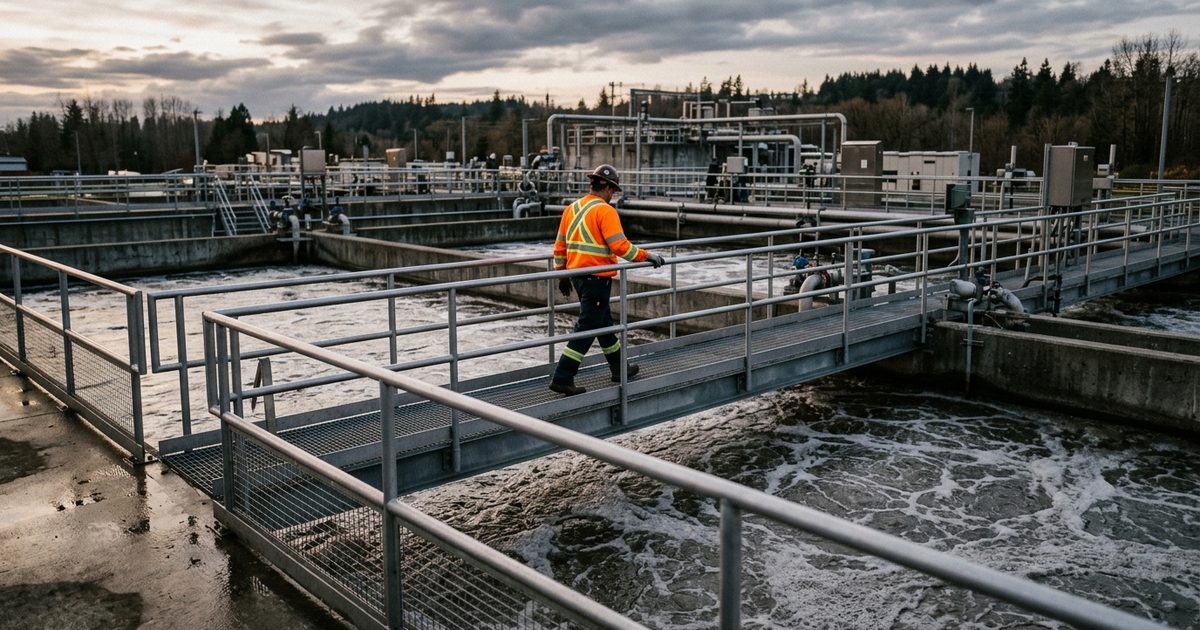
A water and wastewater coverage plan has to work at two very different scales at once — the flagship plant and the long tail of unmanned remote sites — and a relocatable model is what makes covering both practical:
- The treatment plant and chemical storage: The highest-consequence site in the system. During construction, a known vulnerability window, or simply as ongoing practice, an MSU adds live-verified loitering detection around tanks and chemical storage without disrupting the plant's existing fixed system.
- Finished-water storage tanks: Elevated and ground-level tanks where any unauthorized access is a direct contamination concern, watched with object detection that distinguishes a person approaching from routine site traffic.
- Remote pump and lift stations: The sites most utilities have written off as unprotectable because there's no power or internet to run a fixed camera to. A solar-autonomous unit removes that excuse entirely.
- Well fields and reservoirs: Distributed, low-traffic assets spread across open ground, where a single incident can go unnoticed for days without any monitoring at all.
- Gated access points, with LPR: License plate recognition at every gated entry ties vehicle access to a plate and a timestamp — turning the one chokepoint at each site into a verifiable record instead of a gap. Pair it with lighting at sites where visibility itself is the deterrent.
The point isn't to wire every site permanently — it's to be able to put verified coverage anywhere in the system on short notice, whether that's the plant during a threat period or the pump station that just had its first copper theft.
Live Remote Monitoring: Verified Response at Public-Health-Critical Sites
Detection alone doesn't stop a contamination event or a copper theft in progress — response does, and response has to be fast enough to matter at a site with no staff on site to see it happen.
Remote video monitoring puts that response in place. When a camera at a plant or pump station flags movement, a live SOC operator verifies the alert in real time — confirming it isn't utility staff on a routine visit — and then acts: a real-time audio warning through the unit's speaker, which alone is enough to clear most intruders, followed by direct escalation to law enforcement with time-stamped footage and the site's LPR record if a vehicle was involved. At a site where the worst-case outcome is a public-health incident, that live verification step is the difference between a system that only documents what happened and one that's built to prevent it.
The secondary benefit is the paper trail. Every alert, verification, and escalation is logged automatically, which gives a utility exactly the kind of continuous, timestamped monitoring record that supports an AWIA risk and resilience assessment or an internal security audit — without someone manually compiling it after the fact. For utilities running dozens of remote sites, a single SOC covers all of them to the same standard, rather than security quality varying by which site happened to get budget that year.
Compliance, NDAA Hardware & Deployment
Because most water and wastewater utilities are public-sector or public-adjacent entities, hardware provenance is often a procurement requirement, not just a preference. VDS deployments use NDAA-compliant hardware throughout, so utilities don't have to weigh security coverage against federal procurement restrictions — the two aren't in tension.
Deployment follows the same fast timeline whether the priority site is the plant or a pump station three counties away:
- System assessment. Review the plant, tank, well field, and pump station footprint, any existing fixed infrastructure, and findings from a recent AWIA risk assessment if one exists.
- Sensor configuration. Detection zones set around tanks, chemical storage, and fence lines; LPR configured at gated access points; alert thresholds tuned for public-health-sensitive areas.
- Delivery and commissioning. The trailer arrives at the priority site, the mast goes up, cameras and LPR are calibrated, and SOC monitoring starts immediately — no trenching, no fiber run, no waiting on a utility crew.
- Ongoing monitoring and relocation. Documented incident and access logs arrive on a regular cadence for compliance and audit purposes, and the unit relocates across the system as risk priorities shift — from the plant during a construction window to the lift station that just had its first incident.
Most utilities move from an initial conversation to a live unit on their highest-priority site inside a week.
Common Mistakes in Water & Wastewater Security
- Securing the plant and stopping there. The plant usually has budget, staff, and existing infrastructure behind it. The pump stations, tanks, and well fields with none of that are where the actual exposure sits.
- Treating remote sites as unprotectable because they lack power. No grid power and no wired internet used to mean no camera. A solar-autonomous, cellular-connected unit removes that constraint entirely.
- Recording without verifying. A camera that only produces footage for after-the-fact review can't stop a contamination event or an equipment theft in progress. Detection has to route to a live operator who can act in real time.
- Skipping LPR at gated access points. Without a plate-and-time record at every gate, an investigation into unauthorized access starts from nothing, and regulators get no verifiable entry log.
- Waiting for an incident to justify coverage. Copper theft, tampering attempts, and vandalism tend to escalate once a site is identified as unmonitored. Deploying coverage proactively — and being able to move it to wherever risk is highest that month — costs far less than responding after the first loss.
Water and wastewater utilities sit alongside the broader critical infrastructure and utility sectors in facing this same core problem: a small number of high-consequence sites surrounded by a much larger number of remote, unstaffed ones that traditional security was never built to reach. A relocatable, solar-powered, live-monitored model is what closes that gap — on the plant floor and at the well head three counties away alike. See how it's played out for other utility customers in our case studies, or talk to our team about your system.