
The co-op security problem
A cooperative often serves a wide, thinly populated territory with a lean crew. Substations, metering points, storage yards and communication sites may be dozens of miles from headquarters and visited only occasionally. Few people live near them, and most are dark and quiet at night.
That combination makes remote assets attractive to thieves and curious trespassers, and it makes after-hours response slow. A member-owned utility also has to justify spending to members, so any plan must be practical, scalable and not dependent on a large security staff.
What is at risk at co-op sites
The assets that matter most are usually not spectacular.
- Substations. Copper grounding and conductors, control equipment and fencing. Details are in substation physical security.
- Material and vehicle yards. Wire, transformers, poles, hardware and tools. Equipment trucks are often parked there overnight.
- Fuel. Tanks at yards and generator sites.
- Communication and metering sites. Small enclosures with batteries and radio equipment.
- Generation and storage projects. Small solar or battery installations that a cooperative owns or hosts.
Damage at any of these does more than cost money. A cut ground or tampered enclosure can cause an outage, create a safety hazard, and require crews to be pulled off other work. Our article on copper theft prevention at substations explains why copper keeps being targeted.
Constraints that shape the solution
Cooperatives share a few constraints that rule out some common approaches.
Small crews. Nobody is available to watch screens, so alerts have to be filtered and verified before they reach staff.
Remote sites. Many locations have no wired internet and may have no nearby grid power for new equipment. See security cameras without internet for how cellular connections work.
Cost accountability. Spending must be justified and often approved by a board, so rental and term options that match the need are useful.
Operational caution. Utilities are careful about connecting new devices to operational networks, so standalone systems are usually preferable.
Choosing where to start
Do not try to cover every site at once. Rank sites on a short scale, then work down the list.
| Site type | Typical risk | Suggested coverage |
|---|---|---|
| Unstaffed rural substation | Copper theft, intrusion, outage | Gate and equipment view, after-hours detection |
| Headquarters or operations yard | Vehicle, tool, fuel and wire theft | Gate, fuel area and material storage |
| Remote material storage | Wire, transformers and hardware | Mobile unit at the stock |
| Communication or metering site | Equipment and battery theft, tampering | Single unit or small camera with alerts |
| Generation or storage project | Equipment theft during and after build | Gate and equipment pad coverage |
Include a history of incidents, the cost and lead time to replace the equipment, and the effect of an outage on members in your ranking. A site that has been hit once is more likely to be hit again.
Monitoring without a control room
Cameras that only record are rarely worth installing at an unstaffed site. A 2019 systematic review of 76 studies found that actively monitored camera systems were associated with roughly a 15% reduction in crime, while passive recording-only systems showed no significant effect. For a cooperative, the practical question is who watches.
Remote monitoring answers it. AI detection flags people and vehicles after hours, a trained operator verifies each event, and only confirmed incidents escalate to your on-call staff or police. Remote video monitoring explains the model. Write an escalation list that names who is called first, who is the backup, and when police are dispatched. Staff should never be asked to confront intruders.
Fitting cameras into daily operations
Technology only helps if crews and managers accept it. Before installing anything, tell line crews and operations staff what the cameras do and what they do not do. Cameras are there to protect assets, not to track employees, and the placement should reflect that. Decide in advance who may view live and recorded video, how long footage is kept, and how it is shared with police. Your counsel should confirm state requirements.
Agree a short list of normal activity, such as scheduled line crew visits to a substation, so the monitoring team can recognize legitimate arrivals. Share a call list and update it when people change roles. Test the full chain once after installation, from detection to operator to on-call contact, so everyone knows what a real alert looks like.
Starting small and expanding
A cooperative does not need to commit to a full program on day one. A common path is to place a mobile unit at the site with the worst history, observe how alerts are handled for a few weeks, and use the results to decide on the next sites. Because mobile units can be moved, the same equipment can follow a problem from one location to another, or be redeployed to cover a storm response yard or a construction project. Keep a simple log of incidents, alerts and outcomes. After a few months, that record shows whether coverage is working and which sites deserve a permanent solution.
Funding and approvals
Some cooperatives look to grants or outside programs for security and resilience work. Program rules and availability change, so check current requirements with the relevant agency or your statewide association before counting on funding. Our overview of security camera grants covers how to approach the search. Document incidents and outage costs, since they strengthen both a grant application and a board request.
How VDS fits
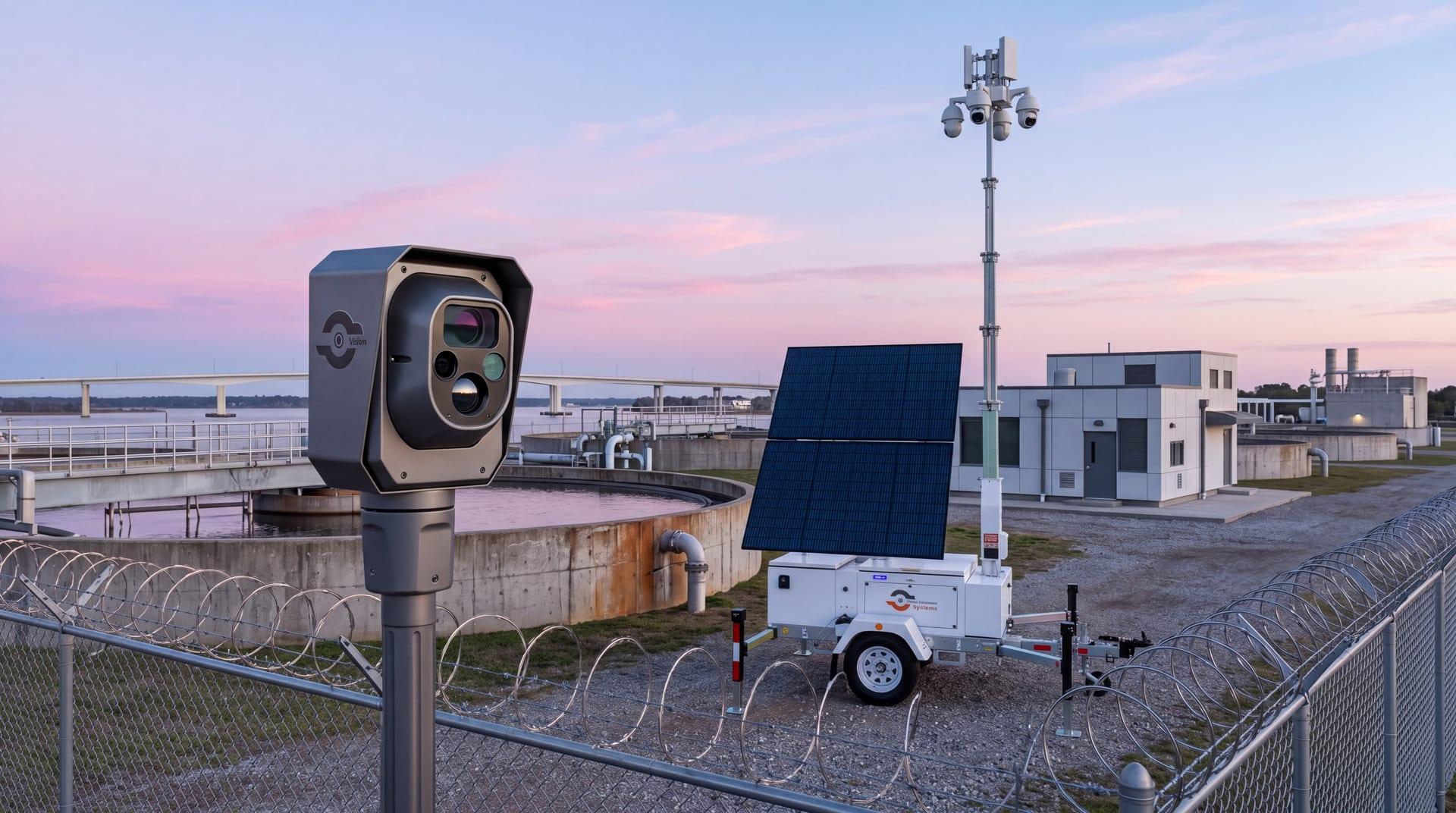
VDS builds solar-powered mobile surveillance units that suit sites with no power or internet. Each carries a 5MP PTZ camera with 25x optical zoom and three 8MP wide-angle cameras on a 22 ft telescopic mast, with a 30 ft mast available. A 900W bifacial solar array charges an 11.8 kWh LiFePO4 battery bank with reserve for 3-5 consecutive cloudy days, and dual-SIM 4G/5G cellular carries video. No site power, internet or trenching is needed. Hardware is NDAA Section 889 compliant.
AI detection covers people, vehicles and loitering. A 24/7 US-based security operations center verifies events, uses live talk-down through a loudspeaker, and dispatches police with video, so your crews or security partner handle verified incidents. Rental, month-to-month and term subscriptions are available, and most deployments go live about a week after a signed quote. See our utility industry page or talk to our team.
Sources
- Piza, E. L., Welsh, B. C., Farrington, D. P., & Thomas, A. L. (2019). CCTV surveillance for crime prevention: A 40-year systematic review with meta-analysis. Criminology & Public Policy, 18(1). onlinelibrary.wiley.com