
Why cooling units are targeted
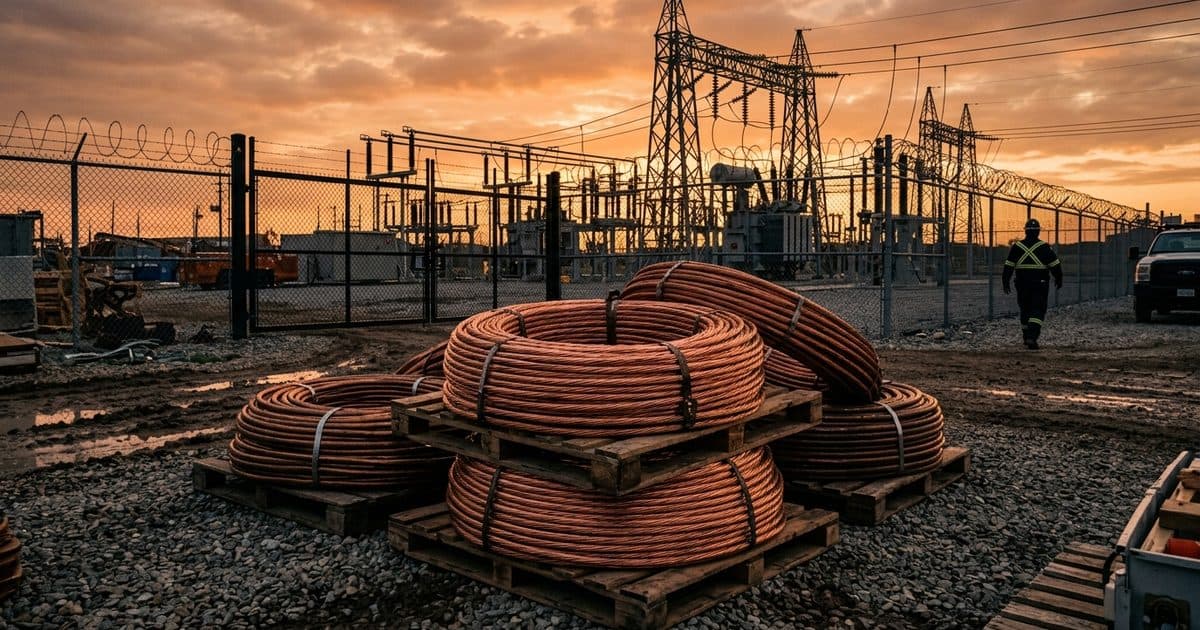
Air conditioners and heat pumps contain copper tubing and coils. Scrap buyers pay for copper, and a thief who knows how to cut it out can work quickly with common hand tools. The visible damage is often small compared to the cost of repair, and the unit may be unusable afterward.
The pattern repeats across commercial property. Ground-level condensers behind a building, rooftop units on retail and office properties, and units at vacant or closed buildings are all exposed. Thefts tend to follow scrap price movements and seasonal patterns, so it helps to read our guides to copper theft trends and copper theft in winter when assessing risk.
The consequence goes beyond the unit. A stripped system can leave tenants without cooling, damage ceilings and inventory when refrigerant lines or condensate lines are cut, and trigger insurance claims and downtime.
Rooftop units versus ground units
The two layouts have different weak points.
Rooftop units. The roof is out of sight from the street, which gives thieves cover. Access usually comes by an exterior ladder, an adjoining lower roof, a stacked pallet or an unlocked hatch. Once up, a thief can work for a while without being seen from below.
Ground units. Ground-level condensers sit at the back or side of a building, in loading areas or behind fences. They are easy to reach and often poorly lit. Thieves can pull a vehicle close, strip the unit and load the scrap.
Both benefit from basic physical hardening, then camera coverage that sees the way in and the equipment itself.
Physical measures that slow thieves
Physical protection will not stop a determined thief, but it adds time, noise and risk, which helps your cameras and responders. Consider:
- Locking and securing roof hatches and removing or guarding exterior ladders.
- Cages or fencing around ground units, with locked gates.
- Tamper-resistant fasteners on panels and access doors.
- Lighting aimed at the equipment and the approach.
- Clear sight lines, with vegetation, stacked materials and parked vehicles kept away from the units.
- Permanent marking or recorded serial numbers on equipment, which helps recovery and reporting.
Check local codes and your lease before adding cages or modifying roof access, since fire and safety rules can apply. Confirm any requirements with counsel or your building department.
Camera placement that works
Aim cameras at two things, the path to the unit and the unit itself. A camera that only sees the equipment will show the theft, while a camera that sees the way in can flag the intrusion before the copper is touched.
For a ground unit, place a camera so that it sees the approach, the unit and any vehicle that pulls up next to it. For a roof, you need a view of the roof access and a camera positioned to see across the units, which may be a pole or building-mounted camera from an adjacent structure. Our camera field of view guide discusses how mounting height changes what you can detect and identify.
Night views matter, since many HVAC thefts happen in the dark. Infrared handles most conditions at moderate range. Thermal can detect a person against a cool background and help in poor lighting. Compare them in our guide to thermal security cameras.
Detection and response
Recording an HVAC theft helps with a claim and a police report, but it does not stop the loss. A study review by Piza and colleagues found actively monitored CCTV systems were associated with roughly a 15% reduction in crime, while passive systems that only recorded showed no significant effect. For a site where the loss happens in minutes, that difference is the whole point.
A monitored setup works as follows:
- Detection flags a person on the roof or near the units outside normal hours.
- A trained operator checks the live video.
- If it is real, the operator speaks to the person through a loudspeaker.
- If they stay, the operator escalates to your security partner or police with video.
Verified events tend to get a better response than unverified alarms. Our article on video-verified alarm response explains why, and the after-hours security guide covers how to set up the first steps.
When the building is vacant or the roof is out of reach
Closed, vacant or seasonal buildings are especially exposed. No one is there to notice noise or missing equipment, and thefts can sit undiscovered for days. A relocatable solar-powered unit can watch a parking lot, rear lot or a cluster of buildings without needing the building's power or network, which may be shut off.
HVAC theft also has neighbors in the same family of crimes, such as catalytic converter theft from parked vehicles. If your site has both rooftop equipment and parked vehicles, see our catalytic converter theft prevention guide to see how coverage overlaps.
Quick reference
| Layer | Rooftop units | Ground units |
|---|---|---|
| Physical | Secure hatch, remove or guard ladder | Cage or fence, locked gate |
| Lighting | Light on roof access points | Light on approach and unit |
| Camera view | Roof access plus view across units | Approach, unit and parked vehicle |
| Detection | Person detected on roof after hours | Person or vehicle near unit |
| Response | Verify, speak, escalate | Verify, speak, escalate |
How VDS fits
VDS builds solar-powered mobile surveillance trailers that need no site power, internet or trenching. Each unit has a 5MP PTZ camera with 25x optical zoom and three 8MP wide-angle cameras on a 22 ft telescopic mast (30 ft available). A 900W bifacial solar array charges an 11.8 kWh LiFePO4 battery bank with reserve for 3 to 5 consecutive cloudy days, and dual-SIM 4G/5G cellular carries the video.
AI detects people, vehicles, loitering, objects and license plates. A 24/7 US-based security operations center verifies events, responds with live talk-down through a loudspeaker, then dispatches police with video. That lets your team or your security partner handle verified incidents. Most deployments go from signed quote to live monitoring in about a week. See the mobile surveillance unit or talk to our team.
Sources
- Piza, E. L., Welsh, B. C., Farrington, D. P., & Thomas, A. L. (2019). CCTV surveillance for crime prevention: A 40-year systematic review with meta-analysis. Criminology & Public Policy, 18(1). onlinelibrary.wiley.com