
Why water sites are different
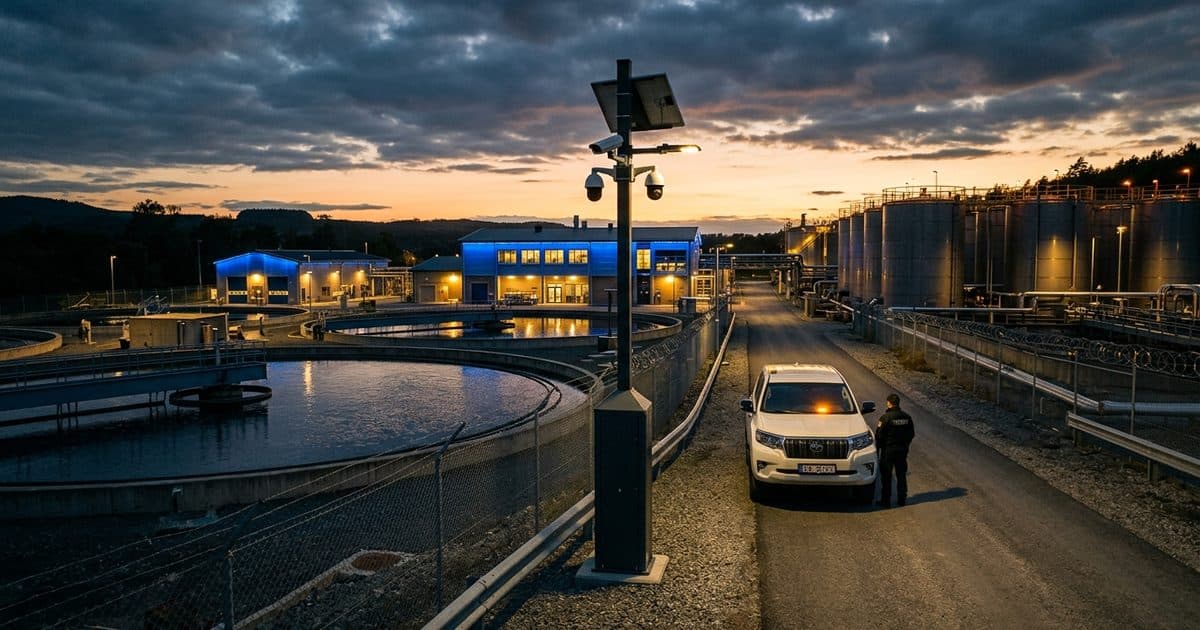
A water tower, ground tank or reservoir is simple to look at and serious to protect. The water is public, the site is usually fenced and the structure is visible for miles. Nobody works there on a normal night.
That makes three kinds of visitor likely. Curious people climb towers or jump fences, sometimes for photos. Vandals paint, break locks and damage equipment. A smaller number of visitors may tamper with hatches, vents, valves or controls. Even if tampering is unlikely, a utility cannot treat an open hatch casually. Any sign of access to stored water triggers procedures, testing and public communication, which makes the response expensive even when nothing was done.
For related guidance on treatment sites, see our article on water treatment security cameras. For the broader framework, critical infrastructure physical security explains how layers fit together.
Layers that work at remote sites
Security at a remote water site is a set of layers, each of which buys time.
- Deter. Fencing, signage and lighting tell visitors the site is controlled.
- Detect. Cameras with people and vehicle detection notice entry at the road, the gate or the fence line.
- Verify. A person looks at the video and decides what is happening.
- Respond. The verified event leads to a talk-down, a call to staff or police, or both.
- Document. Clips and logs support reports and investigations.
Detection without verification creates a stream of alerts that people learn to ignore. Verification without a response is just watching. All five layers need to be in place.
What to cover at a tower or tank
Walk the site and list the points where someone can reach the water or the controls.
- Access road and gate. Everything starts here. Capture vehicles and plates where possible.
- Fence line. Look for the low points, the dark corners and the sections that face a road.
- Ladders and climbing routes. Cover the base of the structure and any caged ladder.
- Hatches, vents and manways. These should be locked and, where practical, visible to a camera.
- Valves, pumps and control cabinets. These are small, valuable and a risk if tampered with.
- Telemetry and antenna equipment. Often mounted on the structure and a target for metal theft.
Placing a camera so it sees both the base of the structure and the fence line often means mounting it higher or using a mast. Higher mounting widens the view but reduces facial detail, so combine a wide view for detection with a zoom camera for identification.
Quick reference
| Risk | Typical sign | Control to consider |
|---|---|---|
| Trespass | Fence climbing, vehicles at the gate | Perimeter detection and talk-down |
| Tampering | Open or damaged hatch, lock or vent | Close camera view and regular checks |
| Vandalism | Graffiti, broken lights | Lighting and monitored video |
| Metal theft | Missing cable or antenna equipment | Camera view of equipment and cabinets |
| Climbing | Person on a ladder or tank | Detection at the base and verified response |
Power and connectivity on a hill
Remote water sites often have limited power and weak or no network. Some have telemetry but not enough bandwidth for video. Self-powered, cellular-connected cameras remove these problems. The article on security cameras without internet explains how video can work when a site has no wired connection, and what to ask about storage and bandwidth.
A mobile unit also helps while a permanent system is being designed. It can cover a site during a tank rehabilitation, a painting contract or a construction project, when contractors and equipment are on site and the normal controls are relaxed.
Keep a simple site log
For each site, keep a short record of its fence condition, lighting, lock status, camera views and response contacts. Review it after any incident and after any maintenance visit. Small details, such as a lock that was left open or a light that has failed, are often what make a site easy to enter. A site log also helps a monitoring team understand what normal looks like, so they can spot what is not.
Verified response beats patrols
Patrolling dozens of scattered sites is expensive and slow. A vehicle may arrive after the person has left, or not at all. Monitored cameras watch every site continuously and the monitoring team verifies events on video. A systematic review of closed-circuit television studies found that actively monitored systems were associated with a larger crime reduction than passive recording-only systems, which showed no significant effect.
A typical response is to speak to the person through a loudspeaker, which often ends the visit. If the person stays or does something concerning, the team contacts police with video and notifies utility staff. This lets your operators, or your security partner, handle verified incidents rather than responding to every alert. See live talk-down audio deterrence and how to stop trespassing on commercial property for more on the approach.
Confirm requirements and secure the cameras
Reporting duties, security plans and funding rules for water systems vary by state and by utility, so confirm them with counsel and your state agency before you finalize a plan.
Also protect the camera system itself. Cameras and cellular links are part of your network, so ask how they are secured and which hardware is used. Hardware that meets Section 889 of the National Defense Authorization Act matters if any federal funds are involved.
How VDS fits
VDS builds solar-powered mobile surveillance trailers. Each unit carries a 5MP PTZ camera with 25x optical zoom and three 8MP wide-angle cameras on a 22 ft telescopic mast (30 ft available). A 900W bifacial solar array charges an 11.8 kWh LiFePO4 battery bank with reserve for 3 to 5 consecutive cloudy days, and dual-SIM 4G/5G cellular carries the video. No site power, internet or trenching is needed.
AI detection covers people, vehicles, loitering, objects and license plates. Our 24/7 US-based security operations center verifies events, uses live talk-down through a loudspeaker, then dispatches police with video. Hardware is NDAA Section 889 compliant. Most deployments go from signed quote to live monitoring in about a week, and on-site setup takes one person under 20 minutes. Learn how remote monitoring works, contact our team, or call (410) 401-1986.
Sources
- Piza, E. L., Welsh, B. C., Farrington, D. P., & Thomas, A. L. (2019). CCTV surveillance for crime prevention: A 40-year systematic review with meta-analysis. Criminology & Public Policy, 18(1). onlinelibrary.wiley.com