
Why travel centers are hard to secure
A travel center is more than a large gas station. It often combines fuel islands for cars and trucks, a convenience store or restaurant, showers and services, a repair bay, and acres of parking. It operates around the clock, and many of its customers are strangers who stay for hours and then leave for another state.
That makes the property open by design. Trucks need room to maneuver, entries must be wide, and drivers expect to park and rest at any hour. Security has to work inside that openness, which is why watching and response matter more than barriers. For the fueling side, see our guide to gas station security cameras.
Security by zone
Treat each zone separately, since threats and solutions differ.
| Zone | Main risks | What helps |
|---|---|---|
| Fuel islands | Drive-offs, skimming, tampering, fuel theft | Pump-level cameras, plate capture, lighting, monitoring |
| Bulk fuel and storage | Theft from tanks or hoses | Fencing, camera coverage, alerts after hours |
| Truck parking | Cargo theft, cab break-ins, trailer tampering | Wide coverage, loitering and vehicle analytics, live monitoring |
| Store and entrances | Robbery, shoplifting, disturbances | Interior and exterior cameras, clear sightlines |
| Perimeter and exits | Unauthorized access, quick getaways | Cameras on every entry and exit, plate capture |
Fuel security
Fuel is both the main revenue source and a frequent target. Drive-offs happen at the pump, while tampering and skimming devices target payment systems. Thieves may also go after stored fuel or the fuel in parked trucks. Our guide to diesel fuel theft prevention covers this in depth.
Useful steps include:
- Cover each pump with a camera view that includes the vehicle and the plate
- Light the fueling area evenly so cameras can see at night
- Inspect pumps regularly for signs of tampering
- Secure bulk storage with fencing, locks and camera coverage
- Use plate capture at entrances and exits so repeat offenders can be identified
Plate reading depends on the setup. Plate characters need roughly 20-30 pixels of height, the camera angle should stay within about 15-30 degrees of the plate, and moving vehicles call for a shutter speed of 1/1000s or faster. Rules on collecting and keeping plate data vary by state, so confirm your approach with counsel.
Overnight truck parking and cargo
Overnight parking is the hardest zone to watch. Rows of tractors and trailers sit in dim lighting while drivers sleep. Cargo thieves look for loaded trailers and quiet corners. Because many trailers carry high-value freight, a short window of access can mean a large loss. Our article on truck yard cargo theft security and the logistics yard cargo theft prevention checklist discuss the patterns, and the cargo theft statistics for 2026 page collects industry data.
Practical measures for the parking area:
- Light the lot evenly, with particular attention to the back rows.
- Keep rows organized so cameras can see down the lanes.
- Place cameras high enough to see over trailers.
- Use analytics that flag people walking between trailers after hours.
- Make sure the monitoring team can speak to people on the lot through a loudspeaker.
- Post signage that tells drivers and visitors the lot is monitored.
Higher mounting widens the view but reduces facial detail, so many travel centers pair a tall camera for overall coverage with closer cameras near the entrances and fuel islands.
Why live monitoring matters on large sites
The bigger the property, the less likely staff are to see a problem in time. A cashier cannot watch the back lot. A single guard cannot watch every row. Monitored cameras fill that gap.
A 2019 systematic review of CCTV studies found that actively monitored systems were associated with about a 15% reduction in crime, while passive recording-only systems showed no significant effect. Monitored cameras let a remote team see activity, verify it and speak to the person through a loudspeaker. If the situation calls for it, police can be called with video. This supports on-site staff and any security partner you already use. The cameras and analytics do the watching so people, yours or your security partner's, handle verified incidents. Our overview of the fuel and convenience store industry covers related setups.
Adding coverage without trenching
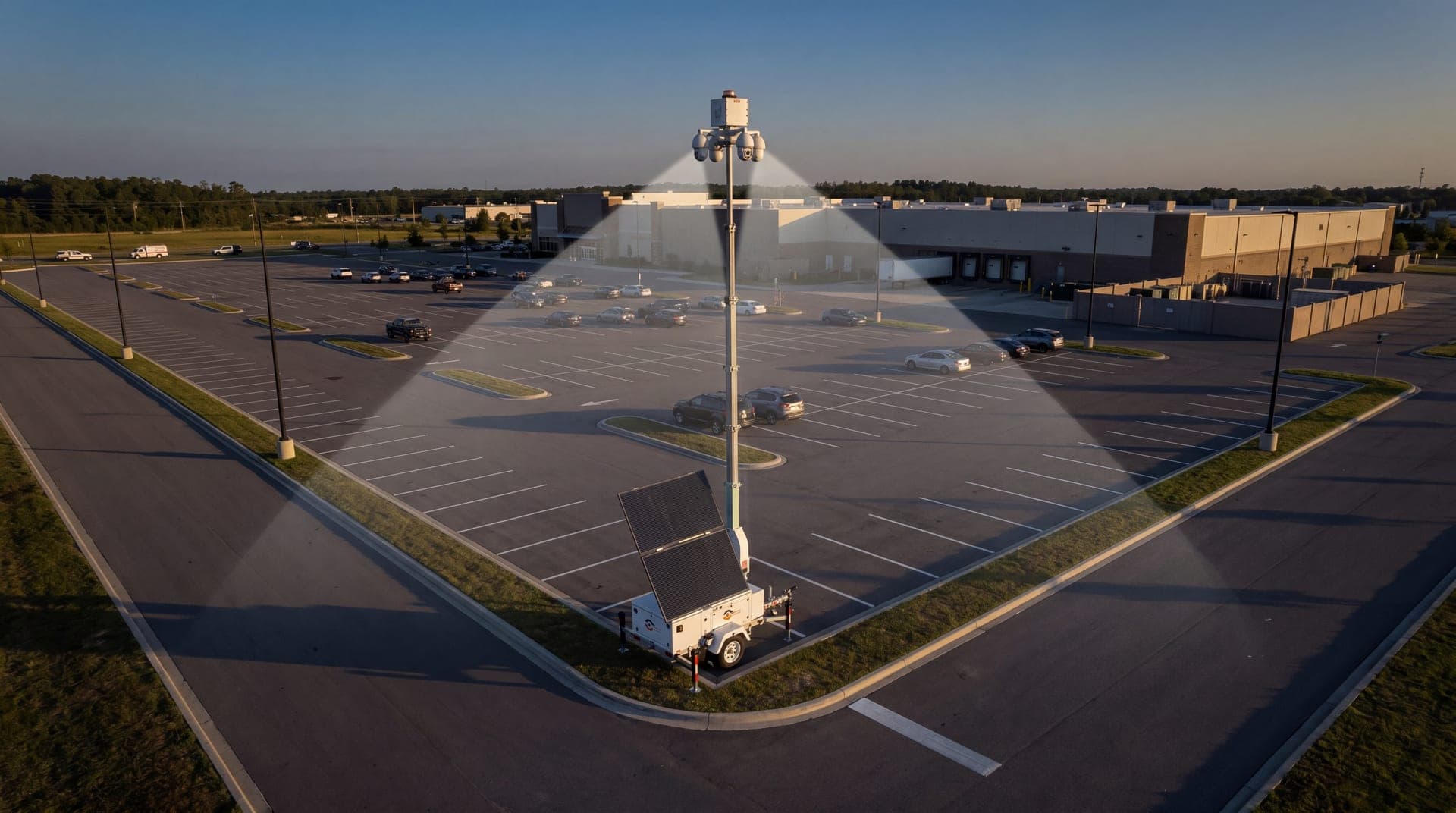
Large travel centers often have blind spots that fixed cameras do not reach, such as the far end of a long truck lot or a newly added parking area. Running power and network to those spots can mean trenching across paved lots, which is costly and disruptive. A mobile surveillance trailer can be placed at the problem area with its own power and connection. It can also move if parking layouts change.
Drivers, staff and on-site routines
Technology depends on routines. Staff should know how to report a suspicious person, a damaged pump or a tampered trailer, and who to call. Parking-lot patrols, even by a single employee at set times, add a human check that cameras cannot replace.
Drivers are a useful partner. Many experienced drivers notice odd activity quickly, and a simple way to report it, such as a posted number, helps. Post signs that tell drivers the property is monitored and that cargo theft is taken seriously. Keep a clear procedure for after-hours incidents, including how the monitoring team contacts site management, and keep emergency numbers current. Keep a written record of each incident so you can spot repeating times and locations, which tells you where to focus lighting and camera coverage.
How VDS fits
VDS builds solar-powered mobile surveillance trailers. Each carries a 5MP PTZ camera with 25x optical zoom and three 8MP wide-angle cameras on a 22 ft telescopic mast, with 30 ft available. A 900W bifacial solar array charges an 11.8 kWh LiFePO4 battery bank with reserve for 3-5 consecutive cloudy days, and dual-SIM 4G/5G cellular means no site power, internet or trenching is needed.
AI detection covers people, vehicles, loitering, objects and license plates. A 24/7 US-based security operations center verifies events, responds with live talk-down through a loudspeaker, then dispatches police with video. The hardware is NDAA Section 889 compliant. Most deployments go from signed quote to live monitoring in about a week, and setup takes one person under 20 minutes. Rental, month-to-month and term subscriptions are available. Talk to our team about your site.