
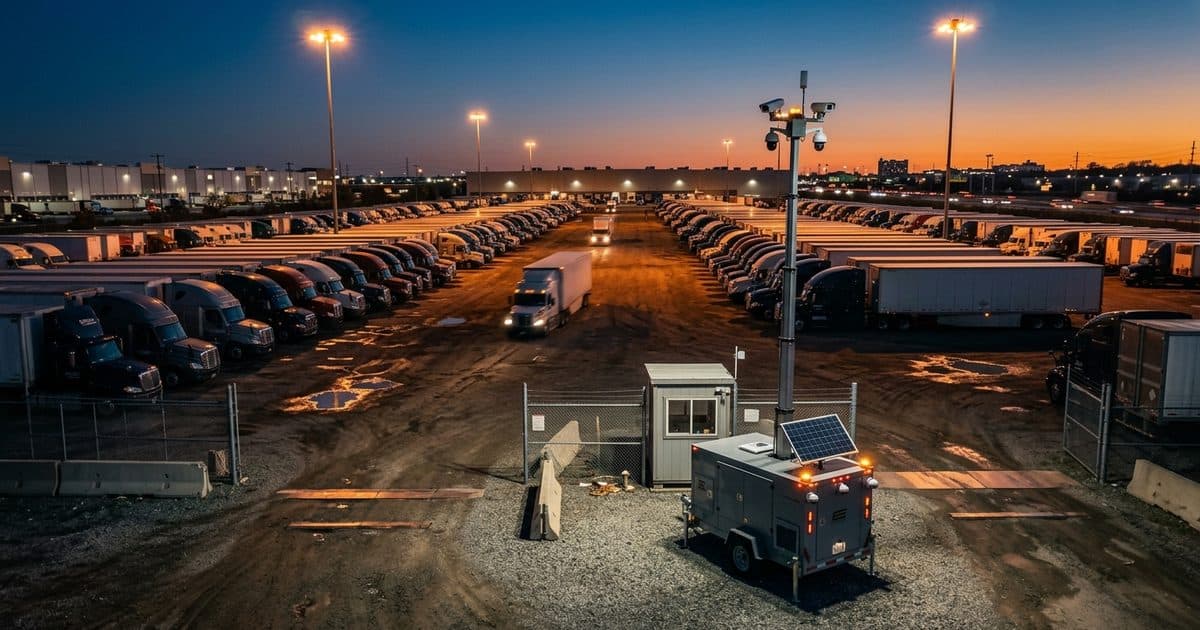
Truck yards are built to move freight fast, not to be defended. A trailer drop lot exists so a load can sit disconnected from a tractor for hours or days until the next leg picks it up, and an intermodal or distribution yard exists to process high volumes of trucks with minimal friction at the gate. Both of those design goals work directly against security: sprawling, unlit ground packed with loaded trailers, and a gate that sees so much legitimate traffic that a thief with a clipboard and a plausible story can roll straight through it. This post covers the threats specific to truck yards and cargo drop lots, why fixed CCTV and a busy gate can't solve this on their own, what a coverage plan built for the way freight actually moves looks like, and how gate LPR with live SOC monitoring closes the gap.
The Threat Landscape at Truck Yards and Cargo Drop Lots
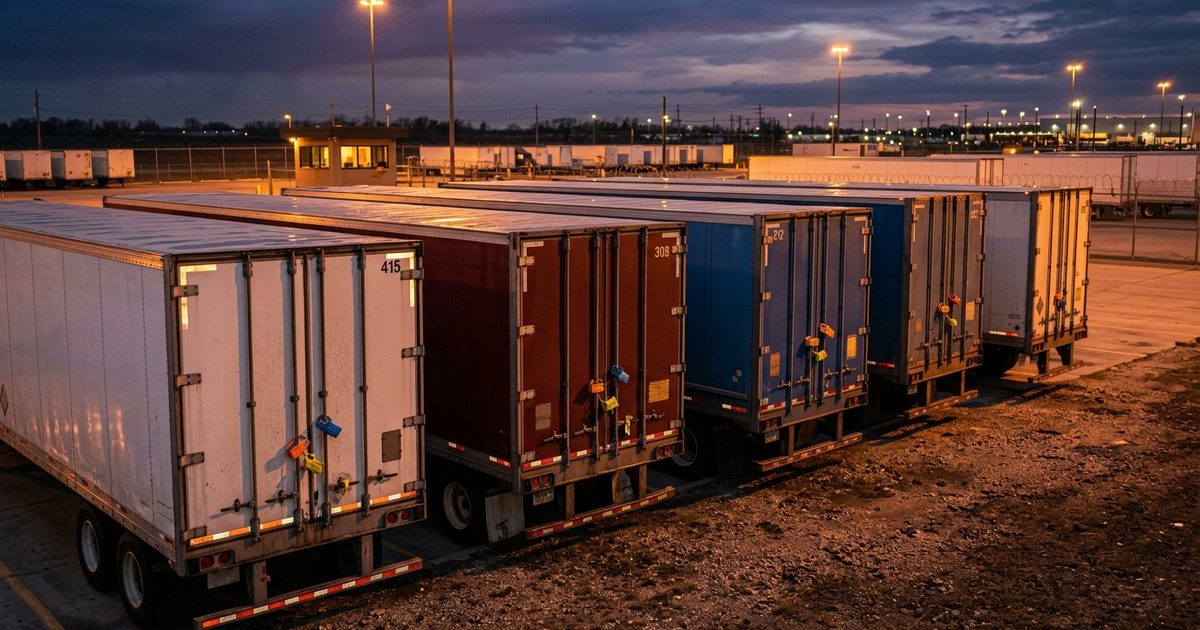
The core exposure at any cargo yard is that the asset — a loaded trailer — is designed to sit still and unattended. Unlike a warehouse or a retail store, nobody is inside a parked trailer watching it, and depending on the yard, nobody may be within sight of it for hours. That single fact drives most of the loss categories operators deal with.
Cargo theft from loaded trailers is the headline problem and one of the top-growth crime categories in freight. A cut seal, a hooked trailer, and a driver a few minutes away is often all it takes — the freight itself, not just the trailer, is the target, and a single load can be worth well into six figures.
Fictitious and strategic pickups are the more sophisticated version of the same theft. Instead of breaking in, the thief poses as a legitimate carrier — often with fraudulent paperwork, a spoofed company name, or a hijacked load number — and simply drives the trailer out the front gate like any other pickup. Because gates see heavy, constant legitimate traffic, a fake pickup is nearly invisible to a person checking paperwork under time pressure. It looks exactly like the job working correctly, right up until the freight never arrives.
Full trailer theft and diesel fuel theft round out the picture. An unattended tractor-trailer parked overnight is a target for thieves who want the whole unit, not just the load, and fuel siphoning from parked tractors is a persistent, low-effort loss that adds up across a large yard.
Yard trespass and staged theft during driver rest windows tie it together. Federal hours-of-service rules mean drivers legally have to stop and rest, often in the yard itself, and that creates a predictable window — the driver is in the cab, asleep, a few rows from a trailer that a trespasser has been casing all night. Sprawling, poorly lit yards give that trespasser plenty of cover to work.
The through-line across all four is the same: high-dwell-time, high-value assets sitting in a yard with no fixed security infrastructure, watched — if at all — by cameras that were never built for acres of parked freight or a gate that never stops moving.
Why Fixed CCTV and a Busy Gate Can't Solve This
Truck yards that already have cameras still take heavy losses, for the same structural reasons self-storage facilities and other sprawling, low-staffed sites do — plus one that's unique to freight: gate volume.
| Capability | Fixed CCTV + Manual Gate Check | Solar Mobile Surveillance + LPR |
|---|---|---|
| Coverage | Clustered near the office/scale house; thin across trailer rows and the back of the lot | Elevated wide-area coverage across the whole yard from one position |
| Gate verification | Manual paperwork check under time pressure — fictitious pickups pass easily | Automatic plate capture and log independent of paperwork, cross-checked against dispatch |
| Unlit rows | Requires trenching and conduit to extend power and cameras — rarely done across a whole yard | Solar and cellular — deploys anywhere trailers sit, no wiring |
| Response | Passive recording reviewed after a load is reported missing | Live SOC verification and audio warning in real time |
| Expansion | Fixed; a new drop lot or yard means a new install project | Relocatable to whichever yard is being targeted this month |
The gate row matters most. A camera pointed at the gate that only records plates for later review does nothing to stop a fictitious pickup in the moment — it just gives you a clip to watch after the load is already gone. What changes the outcome is a system that captures and logs the plate automatically, independent of the paperwork a driver hands over, so a mismatch or an unscheduled pickup can be flagged before the trailer clears the gate.
Tip: Treat the gate as your highest-value single camera position, full stop. Every tractor and trailer in the yard has to pass through it, which makes it the one place where a plate-and-time record turns hundreds of daily transactions — most of them completely legitimate — into a searchable, evidence-grade log. If you can only fund one upgrade this quarter, LPR at the gate is it.
What a Coverage Plan Looks Like for a Cargo Yard
An effective plan treats the gate as the anchor and weights the rest of the coverage toward where loaded trailers sit longest. For a typical trailer drop lot or distribution yard, that includes:
- The gate, with LPR: The single chokepoint every tractor and trailer passes through. License plate recognition logs every entry and exit against a plate and a timestamp, exposes fictitious pickups and paperwork mismatches, and flags hotlisted vehicles automatically.
- Loaded trailer rows and drop zones: Elevated coverage looking down the rows, with object detection classifying people versus vehicles and flagging movement between trailers when the yard should be quiet.
- Overnight and driver-rest parking: The specific window thieves target. Dedicated coverage with loitering detection flags anyone lingering between rows rather than moving with purpose toward a specific unit.
- Perimeter and fuel islands: The back fence line and fueling areas where trespassers bypass the gate entirely and where diesel theft concentrates.
The piece that turns this from a camera plan into an actual deterrent is visible, on-lot presence backed by live response. A Mobile Surveillance Unit parked in a trailer row changes how the yard reads to anyone scoping it for a theft — and because it's solar-autonomous, it covers the unlit back rows a fixed system never reached, without a single trench dug.
Live Monitoring: Watching the Gate and the Yard at Once
Paperwork checks alone can be fooled by a convincing fake. A camera with nobody watching it can't stop anything in real time. Live remote monitoring covers both jobs at once, continuously, across the whole property.
Remote video monitoring routes every alert — an unscheduled pickup at the gate, movement between trailers at 3am, someone lingering near a fuel island — to a SOC operator who verifies it immediately. A verified threat gets a live audio warning through the unit's speaker, which alone clears most trespassers off the lot, followed by escalation to law enforcement with time-stamped footage and the LPR record of exactly what drove in and out. A driver resting legally in the cab never has to wake up to confront anyone; the response happens without them.
That verified-response model produces something a paperwork check and a passive camera never do: a complete, time-stamped record for every incident — the alert, the verification, the plate, the escalation. When a carrier has to document a loss for a claim, defend against a shipper's dispute, or hand law enforcement an evidence package for a fictitious-pickup investigation, that record already exists. For 3PLs and carriers running multiple yards, one SOC covers every site to the same standard, whether it's a company-owned distribution yard or a satellite drop lot with almost no other infrastructure.
Deployment That Follows the Freight, Not the Wiring
Freight networks shift — a new drop lot opens, a seasonal surge needs overflow parking, a specific yard suddenly starts taking losses. Fixed camera installs can't follow any of that; they're bolted to wherever the conduit already runs.
A relocatable, solar-autonomous unit does. It covers a new drop lot the week it opens, shifts to the yard that just got hit without a multi-week install project, and drops into a leased or satellite location with zero existing infrastructure. For operators running mixed logistics and critical infrastructure sites, the same model scales across the whole footprint — coverage goes where the risk is this month, not where it was first installed years ago.
Common Mistakes in Cargo Yard Security
- Trusting paperwork alone at the gate. Fictitious pickups exist specifically because paperwork can be faked. A plate-and-time record independent of the documents a driver hands over is what actually catches the mismatch.
- Clustering cameras near the scale house or office. The losses happen in the trailer rows and the back of the lot — exactly where fixed coverage thins out fastest.
- Recording without responding. A camera that only produces footage for after a load is reported missing prevents nothing. Detection has to trigger live verification and a real-time audio warning to change the outcome.
- Leaving overnight and rest-window parking thinly covered. This is the specific window thieves plan around, precisely because a driver's presence a few rows away creates a false sense of security.
- Treating one yard's coverage as fixed forever. Freight networks shift constantly, and losses concentrate wherever coverage is currently weakest. A relocatable strategy keeps the unit where the exposure actually is, not where it happened to be installed first.
Truck yards and trailer drop lots are one of several sprawling, high-dwell-time environments where the same solar-autonomous, gate-anchored, live-monitored model closes the loss window. It sits alongside self-storage facilities as a flagship example of assets sitting exposed across acres of ground with no one watching — and the same combination of gate LPR, wide-area coverage, and a live SOC operator closes the gap in both.