
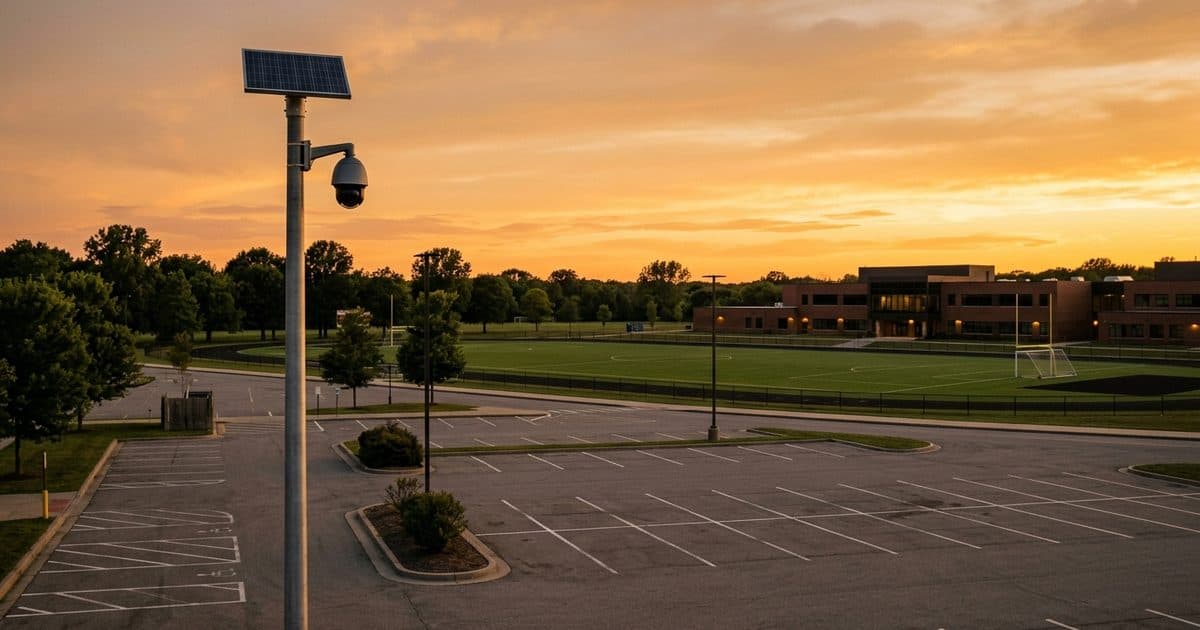
Why campus parking is a safety issue as well as a property issue
At a business, parking security is mostly about vehicles and property. On a campus, it is also about people. Students walk to cars after late classes and library hours. Staff leave after evening events. Commuters park far from their buildings and walk through areas that are quiet after dark.
That changes the priorities. Theft and break-ins matter, but so do the feeling of safety, the ability to call for help and the speed of response. Campuses also carry public expectations. Parents, students and employees notice how well lit and well watched a campus feels, and that perception affects enrollment and morale.
Our broader guide to school campus security cameras covers the campus as a whole. This article focuses on parking.
Different lots, different needs
A useful plan starts by sorting lots by who uses them and when.
| Lot type | Typical users | Main concerns |
|---|---|---|
| Commuter lots | Students and staff arriving by day | Vehicle theft, break-ins, long walks |
| Residence lots | Students parked overnight | Break-ins, loitering, late-night safety |
| Staff and faculty lots | Employees on regular schedules | Targeted theft, evening exits |
| Visitor and garage areas | Short-term users, unfamiliar with layout | Wayfinding, theft, safety |
| Overflow and remote lots | Event attendees, seasonal use | Little lighting, little oversight |
Most campuses already know which lots generate complaints, and the public safety office usually holds the best data. Ask for call volume by location and time, and compare it with the lots where cameras already exist. The gaps between the two lists are usually where to start.
Most campuses already know which lots generate complaints. Start with campus security logs, incident reports and student feedback to find the places that need attention first.
Lighting, sightlines and walking routes
Cameras are only part of the picture. The routes between lots and buildings matter as much as the lots themselves. Look for stretches where a person walks alone between lights, around a blind corner or through a gap in landscaping.
Trim vegetation that blocks views, replace lights that have failed and consider moving a camera to cover the route rather than the pavement. Our parking lot security guide covers lighting and layout in more detail.
Many campuses add emergency call points along these routes. A call point works best when it is easy to see, well lit and near a camera so the responder can view the scene. Pairing the two shortens the time between a request for help and the right response.
Emergency response and what monitoring adds
When a student presses a call button or a camera flags something unusual, the question is who sees it and what happens next. Campus police and security teams are often small, and they cover a large area with limited staff.
Monitoring helps fill that gap. Analytics can flag a person or vehicle in a restricted lot at night, and an operator can verify what is happening before anyone is dispatched. If the event is real, the operator can speak through a loudspeaker, which often resolves a minor situation without further escalation. For serious events, video can go to police dispatch with the incident. Our article on live talk-down audio deterrence explains how this works.
This fits the idea that cameras do the watching so people, yours or your security partner's, handle verified incidents. Campus public safety officers stay focused on responses that need a person, not on staring at screens.
A 2019 systematic review of 76 studies found CCTV associated with roughly a 13% reduction in crime in target areas and about 37% in parking lots. Actively monitored systems showed about a 15% reduction, while passive recording-only systems showed no significant effect.
Event days change the picture
A football Saturday, a graduation weekend, a concert or move-in day can fill lots that are normally empty. Overflow areas, grass fields and temporary lots may have no lighting, no cameras and no staff.
Plan event days in advance:
- Identify which lots will be used and which have no coverage.
- Place temporary cameras at overflow areas and at the main routes to the event.
- Decide who monitors the video and who responds.
- Coordinate with traffic control, public safety and event staff.
- Plan for the hours after the event, when lots empty and vehicles are left behind.
Our guide to the mobile surveillance trailer for events describes how temporary coverage works. Event traffic also raises the question of visitor privacy, so a short written notice and policy are good practice.
Privacy, access and policy
Campus video raises privacy questions. Decide in writing who can view live and recorded video, how long footage is kept and how requests from outside the campus are handled. Student privacy rules and state law can apply, and public institutions may have records obligations that private ones do not. Confirm your policy with counsel before it is finalized.
Keep cameras pointed at parking areas, roads and walkways rather than into windows or residence interiors. Review the views after installation, and use privacy masking where a camera would otherwise see into a private space. Tell students, staff and visitors what the cameras are for through signs, the student handbook and the campus website, so the program is understood before the first question arrives.
Funding and budget
Campus security budgets are often tight, and grants sometimes help. Our overview of security camera grants for public safety explains how to look for funding and what applications usually ask for. Rental and subscription options can also help a campus cover a need without a large capital purchase.
How VDS fits campus parking
The VDS mobile surveillance unit is a solar-powered trailer with a 5MP PTZ camera with 25x optical zoom and three 8MP wide-angle cameras on a 22 ft telescopic mast. A 900W bifacial solar array charges an 11.8 kWh LiFePO4 battery bank, and dual-SIM 4G/5G cellular carries the video, so there is no need for site power, internet or trenching. That suits remote lots, overflow fields and construction zones on a campus.
AI detection covers people, vehicles, loitering, objects and license plates. Our 24/7 US-based security operations center verifies events, uses live talk-down through a loudspeaker, then dispatches police with video. Most deployments go from signed quote to live monitoring in about a week. Learn more about our work with education sites, see the mobile surveillance unit, or talk to our team.
Sources
- Piza, E. L., Welsh, B. C., Farrington, D. P., & Thomas, A. L. (2019). CCTV surveillance for crime prevention: A 40-year systematic review with meta-analysis. Criminology & Public Policy, 18(1). onlinelibrary.wiley.com