
Why solar construction is different from other builds
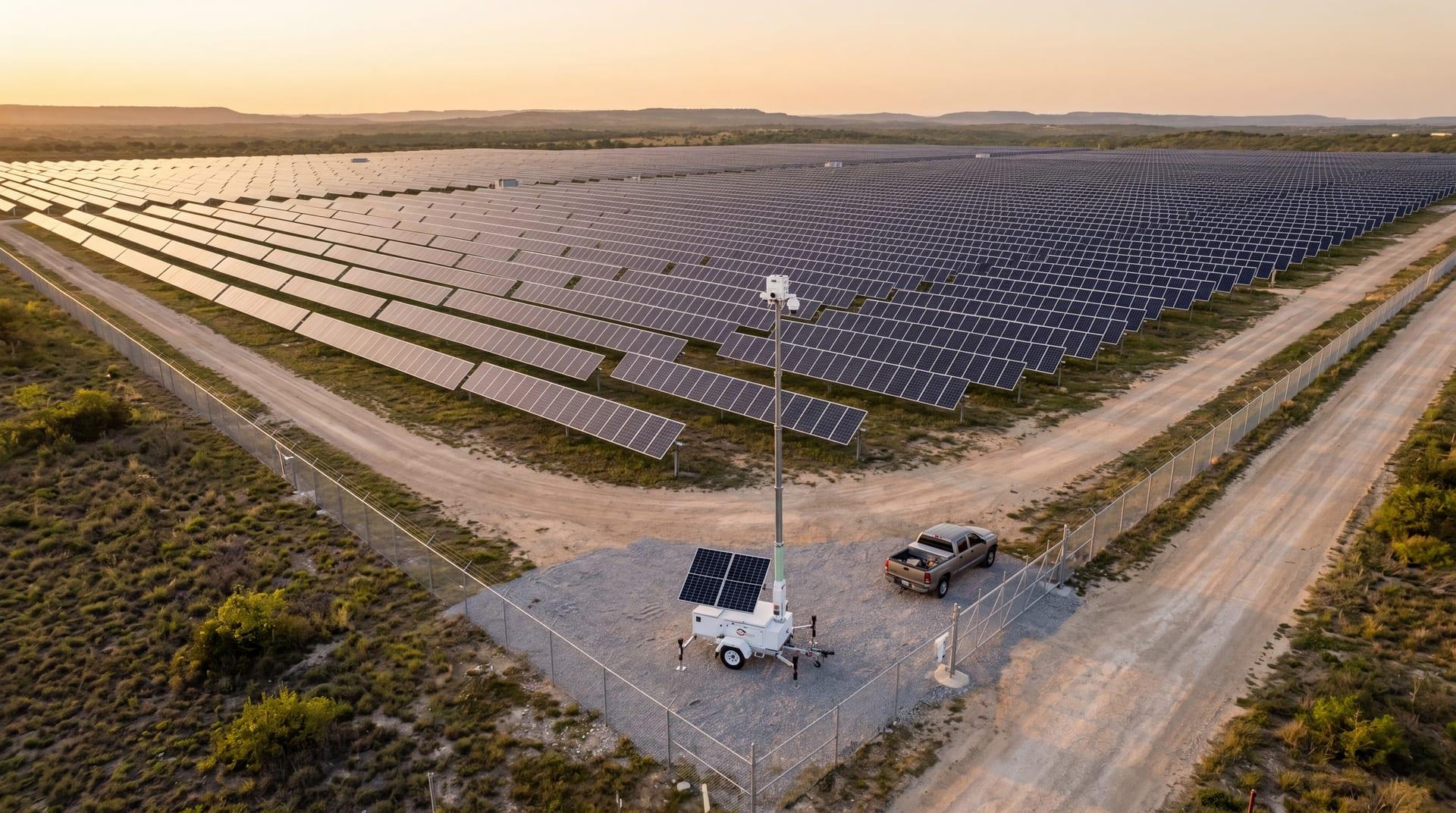
A utility-scale solar project spreads across hundreds of acres or more, with long fence lines, several access points and very little built structure to anchor security to. Value is not locked inside a building. It sits in rows of modules on pallets, spools of cable, inverters and combiner boxes waiting for their turn.
The site also changes every week. Early on, the exposure is the laydown area. Mid-build, material is distributed along the arrays, so the exposure moves with the crews. Near completion, energized equipment appears alongside finished assets that still belong to the contractor. A security plan written once at mobilization goes stale quickly.
For a broader view of finished and operating sites, see our guide to solar farm security cameras.
Where the risk concentrates
Most losses on solar builds come from a short list of places:
- The main laydown area, where deliveries arrive and are counted.
- Satellite staging areas closer to the work, often with lighter fencing.
- Cable and conductor storage, because copper and aluminum have scrap value.
- Electrical equipment pads, where inverters, combiner boxes and transformers are set before they are fully tied in.
- Fuel and equipment parking, which serves every trade on site.
- Access roads and gates, where an unauthorized vehicle can arrive and leave unseen.
Rather than trying to cover every acre, identify which of these hold the most value at each phase and put detection there.
Module and cable staging
Modules are bulky, fragile and valuable, which creates a particular pattern. A thief needs a vehicle and time, so the exposure is highest where pallets sit near a gate or a road, at night, with no one around. Cable is the opposite. It is quick to cut and load, and it can be stripped and sold without much context.
Good staging practice reduces risk before any camera is added. Keep staged material close together rather than scattered, keep it away from perimeter fencing where possible, and match what is delivered against what is installed on a regular count. Cameras then watch a small, defined area instead of a sprawling one. For the copper side of the problem, see our overview of copper theft in 2026.
Remote sites and the connectivity problem
Many solar sites have no grid power at the time of mobilization and weak or no wired internet. Cameras that depend on either one cannot be placed where the risk is, so they end up near the construction office, not near the material.
Solar-powered, cellular-connected trailers solve that. They go where the material is and need no trenching or site utilities, which matters when the layout will change in a month. Our notes on construction site cameras with no WiFi explain how this works in practice.
Subcontractor access and accountability
A solar project may have civil, pile driving, racking, module, electrical and commissioning crews, each with its own supervisors and vehicles. That turnover is a security issue because it is hard to say who belongs on site at any moment.
Useful controls are simple:
- One controlled entrance for deliveries and crews, with a sign-in process.
- A written access list kept current by the EPC, with crew start and end dates.
- Vehicle identification, such as decals or a gate list, so unfamiliar vehicles stand out.
- A clear rule that nobody enters staging areas outside working hours without notifying the site manager.
- Camera coverage at the gate that records who comes and goes.
Cameras also help settle disputes about damaged or missing material, since time-stamped video shows who was where. Brief every new crew lead on the rules at their first toolbox talk, and remove departing crews from the list the day they demobilize, so the list stays trustworthy.
Schedule risk and what theft really costs
On a solar build, the direct cost of stolen material is only part of the loss. Replacement modules or cable may have long lead times, so a theft can idle crews or force resequencing. Insurance deductibles, police reports and investigation time add more. For a project with a fixed energization date, that delay often matters more than the replacement price.
Because delay is the bigger risk, the goal is detection early enough to stop the loss, not documentation afterward. That means monitored detection with a response, not recording alone. A 2019 systematic review of 76 studies found that actively monitored camera systems were associated with roughly a 15% reduction in crime, while passive recording-only systems showed no significant effect. Programs that combined cameras with other interventions, such as lighting and access control, did better still, at about 34%.
A coverage plan by phase
| Phase | Main exposure | Coverage priority |
|---|---|---|
| Mobilization | Gate, office trailers, fuel | Entrance camera, one unit at the compound |
| Material delivery | Module pallets, cable spools | Unit at laydown area, lighting |
| Installation | Distributed material along arrays | Mobile units repositioned with the crews |
| Electrical tie-in | Inverters, combiner boxes, copper | Units near equipment pads |
| Commissioning | Energized and finished assets | Gate and perimeter detection, remote monitoring |
Review this at each phase change, and move units rather than adding more of them whenever possible. Our construction site security plan guide and utility laydown yard security article give a template for the staging side.
How VDS fits
VDS builds solar-powered mobile surveillance units for exactly this kind of site. Each unit carries a 5MP PTZ camera with 25x optical zoom plus three 8MP wide-angle cameras on a 22 ft telescopic mast (30 ft is available). A 900W bifacial solar array charges an 11.8 kWh LiFePO4 battery bank with reserve for 3-5 consecutive cloudy days, and dual-SIM 4G/5G cellular carries the video, so no site power, internet or trenching is needed.
AI detection flags people, vehicles and loitering, and a 24/7 US-based security operations center verifies events and responds with live talk-down through a loudspeaker, then police dispatch with video if needed. That lets the people on your project, or your security partner, handle verified incidents instead of chasing false alarms. Most deployments go from signed quote to live monitoring in about a week, and setup takes one person under 20 minutes. Learn more about mobile surveillance units or talk to our team about your site.
Sources
- Piza, E. L., Welsh, B. C., Farrington, D. P., & Thomas, A. L. (2019). CCTV surveillance for crime prevention: A 40-year systematic review with meta-analysis. Criminology & Public Policy, 18(1). onlinelibrary.wiley.com