
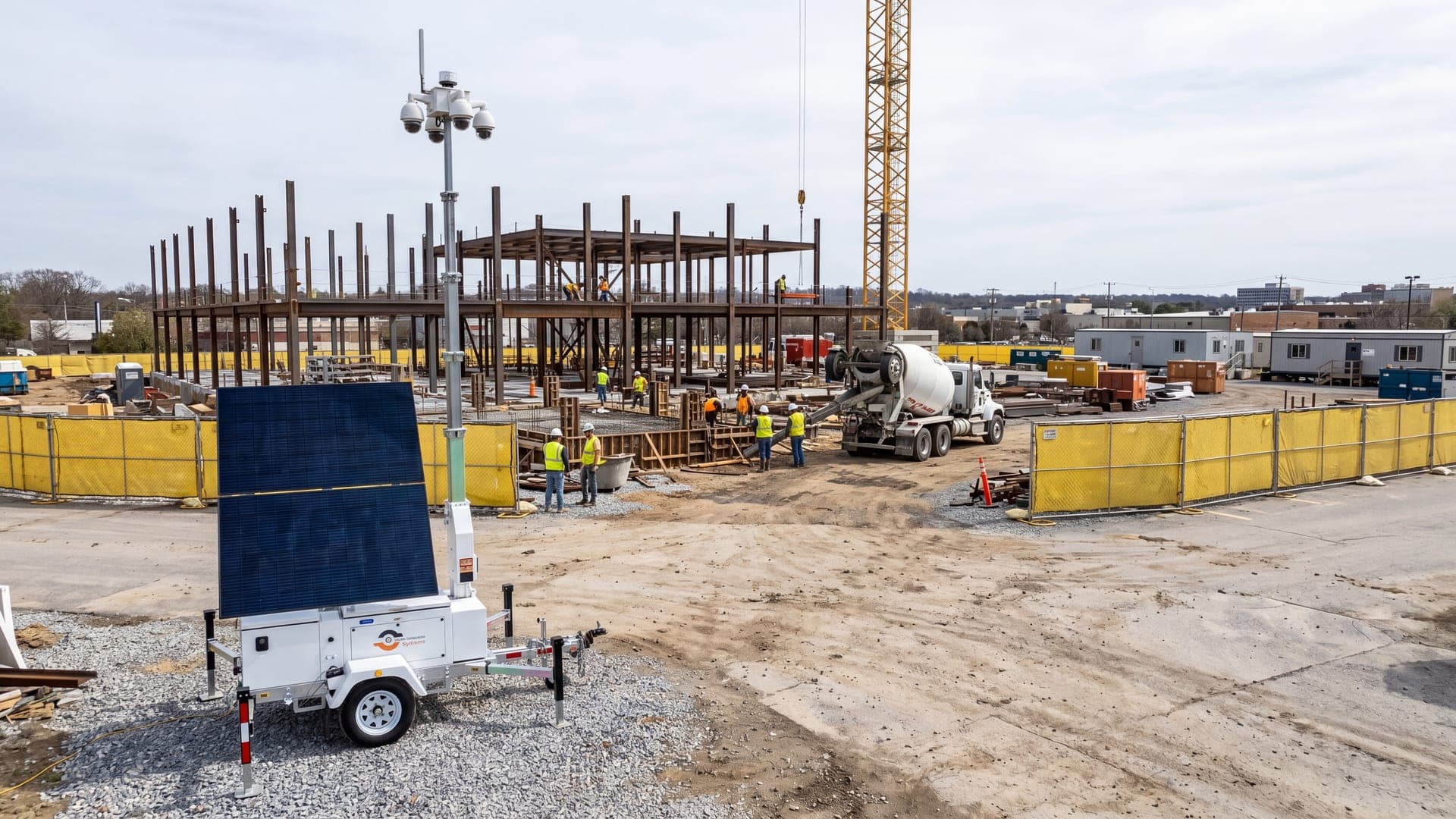
This isn't a new category, but the hardware and monitoring behind it has changed fast. Buyers researching options today are comparing solar runtime, analytics accuracy, and whether anyone is actually watching the feed—not just camera count. This guide covers what a modern mobile surveillance unit includes, where it earns its cost back, and the questions that separate a unit that holds up from one that goes dark in week three.
What a Mobile Surveillance Unit Actually Includes
A mobile surveillance unit is a self-contained camera system mounted on a trailer or skid, built to deploy without trenching power lines or running network cable. Most units combine a telescoping mast, multiple cameras (often a mix of fixed and PTZ), solar panels or a generator for power, and cellular connectivity for streaming footage off-site.
The difference between a basic unit and one worth paying for is what happens after the hardware is in place. A standalone trailer with no monitoring behind it just records—it doesn't alert anyone, verify a threat, or escalate a response. Our mobile surveillance unit pairs the hardware with analytics and human verification so an alert actually means something happened, not just that a cat walked past a motion sensor.
How Mobile Surveillance Units Work in the Field
Deployment typically runs on three layers: power, connectivity, and detection. Solar arrays charge battery banks sized for multi-day cloud cover, so the unit doesn't go dark during a stretch of bad weather. Cellular modems push video to a cloud platform in near real time, which means footage lives off-site even if the trailer itself is damaged or stolen.
On the detection side, most units run edge AI that flags motion in defined zones—a perimeter line, an equipment yard, a gate—rather than recording everything indiscriminately. Running analytics on the camera itself draws less power than sending video to a separate processing box, which stretches how long a unit runs on battery alone. That power efficiency is the difference between a unit that survives a week of overcast skies and one that needs a service call.
PTZ cameras add another layer by actively scanning rather than sitting on a fixed view. The Department of Homeland Security's 2025 video security systems handbook notes that PTZ cameras are commonly programmed to cycle to a new preset view roughly every 10 seconds, giving a single camera coverage across an entire yard or lot instead of one static angle.
Where Mobile Surveillance Units Make the Most Sense
Construction sites are the most common use case, and for good reason—materials, equipment, and copper are stolen most often during the window between site clearing and permanent fencing. Over the July 4th week of 2026 alone, the National Equipment Register logged 245 heavy equipment thefts worth more than $5.5 million. A unit deployed at the start of a project covers exactly that gap. For a full walkthrough of zone planning and placement, see our guide on covering a construction site with mobile surveillance trailers.
Parking lots and garages use mobile units for seasonal demand spikes, overflow lots without existing infrastructure, or temporary coverage while a permanent system is installed. Retail centers often run them during holiday shopping periods when foot traffic and vehicle break-ins both climb. Our breakdown of parking lot surveillance and 24/7 monitoring covers how zone rules cut down false alerts in high-traffic lots.
Events, disaster recovery sites, and cargo yards round out the list of common deployments. Each shares the same core requirement: coverage that can show up fast, run without grid power, and relocate when the risk moves. Law enforcement agencies increasingly rent units for the same reason—temporary hot spots don't justify permanent camera installs, but they absolutely justify a week or two of verified coverage.
Mobile Trailers, Towers, Fixed Cameras, and Guards: How They Compare
Not every job calls for the same solution, and picking the wrong one either overspends or leaves a gap. The table below breaks down where each option fits.
| Option | Best For | Deployment Time | Ongoing Cost |
|---|---|---|---|
| Mobile surveillance trailer | Temporary or shifting risk, open sites | Hours to 1 day | Low–moderate, scales with rental term |
| Mobile surveillance tower | Elevated, long sightline coverage on one spot | 1–2 days | Moderate |
| Fixed installed cameras | Permanent sites with infrastructure | Weeks (permitting, wiring) | Higher upfront, lower per-month |
| On-site security guards | Line-of-sight patrol, visitor control | Immediate | Highest ongoing, labor-driven |
On-site guards handle what cameras cannot, such as visitor control and physical response, but one person can only watch one line of sight at a time. Monitored units extend that reach so people respond to verified incidents. Fixed cameras win on permanent sites but can't move with the project. For a direct comparison of the two mobile formats, read mobile security tower vs. trailer, and for the fixed-vs-mobile question specifically, see remote surveillance trailer vs. fixed cameras.
What to Check Before You Rent or Buy
Most of the disappointment with mobile surveillance units traces back to a handful of avoidable mistakes made before deployment, not after.
- Skipping the uptime question: Ask how the provider measures and guarantees connectivity, not just whether the unit "has cellular." Our surveillance trailer uptime guide covers what a real SLA should include.
- Assuming solar covers every climate: Battery sizing matters more in regions with extended cloud cover or short winter daylight—confirm runtime for worst-case weather, not average conditions.
- No monitoring behind the cameras: A unit that only records gives you footage after the fact. Verified alerts and escalation rules are what actually shorten response time.
- Ignoring wind and weather ratings: Units deployed in open lots or coastal areas need a real structural rating. Ask for the rated wind speed with the mast fully raised and the IP rating (IP66 or higher for dust and driving rain), then match both to the site's worst weather, not its average.
- Overlooking retention and export workflow: If footage gets overwritten before anyone pulls the clip, it doesn't matter how good the camera was.
- Treating placement as an afterthought: Zone rules and camera angles determine whether you get a usable alert or a flood of false ones from traffic passing a public road.
Rental rates also vary more than most buyers expect based on term length, number of cameras, and monitoring tier. Before signing anything, compare current mobile surveillance trailer rental cost benchmarks so you know what a fair quote looks like, and check our mobile surveillance trailer rental guide for contract terms to ask about up front.
Solar, Connectivity, and Keeping Units Running Unattended
Unattended sites raise the stakes on every component, because there's no one to reboot a modem or swap a battery when something fails. Solar-powered units need panels sized to the local climate and battery banks rated for several consecutive days without sun, not just average daily charge.
Connectivity redundancy matters just as much. Units relying on a single cellular carrier go dark in dead zones or during outages, which is why multi-carrier modems have become standard on better-built units. For a deeper look at sizing solar systems correctly for different regions and seasons, see our solar surveillance trailer guide.
A mobile surveillance unit is only as good as its weakest link—if the power fails or the signal drops, the cameras don't matter.
General guidance on evaluating remote, unattended deployments—covering everything from mast height to cellular backup—is in our remote surveillance trailer guide.