
Why work zones are a different problem
A building site has a fence, a gate and a footprint that stays put. A linear project does not. A highway resurfacing job, a utility trench along a road or a bridge approach can stretch far from any building, and the open sides give almost anyone a way in. Equipment is parked wherever the crew stopped at the end of a shift. Materials are staged near the work, then moved. The traffic that the project is meant to manage also passes right beside the equipment, which gives thieves an easy approach and an easy exit.
Because of this, the fixed-camera model used on a building site rarely fits. Our general guides on construction site theft prevention and the construction industry page explain the basics, and the points below add what is specific to roadwork.
What is at risk
The targets on a road project tend to follow the same pattern.
- Fuel and fluids, stored in tanks or portable containers near the work.
- Tools and small equipment, which are easy to carry and sell.
- Copper, cable and other metals, especially where the project touches lighting, signals or utilities.
- Signs, barriers and traffic-control devices, which are costly and left out by design.
- Heavy equipment and trailers, left parked along the work area.
- Materials, including aggregate, pipe and fittings in staging areas.
Vandalism and trespass are also common, as are after-hours visits by people who are not thieves but still create liability. Describe the risks that apply to your project in writing before choosing equipment.
Protect the staging yard first
The staging yard or laydown area is often the highest-value, lowest-effort target. It concentrates equipment, fuel and materials in one place and is empty for long stretches. Start here. A single well-placed trailer with a tall mast can cover much of a yard, and a monitored system can speak to anyone who enters after hours. For yards with many assets, see our notes on equipment yard security.
Along the work itself, think in terms of clusters. Rather than trying to watch every mile, place coverage where equipment is parked overnight, near material stockpiles, and at points where thieves would access the site from the road or a side street.
Plan for no power and a moving site
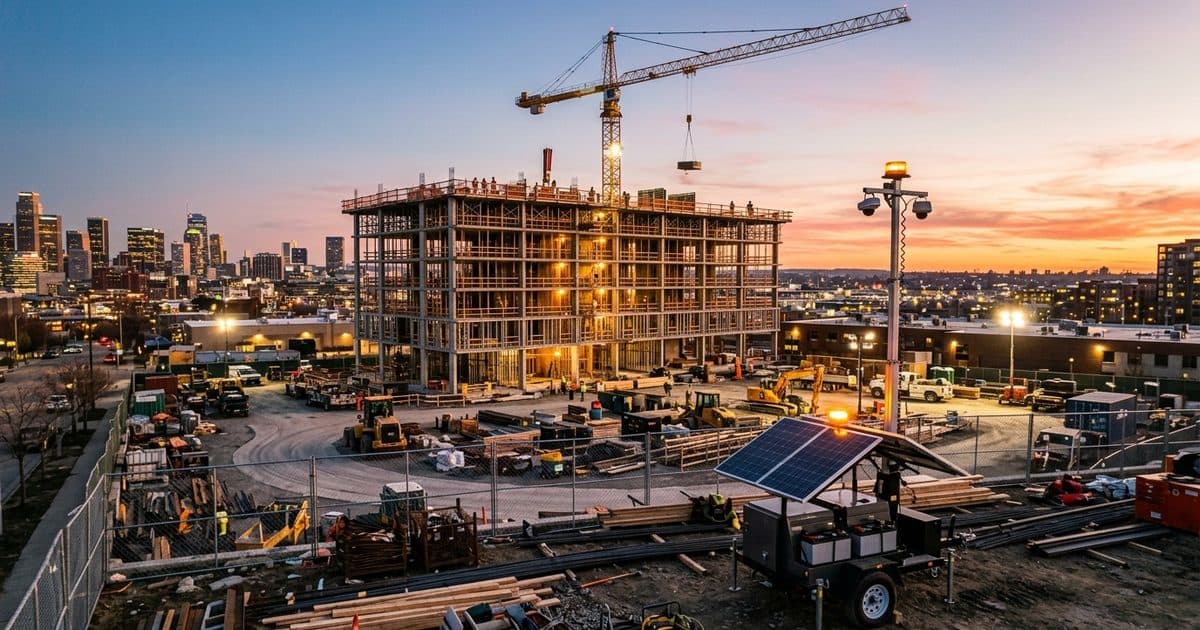
Most work zones have no electrical service, and running cable or trenching for a short-term job rarely makes sense. Solar-powered trailers carry their own power and use cellular for connection, so they can be placed where the work is. Our article on cameras for construction sites with no Wi-Fi covers this in detail.
Because the work advances, plan how often units will move. Ask:
- How quickly can a unit be lowered, towed and set up again?
- Who does the move, and how much notice is needed?
- Does the provider re-check aiming, detection zones and cellular signal at each new position?
- Can the unit sit a safe distance from traffic and still see the equipment?
Position trailers off the travel lanes, behind barriers where needed, and clear of the area where machines swing or back up. The guide on covering a construction site with mobile surveillance trailers goes through layout choices.
Night work and shift changes
Many road projects work at night to limit traffic impact, which complicates security. Lights and machines are running, crews are moving, and the line between authorized and unauthorized presence is blurred. Define who should be on site and when, and share the schedule with whoever monitors the cameras. A monitoring team that knows a crew is expected can avoid false alarms and focus on activity that does not fit.
The harder window is often the hours right after the crew leaves, when equipment is parked and nobody is around. Active hours for detection and live response should line up with those periods.
Monitoring turns cameras into response
Recording footage helps with a claim after a loss. Monitoring can stop the loss. In a 2019 systematic review of 76 studies, actively monitored camera systems were associated with about a 15% reduction in crime, while passive recording-only systems showed no significant effect. On a remote work zone, that means an operator who sees someone approaching parked equipment, speaks to them through a loudspeaker, and calls police with video if they do not leave. Cameras do the watching, so people, yours or your security partner's, handle verified incidents. Read more about remote video monitoring.
Cameras are not a substitute for traffic control, barriers or safety plans. They address theft, vandalism and trespass, and they sit alongside the measures that protect workers and drivers.
Quick reference
| Challenge | Practical response |
|---|---|
| Site stretches for miles | Cover staging yards and overnight equipment clusters first |
| Active area moves | Use towable, self-powered trailers and plan relocation |
| No power or internet | Solar and battery with cellular connection |
| Fuel, tools and metals | Place cameras with a clear view of storage and parked equipment |
| Night work | Share schedules with monitors so crews are not flagged |
| Open sides and public traffic | Detection zones that ignore the road and focus on the equipment |
| Evidence and claims | Keep clips and event records ready for police and insurers |
How VDS fits
The VDS mobile surveillance unit is a solar-powered trailer that needs no site power, internet or trenching. It carries a 5MP PTZ with 25x optical zoom and three 8MP wide-angle cameras on a 22 ft telescopic mast (30 ft available), a 900W bifacial solar array charging an 11.8 kWh LiFePO4 battery bank with reserve for 3-5 consecutive cloudy days, and dual-SIM 4G/5G cellular. AI detection covers people, vehicles, loitering, objects and license plates. A 24/7 US-based security operations center verifies events and responds with live talk-down through a loudspeaker, then police dispatch with video. On-site setup takes one person under 20 minutes, and most deployments go from signed quote to live monitoring in about a week. Talk to our team or call (410) 401-1986.
Sources
- Piza, E. L., Welsh, B. C., Farrington, D. P., & Thomas, A. L. (2019). CCTV surveillance for crime prevention: A 40-year systematic review with meta-analysis. Criminology & Public Policy, 18(1). onlinelibrary.wiley.com