
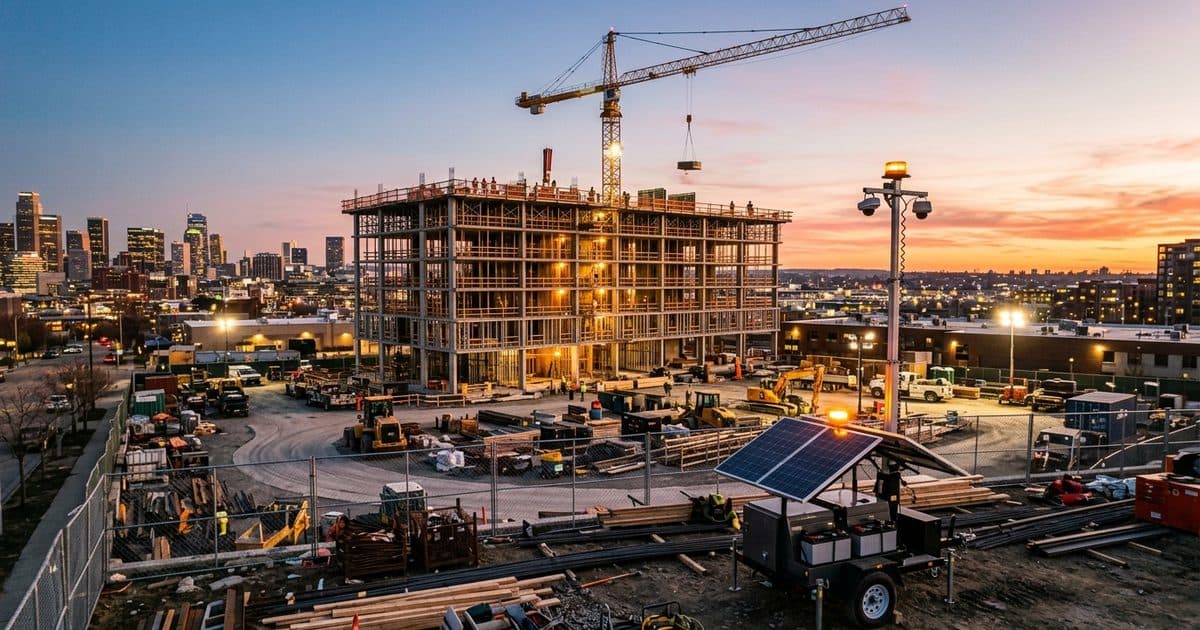
This guide covers the physical security basics every site needs, where those basics fall short, and how to build a layered plan that actually catches theft before it happens instead of just documenting it after the fact. For a quick-reference version, see 7 proven strategies to prevent construction site theft.
Why Construction Sites Are Easy Targets
Jobsites are open by necessity. Materials have to move in, equipment has to be staged, and crews need access at odd hours. That same openness is exactly what makes a site attractive to someone casing the area for a weekend score.
Heavy equipment is also easy to resell and hard to trace. Skid steers, generators, and portable welders rarely carry visible serial numbers, and buyers in secondary markets don't ask many questions. Copper wiring, HVAC units, and plumbing fixtures are just as attractive—they're valuable, portable, and usually unguarded until they're installed.
Timing matters as much as the target. Most jobsite theft happens overnight or over the weekend, when there's no foreman on-site, no crew noise, and hours before anyone notices something is missing. By the time Monday's walkthrough happens, the trail is already cold.
Physical Security Measures That Actually Work
Every effective theft prevention plan starts with the basics: a secured perimeter, controlled entry points, and enough light that nobody can move through the site unseen. None of these stop a determined thief on their own, but together they raise the cost and risk of attempting theft in the first place.
| Measure | What It Does | Where It Falls Short |
|---|---|---|
| Perimeter fencing | Blocks casual access and vehicle entry | Can be cut or climbed without detection |
| Access control / sign-in | Tracks who's on-site during work hours | Useless after hours or on unmanned entries |
| Lighting | Removes cover of darkness | Doesn't verify or report anything by itself |
| Equipment ID marking | Helps recover stolen gear after the fact | Doesn't prevent the theft from happening |
| GPS / telematics | Tracks equipment location in real time | Reactive—alerts you after the machine is already moving |
Tip: Mark high-value equipment with hidden serial tags in addition to visible ones. Visible tags deter casual theft; hidden ones help recover equipment that's already been stolen and resold.
Why Cameras Alone Don't Stop Theft
Most contractors already have some cameras on-site. The problem isn't camera count—it's what happens between the moment a camera records an intrusion and the moment someone actually does something about it.
A camera pointed at a staging yard at 2 a.m. with nobody watching the feed is a recording device, not a theft prevention tool. If the footage is dark, glared out by a security light, or angled wrong, it may not even hold up as usable evidence later. And if retention is short, footage of the incident can get overwritten before anyone realizes equipment is missing.
This is the gap construction-specific monitoring is built to close. Instead of recording and hoping, a monitored system verifies activity in real time, triggers an alert when someone crosses a defined zone after hours, and starts an escalation—which can include an audible warning, a call to site management, or a call to local law enforcement—before equipment leaves the property.
"The incidents that get prosecuted are the ones with a verified timestamp, a clear angle, and a documented chain of escalation—not just a grainy clip nobody reviewed until Monday."—VDS Operations Team
Building a Layered Theft Prevention Plan
No single tool solves construction site theft prevention on its own. The sites that stop losing equipment combine physical deterrents with active monitoring and a documented response process.
- Secure the perimeter: Fencing and controlled gates establish a clear boundary and slow down anyone attempting a quick grab-and-go.
- Light the yard, not just the entrance: Equipment staging areas and material laydown zones need coverage, not just the main gate.
- Deploy mobile surveillance where infrastructure isn't ready yet: Mobile surveillance trailers can be placed within days to cover open lots, staging yards, and material drops during the highest-risk phases of a project, long before permanent power or fencing is finished.
- Add license plate recognition at site entries: LPR cameras log every vehicle entering or exiting, which is critical when a stolen truck or trailer needs to be identified after the fact.
- Put eyes on the feed, not just a recorder: Live monitoring turns motion into a verified alert and a documented response instead of a clip nobody reviews until the damage is already done.
- Set retention and export workflows before you need them: Decide in advance how long footage is kept and how fast a clip can be pulled for police or insurance—not after an incident when it's too late.
Multi-site operators get an added benefit from this approach: standardized rules and reporting across every location mean a project manager running three jobsites can see the same incident data in the same format, instead of chasing down footage from three different systems.
Guards vs. Monitored Coverage: What Costs Less Long-Term
Hiring a night guard feels like the obvious answer, but a single guard can only watch one sightline at a time, gets fatigued over long shifts, and costs more per month than most contractors expect once overtime and turnover are factored in.
Monitored camera coverage extends across the entire site at once, doesn't take breaks, and produces a documented record of every alert and response. For most mid-size and larger jobsites, a mix of mobile trailers and remote monitoring covers more ground at a lower monthly cost than staffing round-the-clock security guards, while also generating the evidence a guard's eyewitness account alone can't provide.
According to the National Insurance Crime Bureau, equipment theft recovery rates remain low industry-wide, which makes prevention—not recovery—the more reliable strategy. The Associated General Contractors of America has flagged jobsite theft as a recurring cost pressure for contractors managing tight margins, particularly on projects with multiple phases and shifting risk zones.
Protect Your Jobsite With Mobile Surveillance Trailers Nationwide
If your site has already lost equipment, materials, or copper to theft—or you're opening a new phase with no infrastructure in place yet—a coverage plan needs to go in before the risk window, not after a loss report. Vision Detection Systems solves the three problems that let jobsite theft happen: unmonitored footage, no escalation workflow, and gaps in coverage during the highest-risk hours. We deploy mobile surveillance trailers fast, monitor the feed in real time, and document every incident in a format that holds up for insurance and law enforcement.
Request a coverage plan for your jobsite and get a quote built around your site's actual risk periods, not a generic package.