
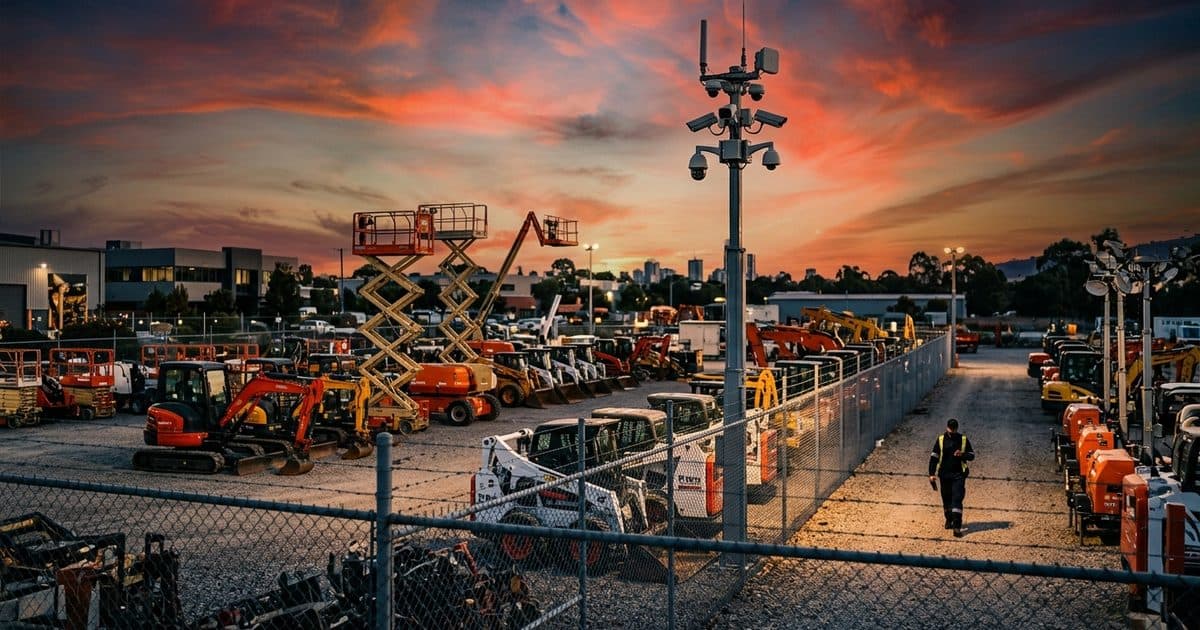
Rental yards and heavy-equipment dealers have a security problem that's baked into the business model. The inventory is valuable, it's mobile by design, and it sits outside overnight with minimal staffing because that's how the economics of the business work. A skid steer, a mini-excavator, a towable generator, or an aerial lift isn't bolted down — it's built to be loaded, hitched, and moved, which is exactly what makes it easy for someone else to load, hitch, and move it too. This post covers the specific threats rental yards and dealer lots face, why the cameras most yards already have don't stop them, what a coverage plan built for a yard full of movable iron actually looks like, and how solar-autonomous surveillance with gate LPR and live monitoring closes the gap.
The Threat Landscape at Equipment Rental Yards
The core exposure is simple: a yard full of high-value, easily transportable machines with nobody on site for ten or twelve hours a night. Skid steers, mini-excavators, generators, aerial lifts, and attachments are compact enough to load onto a trailer in minutes, and a crew that knows what it's doing can be in and out of a yard before a passive camera system even gets reviewed. Because the equipment has resale value on its own or strips down into parts, a single successful theft can run tens of thousands of dollars — and dealer lots carrying new and used inventory face losses in the hundreds of thousands from one incident.
Diesel and fuel theft is the quieter, more chronic version of the same problem. Bulk tanks and machine fuel cells get siphoned overnight, a little at a time or all at once, and because it doesn't look like a break-in — nothing's missing from the equipment count — it often goes undetected for weeks. GPS and telematics add a layer of protection on paper, but experienced equipment thieves know exactly which units carry trackers and disable or physically remove them before towing a machine off the lot, turning a tracked asset into an untraceable one the moment it clears the fence.
Add after-hours yard breaches — fence-cutting, gate-jumping, entry through an unsecured gap — and the softer-edged version of the same risk: fraudulent rentals and no-return units that walk out the front gate looking like a completely legitimate transaction, and don't come back. All of it concentrates in the same window: after the counter closes and before the first shift arrives, across ground too large and too full of movable assets for a skeleton crew or a single fixed camera cluster to watch.
Why Fixed CCTV Fails on a Working Rental Yard
Most rental yards and dealer lots already have some cameras, which is why operators are often blindsided when a machine goes missing anyway. The reason is structural: fixed CCTV gets installed where the wiring is easy — the office, the showroom, the front gate — and thins out or disappears entirely across the staging rows, the return lanes, and the back of the lot where the highest-value, least-watched equipment actually sits.
| Capability | Fixed CCTV | Solar Mobile Surveillance |
|---|---|---|
| Coverage | Clustered near office/showroom; thin across staging and return rows | Elevated wide-area coverage across the whole yard from one position |
| Overflow lots | Rarely covered — new wiring for every seasonal or satellite yard | Solar and cellular — deploys to any lot in under 20 minutes |
| Response | Passive recording reviewed after the morning equipment count | Live SOC verification and audio warning while it's happening |
| GPS-defeated units | No independent record once a tracker is disabled | Gate LPR logs every vehicle regardless of what's loaded on it |
| Deterrence | A camera no one is watching | Visible presence plus a live voice-down that clears people out |
The gap that matters most is response, not resolution. A camera that captures a trailer backing up to a mini-excavator at 3am and nothing else does not prevent the theft — it just documents that it happened. By the time anyone reviews the footage, the machine is gone, the trailer's plate was never logged, and the GPS unit was pulled before the yard exit. What changes the outcome is a system that flags the movement as it happens, gets a human to verify it in real time, and puts an audio warning on the lot before the machine clears the gate.
Tip: Site coverage to look across the staging and return rows, not just down the main drive toward the office. An elevated unit positioned to see along the ends of multiple equipment rows catches a vehicle approaching a machine from any angle — the actual theft pattern — instead of only what happens to cross one narrow sightline. And treat every gate, including a rarely used back or delivery gate, as a chokepoint that needs LPR; thieves and no-return rentals both gravitate toward the exit that isn't watched.
What a Coverage Plan Looks Like for a Rental Yard
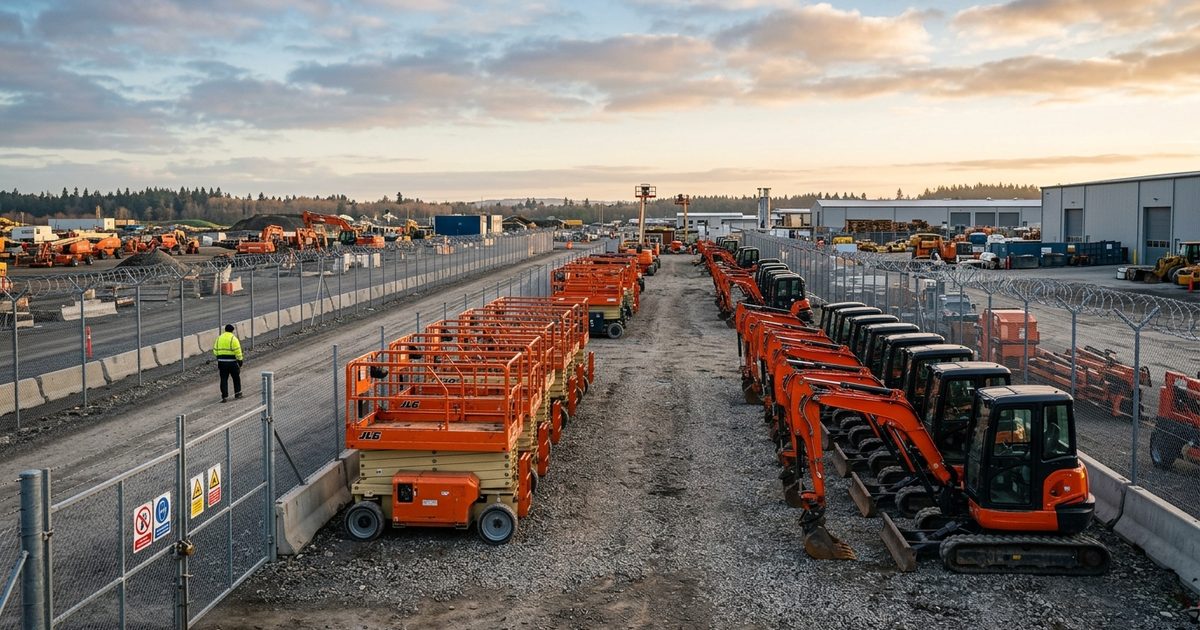
A coverage plan for a working yard has to match how the inventory actually sits and moves, not just protect the building. For a typical rental yard or dealer lot, that means:
- The gate, with LPR: The universal chokepoint for every customer pickup, return, and delivery. License plate recognition ties every entry and exit to a plate and a timestamp, exposes a trailer that came in empty and left loaded, and flags hotlisted vehicles automatically.
- Return and staging rows: The highest-turnover, closest-to-the-gate ground in the yard, and the fastest place for a stolen machine to be moved off the property. Elevated coverage with object detection classifies people versus vehicles and flags a vehicle approaching staged equipment after hours.
- Fuel storage and the fill line: Bulk diesel tanks and the machine fill area, where siphoning happens quietly and often goes unnoticed for weeks without dedicated overnight coverage.
- Perimeter fence line and overflow lots: The back fence and any seasonal or satellite yard where fixed cameras were never installed because the footprint changes from one season to the next — exactly where a relocatable unit earns its keep.
The piece that turns this from a recording system into an actual deterrent is visible, live-backed presence: a Mobile Surveillance Unit with lighting and a speaker changes how the yard reads to anyone scoping it out, and a companion lighting trailer on a large staging area adds visibility that a fixed pole light was never budgeted for. Because the unit runs on solar with cellular backhaul, it goes wherever the equipment sits this season — not wherever conduit happened to be run years ago.
Live Monitoring: Watching the Whole Yard at Once
A night watchman walking a dark yard full of heavy equipment is expensive, hard to staff consistently, and — frankly — not a safe job for one person covering acres of blind corners alone. A camera system with no one watching it live is cheaper but doesn't stop anything while it's happening. Live remote monitoring is the model that beats both.
Remote video monitoring routes every alert to a SOC operator who verifies it in real time. When a camera flags a vehicle approaching a staged excavator at 3am, the operator confirms it isn't a legitimate late pickup, then acts immediately: a live audio warning through the unit's speaker — which on its own clears the majority of would-be thieves off the lot — followed by escalation to law enforcement with time-stamped footage and the gate's LPR record of exactly what drove in and when. A crew that planned around an empty yard and a delayed morning discovery instead gets an immediate, human response before the machine ever reaches the fence.
That verified-response model beats a lone watchman on two counts. It covers the entire yard simultaneously instead of wherever one person happens to be standing, and it produces a complete documented record for every incident — the alert, the verification, the escalation, the plate — automatically. When a claims adjuster asks for proof of loss or law enforcement needs an evidence package, it already exists. For rental chains and dealer groups running multiple locations, the same SOC covers every yard to the same standard without adding a watchman at each one. It's worth noting that heavy-equipment theft doesn't stay inside rental yards — construction sites carrying the same class of machinery face an identical after-hours exposure, and rental fleets deployed to job sites often need the same coverage on the road as they get sitting in the yard.
Deployment Built for How Rental Fleets Move
Rental inventory doesn't sit still, and neither does the footprint it needs protecting. Fleets grow, yards add overflow lots for seasonal peaks, dealers pick up satellite locations, and none of that maps cleanly onto a fixed camera install that took weeks of electrical work to set up in the first place.
A relocatable, solar-autonomous unit matches that pace instead of lagging behind it. A trailer covers a new overflow lot the week it opens, shifts to the staging area after a theft attempt, or drops onto a newly acquired dealer lot while a permanent plan gets designed — with no trenching, no conduit runs, and no waiting on an electrician's schedule. Deployment typically runs under 20 minutes from arrival to live monitoring, and most yards go from an initial conversation to a trailer actively covering the lot inside about a week. Coverage becomes something an operator positions where this month's risk actually is, not infrastructure frozen wherever it was first installed years ago.
Common Mistakes in Rental Yard Security
- Clustering cameras near the office or showroom. The theft happens in the staging and return rows, at the fuel line, and along the back fence — exactly where fixed coverage is thinnest. Weight coverage toward where the equipment actually sits overnight, not the front counter.
- Relying on GPS and telematics alone. Trackers help until someone disables them, and experienced crews know which units carry one. Pair equipment tracking with an independent layer — camera coverage and gate LPR — that doesn't depend on the machine itself.
- Recording without responding. Footage of a theft in progress that no one reviews until the morning count prevents nothing. Detection needs to be tied to live verification and a real-time audio warning to actually change the outcome.
- Skipping LPR at every gate, not just the main one. A back or delivery gate without a camera is the one a thief or a no-return rental will use. Every vehicle chokepoint on the property needs a plate-and-time record.
- Leaving seasonal and overflow lots uncovered. Fixed systems never make it to the satellite yard that only fills up two months a year — which is exactly where a relocatable unit is designed to go.
Equipment rental yards sit in the same underserved category as quarries and aggregate pits and self-storage facilities: large footprints, valuable movable assets, minimal staffing after hours, and losses that a fixed camera near the office was never going to catch. The fix isn't more cameras in the same spot — it's coverage that follows the inventory and a live response behind every alert.