
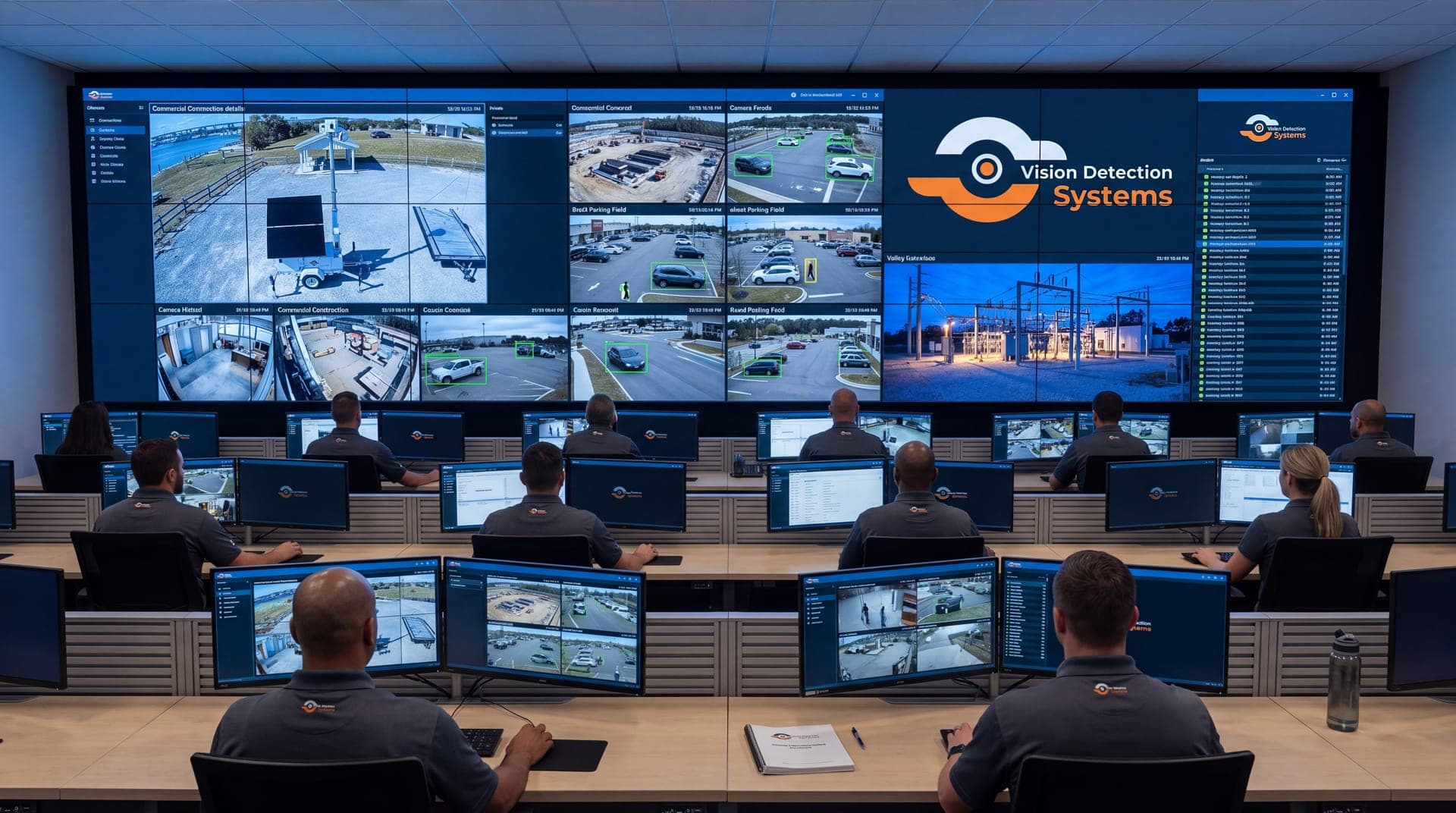
In a remote video monitoring setup, cameras at your site transmit live feeds to a central Security Operations Center (SOC) staffed by trained operators. Those operators watch for threats, respond to AI-generated alerts, and intervene directly when intrusions are confirmed—before anything is taken, damaged, or escalated beyond the point of recovery.
This article explains how the system works from camera to response, what makes monitoring effective, and how to evaluate whether it's the right solution for your site.
The Problem With Passive Recording
Most business owners who install security cameras are operating on an assumption: that having cameras deters crime and that footage will resolve incidents when they occur.
The deterrence part has merit—visible cameras do reduce opportunistic crime. But the second assumption is more problematic. Footage is useful for investigation and insurance claims, but it's inherently after-the-fact. If your goal is preventing a $50,000 equipment theft, knowing exactly how it happened afterward doesn't recover the equipment.
Passive recording also places the monitoring burden on the site owner or a designated staff member. Someone has to watch the feeds, respond to alerts, and contact law enforcement when necessary. In practice, this almost never happens—alerts get ignored, footage is only reviewed after an incident is discovered, and the "monitoring" part of the security system is effectively absent.
Remote video monitoring solves this by moving the monitoring function to a professional operation with the staffing, protocols, and technology to make it work 24/7.
How Remote Video Monitoring Works: The Full System
A remote video monitoring system has three integrated components:
1. The Camera and Sensor Network
Cameras at your site capture continuous video and transmit it over a cellular or wired network connection. For off-grid or temporary sites, mobile surveillance trailers provide a self-contained camera and communication platform that requires no existing infrastructure.
Modern systems integrate multiple sensor types beyond cameras:
- Motion sensors for pre-alert detection
- Acoustic sensors that detect glass break or gunshots
- Thermal cameras for perimeter detection in zero-visibility conditions
- Two-way audio speakers for operator intervention
The sensor network feeds real-time data to both AI analytics and the monitoring center.
2. AI Analytics and Pre-Filtering
The volume of video from a multi-camera site is too large for humans to watch continuously in meaningful detail. AI video analytics solve this by pre-processing camera feeds and filtering events based on configured rules.
What AI analytics typically detect:
- Human presence in a restricted zone
- Vehicle movement after hours
- Perimeter breach (fence-crossing detection)
- Abandoned object detection
- Loitering behavior
AI analytics can reduce the volume of events that require human review by up to 85–95%. Only events that meet the configured threshold for human attention are escalated to monitoring center operators. This keeps operators focused on real security events rather than motion triggered by weather, wildlife, or normal site activity.
Note: AI analytics reduce false alarms but don't eliminate the need for human verification. Professional monitoring services use AI filtering followed by human review—not AI alerts sent directly to law enforcement, which creates problems with false dispatch and damages relationships with local agencies.
3. The Security Operations Center (SOC)
The SOC is the heart of the remote monitoring operation. Staffed by trained operators around the clock, the SOC receives escalated alerts, reviews live footage, and responds according to documented protocols.
The response workflow for a confirmed intrusion:
| Step | Timeline | Action |
|---|---|---|
| Alert triggered | 0 seconds | AI flags event for review |
| Operator review | 5–15 seconds | Operator assesses live footage |
| Verification | 15–30 seconds | Confirms intrusion, not a false positive |
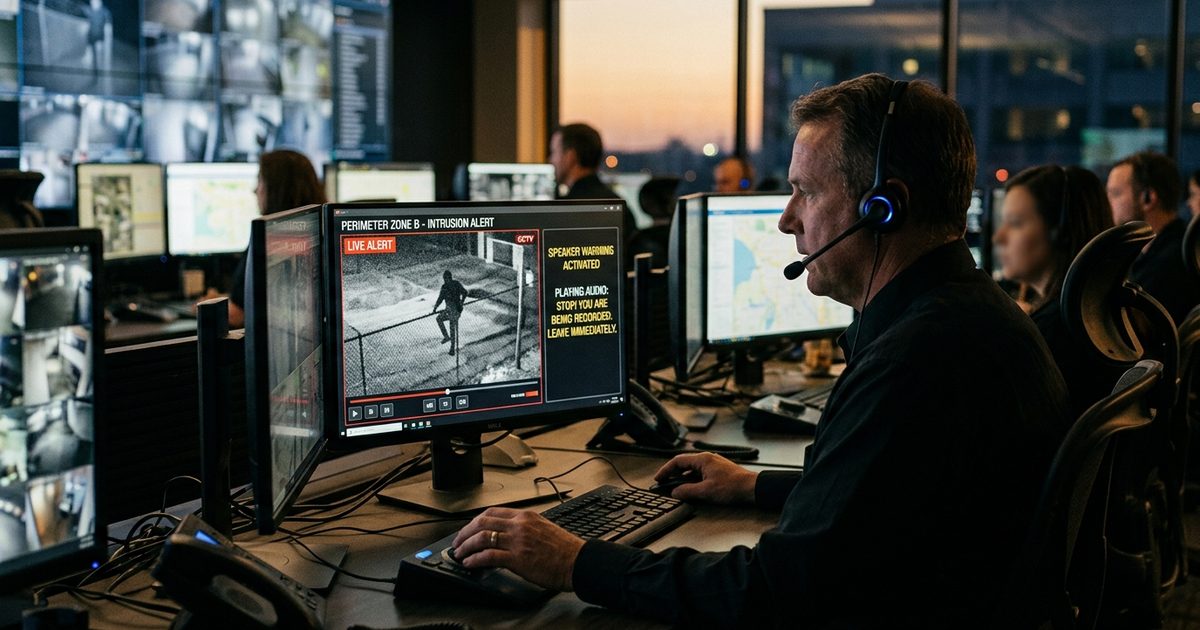
| Audio challenge | 30–45 seconds | Operator issues announcement via site speakers |
| Compliance or escalation | 45–90 seconds | Most intruders leave; non-compliant triggers law enforcement notification |
| Law enforcement contact | 1–2 minutes | Operator contacts 911, provides live feed access |
| Continuous monitoring | Ongoing | Operator monitors until resolution |
| Incident documentation | Post-event | Complete log with timestamps and video clips |
This entire sequence—from AI alert to operator verification to audio challenge—happens rapidly in a well-operated SOC. This is the response speed that transforms a security camera system from passive documentation into active protection.
What Happens During an Audio Challenge
The audio challenge is one of the most effective tools in remote monitoring, and it's often misunderstood. When an operator confirms an intrusion, they use speakers integrated into the surveillance system to announce—in real time—that the site is monitored and that the individual should leave immediately.
This works for a straightforward reason: most theft is opportunistic. People who are breaking into a construction site or trespassing on a utility facility are not professional, highly committed criminals executing a sophisticated plan. They're opportunists who have identified what looks like an unmonitored target. When a voice tells them—from an apparently empty site at 2 AM—that they're being watched and recorded, most leave immediately.
Industry data suggests that 70–80% of intrusion events on monitored sites are resolved at the audio challenge stage—before any theft occurs and before law enforcement needs to be dispatched.
What Remote Monitoring Is Not
It's not the same as alarm monitoring. Traditional alarm monitoring systems receive a signal from a sensor and contact a call list. Remote video monitoring means a human is watching live video, verifying the event, and responding with direct intervention capability—not just making phone calls.
It's not automated AI response. Some providers market AI-based systems that respond to alerts automatically without human verification. These systems generate significantly higher false alarm rates and can't exercise the judgment that distinguishes a contractor working late from an intruder.
It's not a replacement for all physical security measures. Remote monitoring is most effective when combined with good site hardening—adequate fencing, lighting, access control, and site organization that channels movement through monitored zones.
Who Benefits Most From Remote Video Monitoring
Remote monitoring delivers the strongest ROI for sites that have significant assets at risk but don't warrant full-time on-site security staffing. This includes:
- Construction sites with equipment and materials that are expensive to replace and prone to theft
- Utility and energy facilities with theft-targeted infrastructure like copper and aluminum
- Outdoor storage and laydown yards with high-value equipment inventories
- Commercial properties during off-hours when the cost of guard staffing is prohibitive
- Event venues during setup and breakdown periods
If your site has assets worth protecting and you're not currently doing anything beyond passive recording, remote video monitoring is almost certainly the highest-value security investment available at your budget level.
VDS operates a fully staffed SOC that handles alert response for construction, utility, and commercial sites across the country. Our remote monitoring service is available as a standalone service for sites with existing cameras or bundled with mobile surveillance trailers for complete deployments. Contact the team to learn what monitoring would look like for your site.