
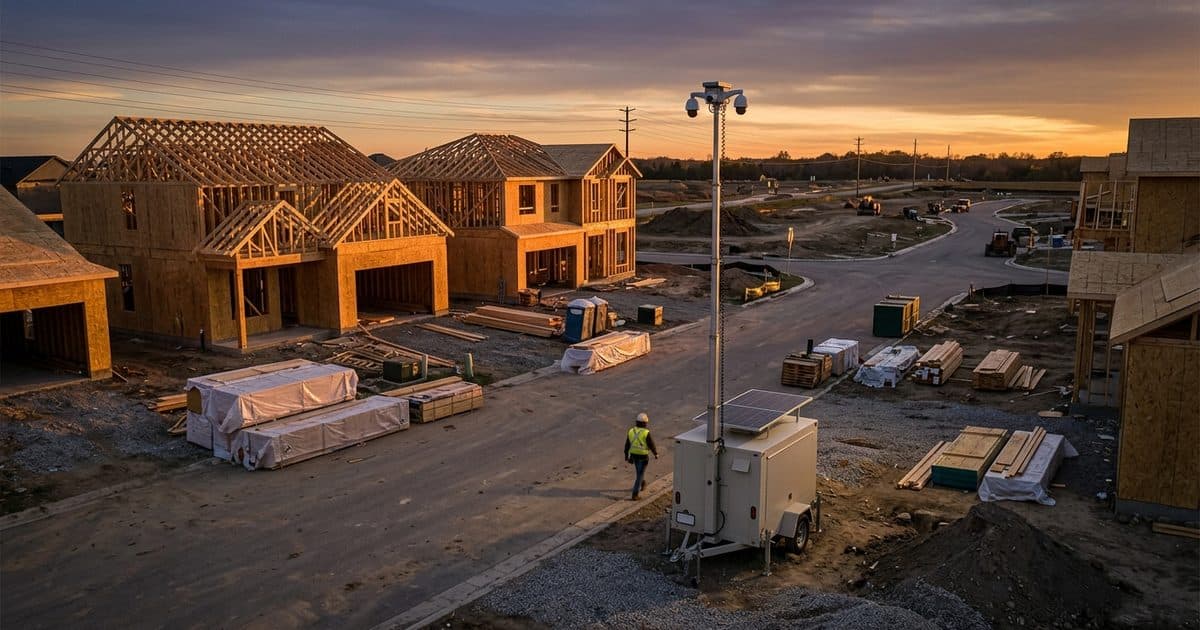
Why are subdivisions harder to secure than commercial jobsites?
A commercial project has one address, one perimeter, and one gate. A production homebuilder might have forty lots in play at once: slabs curing on one street, framing on the next, and nearly finished homes awaiting closing two blocks over. There is no single fence line that contains the value, and the highest-value materials shift location every week as trades move through the community.
Access control is looser by design. Framers, plumbers, electricians, HVAC crews, painters, landscapers, and delivery drivers rotate through daily, often for multiple builders working the same subdivision. Buyers and real estate agents walk spec homes. A pickup loading materials at 6 p.m. looks unremarkable to neighbors because pickups load materials there all day. That familiarity is exactly what opportunistic thieves exploit.
Timing makes it worse. Roughly 80 percent of jobsite theft happens outside working hours, a long-cited industry estimate attributed to National Equipment Register and NICB reporting. On a residential build that means nights and weekends when the subdivision is empty, streetlights may not be energized yet, and the nearest occupied home may be a phase away. A practical construction site security plan for homebuilders has to account for all of this movement rather than assuming a fixed perimeter.
What do thieves steal from residential jobsites, and when?
Theft risk on a residential build is not constant. It spikes at predictable points in the schedule, which is useful because it tells you exactly when protection matters most.
| Target | Peak-risk window | Why it disappears |
|---|---|---|
| Lumber packages | Days between delivery and framing | High resale value, untraceable, forklift-ready bundles |
| Appliances | The final weeks before closing | New-in-box or newly installed, easy to resell locally |
| Copper wire and pipe | Rough-in through trim-out | Scrap value, quick to strip from open walls |
| HVAC condensers | After set, before occupancy | Copper content and resale demand, sits outside unwatched |
| Power tools and equipment | Any phase, especially weekends | Portable, rarely serialized or logged by trades |
The appliance window deserves special attention. Homes get refrigerators, ranges, dishwashers, and condensing units installed in the last stretch before closing, then sit unoccupied with standard builder locksets. A thief who hits one nearly complete home can walk out with thousands of dollars in appliances, and the same crew can hit several homes on the same street in one night.
Recovery after the fact is unlikely. The NICB and National Equipment Register have long estimated equipment theft losses at $300 million to $1 billion annually, with only about 21 to 23 percent of stolen equipment ever recovered. Lumber, copper, and appliances fare even worse because they carry no serial-number trail once they leave the site.
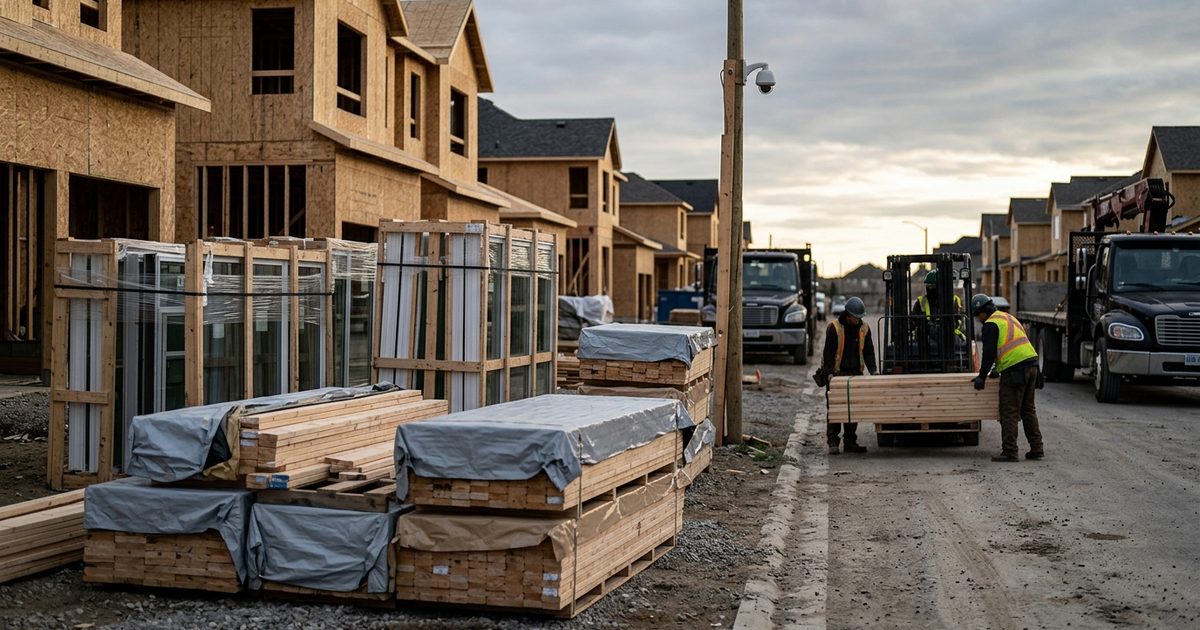
The insurance-claim gap: why prevention is the only real recovery
Most builders never get their money back, and most never even ask. In the builder survey reported by BuilderOnline, 87 percent of builders who experienced theft filed police reports, but roughly 75 percent never filed insurance claims. Deductibles often exceed the individual loss, and builders worry that a claims history will raise builder's risk premiums across every project they carry.
The result is a quiet tax on every home built. Stolen lumber gets reordered at current market prices, stolen appliances get replaced days before closing, and stripped copper means reopening finished walls, all absorbed as cost overruns rather than recovered losses. When the schedule slips, the carrying costs and delayed closings compound the direct loss.
That math leads to one conclusion: for homebuilders, prevention is not one option among several, it is the only mechanism that reliably preserves margin. Deterring the theft costs a fraction of absorbing it, which is why the practical question becomes how to prevent construction site theft in an environment where fences and fixed cameras were never designed to work.
Why fencing and fixed cameras fall short on scattered-lot builds
Perimeter fencing assumes a perimeter. Fencing an entire subdivision is impractical and usually pointless, since the streets must stay open for trades, deliveries, inspectors, and buyers. Fencing individual lots multiplies cost while doing nothing for the staged materials, dumpsters, and equipment that sit in rights-of-way between lots.
Fixed cameras have a different problem: they point at yesterday's risk. A camera mounted on a completed model home watches a street where framing wrapped up weeks ago, while the current lumber drops sit three streets away outside its view. Repositioning wired cameras every few weeks is a standing infrastructure project of its own.
Power and connectivity add a third obstacle. Permanent power is often one of the last utilities energized at the house level, and builder trailers with power sit at the entrance, not beside the active phase. Any residential security approach that depends on grid power and installed internet will always trail the work by weeks. That is the core reason construction site camera rental for homebuilders has consolidated around self-powered, relocatable units rather than fixed installations.
What actually works: layered security for homebuilders
Deterrence works because most thieves screen targets before committing. In a well-known UNC Charlotte study of convicted burglars, about 83 percent said they would check for alarms or cameras before attempting a break-in, and roughly 60 percent said they would avoid a target with visible security altogether. The goal of residential jobsite security is to make the active phase an obviously bad target.
Process controls come first, and they are largely free. NAHB's theft-prevention guidance for builders emphasizes fundamentals that fit scattered-lot construction:
- Time deliveries to installation, so lumber packages and appliances arrive as close as possible to when crews will use them, shrinking the unattended window.
- Stage materials deliberately in visible, lit, consolidated locations instead of scattering them lot by lot.
- Record serial numbers and mark equipment so stolen items are identifiable and less attractive to resellers.
- Enlist neighbors and early residents to report after-hours activity, since occupied homes in earlier phases are a natural observation network.
- Hold trades accountable for locking units and securing their own tools at the end of each day.
Visible, monitored surveillance is the layer that makes those controls credible after dark. A camera that only records produces evidence for a police report that, as the survey data shows, rarely turns into recovery. A monitored camera changes the outcome in the moment: a trained operator sees the person on the lot at 2 a.m., confirms it is not a trade picking up material, issues a live audio warning, and escalates so people, yours or your security partner's, handle the verified incident while the lumber is still on the ground.
How mobile surveillance covers the active phase street by street
A solar-powered mobile surveillance trailer solves the three structural problems of subdivision security at once. It needs no grid power or trenched internet, so it can sit beside the active phase from the first slab. It elevates cameras above fence-and-truck sightlines to watch staged materials, open homes, and street rights-of-way together. And when the work moves, the trailer moves with it, relocating street by street as phases close out instead of guarding where the risk used to be.
For production builders, the deployment pattern is straightforward. One unit covers the current construction phase where lumber drops and open framing concentrate. As homes approach completion, coverage shifts toward the pre-closing streets where appliances and condensers create the second risk peak. Communities with long build-outs simply repeat the cycle, and the same monitored footage doubles as documentation for disputes, deliveries, and vandalism claims.
This is the model Vision Detection Systems runs for homebuilders: solar-powered trailers backed by 24/7 remote monitoring, so detection comes with human verification and escalation rather than a recording nobody watches until after the loss. You can see how the approach applies across jobsite types on our construction industry page, and if you are budgeting security into your per-community costs, our breakdown of construction site security cost per month compares the options homebuilders typically weigh.
Planning past the build: from active phase to occupied community
Security needs do not end at the last closing, they change shape. Model home parks, sales centers, and amenity buildings often remain builder-owned and unattended at night long after the first residents move in. Construction traffic gives way to resident traffic, and the community's security conversation shifts from protecting materials to protecting common areas.
Builders who plan that transition early have an advantage. The same relocatable, monitored approach that protected framing packages can cover the amenity center through build-out, and the eventual homeowners association inherits a documented security baseline instead of starting from zero. For what comes next, our guide to HOA community security cameras covers how associations typically take over surveillance once the builder hands off the community.
The takeaway for homebuilders is simple. Theft on residential builds is predictable in what it targets and when, insurance rarely makes the builder whole, and static security tools cannot follow scattered-lot work. Match your protection to the build: tighten delivery timing and staging, make security visible, and put monitored eyes on the active phase, then move them when the work moves.