
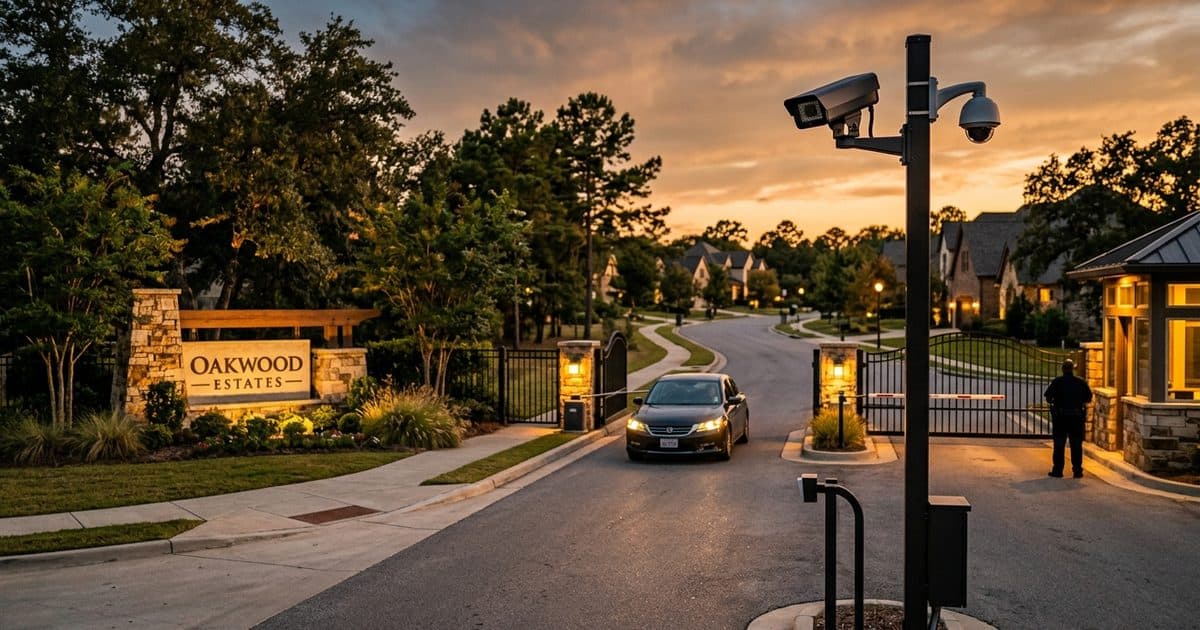
HOA boards and property managers face a specific version of the low-staffed, high-asset problem: a community is large by design, with dozens of driveways, several amenities, and often more than one entrance, but the security budget usually funds one guard shack or one roving patrol, if it funds any on-site presence at all. Residents expect the community to feel safe every hour of the day, and the exposure that keeps boards up at night — a break-in wave, a vandalized clubhouse, a liability claim after a dumping incident nobody can trace — happens in the hours nobody's watching. This is the same pattern our self-storage customers deal with: a sprawling, low-staffed property where the losses cluster in exactly the gaps fixed infrastructure never reached.
The Threat Landscape at HOA & Gated Communities
The most common complaint from a community board is vehicle break-ins and package theft concentrated in driveways, guest parking, and mailbox clusters. These incidents happen fast, look unremarkable to a passing resident, and are spread across so many individual properties that no single homeowner's doorbell camera captures the pattern — only a system watching the common areas ties the incidents together.
Amenities carry the next layer of risk, and it's often the one that generates the most liability. Pools, clubhouses, playgrounds, and tennis or pickleball courts close at a posted hour on paper, but in practice they're where after-hours groups gather, where vandalism happens, and where a trespassing injury becomes a lawsuit against the association. A closed gate on the pool fence doesn't stop anyone determined to climb it, and by the time a resident reports graffiti or a broken fixture on Monday morning, there's no way to know who was responsible or when it happened.
Entrances add a third layer. Many communities aren't fully gated, and even the ones that are see vehicles tailgate through behind a resident or simply follow another car in without ever badging or being logged. Add cut-through speeding on interior streets and illegal dumping on common ground — both routine sources of resident complaints and board liability — and a community association is exposed on several fronts simultaneously, all in the hours and corners with the least visibility.
Why a Fixed Camera and a Gate Guard Aren't Enough
Most communities already have some security spending — a camera at the main entrance, a contracted guard for a few hours a night, maybe a keypad at a secondary gate. The gap is what that spending doesn't cover: everything past the front entrance.
| Capability | Fixed Camera + Gate Guard | Solar Mobile Surveillance |
|---|---|---|
| Coverage | One entrance and whatever a single guard can patrol on foot or in a cart | Elevated wide-area coverage repositioned to the entrance, amenity, or common area under threat |
| Amenities | Pool, clubhouse, and playground typically uncovered after the office closes | Dedicated after-hours coverage on the amenities that draw the most activity |
| Response | Guard presence limited to shift hours and physical location | Live SOC verification and real-time audio warning, any hour, any covered location |
| Cost | Ongoing guard payroll, turnover, and shift gaps | Flat monitoring cost with no staffing, turnover, or overtime |
| Board reporting | Incident reports depend on whoever was on shift noticing | Documented monthly incident and entry logs ready for board meetings |
A gatehouse contract is expensive precisely because it asks one post to solve a whole community's coverage problem. A camera at the front gate is only ever as useful as whoever reviews the footage after a resident complains — it doesn't do anything at 2am when the incident is actually happening. The gap between recording and responding is where most HOA losses occur, and it's the same gap regardless of how nice the front-entrance camera is.
Tip: Don't concentrate your entire security budget on the main entrance. The highest-liability incidents at most communities — amenity vandalism, after-hours trespass, dumping on common ground — happen well past the gate, in spaces the association is directly responsible for maintaining and defending in a dispute. Weight coverage toward the amenities and common areas, not just the point of entry.
What a Coverage Plan Looks Like for a Community
A coverage plan that actually protects a community weights toward where incidents concentrate and where the association carries the most liability. For a typical gated or master-planned community, that includes:
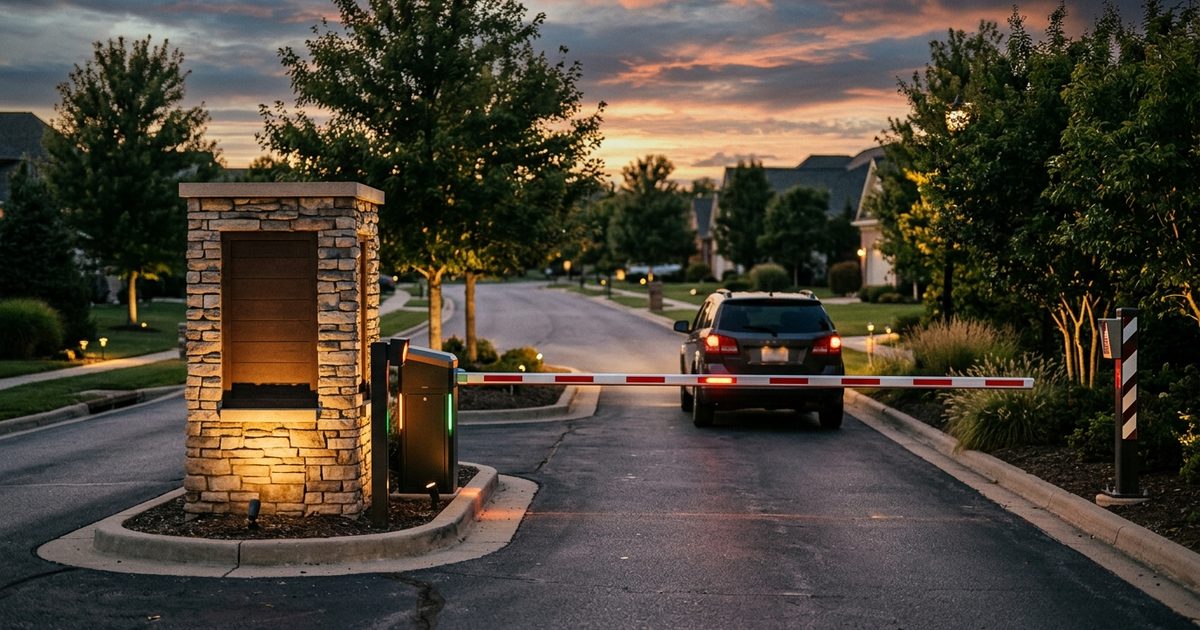
- The entrance, with LPR: Whether the community has a full gate arm or an open entrance, license plate recognition ties every vehicle to a time and a plate, exposes tailgating, and flags vehicles that aren't on an approved list.
- Pool, clubhouse & amenity areas: The highest-liability, highest-activity spaces after hours. Object detection and loitering detection flag a human presence on a closed amenity before a gathering becomes a vandalism report.
- Guest parking & common driveways: Shared lots and cul-de-sacs where vehicle break-ins and package theft cluster away from any single resident's line of sight.
- Secondary entrances & common ground: Cut-through routes, service gates, and open common land where speeding and illegal dumping generate complaints with no footage to resolve them.
The element that turns this from a wish list into protection is a unit that can actually sit in these locations without a construction project: a solar-autonomous Mobile Surveillance Unit with lighting and a speaker covers the entrance during the week and the pool on a summer weekend, because it goes where the risk is instead of where conduit happens to already run. A lighting trailer alongside it adds visible deterrence to a dim parking court or amenity area without a capital project.
Live Monitoring: The Force Multiplier for the Gatehouse Budget
The most expensive way to cover a community is more posted hours at a single gate, and the least effective is a camera nobody's watching in real time. Live remote monitoring is the option that beats both, and it's the one most boards haven't priced out yet.
Remote video monitoring routes every alert — a vehicle at the entrance after hours, movement at the pool past closing, a group gathering at the clubhouse — to a live SOC operator who verifies it. A false alarm gets cleared in seconds. A genuine incident gets a real-time audio warning through the unit's speaker, which alone sends most trespassers and after-hours groups on their way, and if it escalates, the operator loops in local law enforcement with time-stamped footage and the entrance LPR record of what drove in. It's a response that a single roving guard, covering hundreds of homes and several amenities on one shift, simply can't match.
The other thing live monitoring delivers is documentation the board actually needs. Every alert, verification, and escalation is logged, which means the monthly report isn't a guess about what might have happened — it's a record the board can put in front of homeowners at a meeting, cite in a dispute over vandalism liability, or hand to an insurance adjuster or law enforcement without having to reconstruct the night from memory. For associations managing more than one community or a large master-planned property with a management company involved, the same SOC applies a consistent standard everywhere instead of depending on whichever guard was on shift.
Deployment That Matches How Communities Actually Use Their Space
Community security needs shift with the calendar and with the property itself — a new phase opens, the pool gets busy in summer, a secondary entrance goes unmonitored after a management change, a dumping complaint points to a specific stretch of common ground. A fixed camera installed once doesn't move with any of that.
A relocatable, solar-autonomous approach does. The same unit that watches the main entrance in the off-season repositions to the pool for the summer, sits at a new phase's entrance the week it opens, or parks on the common ground getting dumped on until the behavior stops — no trenching, no electrician, no waiting on a capital improvement vote. For communities near shared parking, retail, or amenity lots adjoining the property, the same coverage model extends naturally into parking area security without a separate system.
Most communities go from an initial conversation to a live trailer on site inside about a week: a short site assessment of entrances, amenities, and incident history, camera and LPR configuration tuned to the property, then delivery and commissioning with SOC monitoring active the same day the mast goes up.
Common Mistakes in HOA & Community Security
- Putting the entire budget at the front gate. The incidents that create the most liability — amenity vandalism, after-hours trespass, dumping — happen well past the entrance. A single well-placed entrance camera doesn't protect the pool or the playground.
- Leaving amenities uncovered after posted hours. The pool, clubhouse, and courts are exactly where after-hours activity concentrates once the sign says "closed." Treat them as core coverage, not an afterthought.
- Skipping LPR because there's no full guard gate. LPR doesn't require a manned arm to work. Without a plate-and-time record, tailgating and unauthorized entry stay invisible regardless of how the entrance is built.
- Recording without responding. Footage reviewed after a resident complains on Monday doesn't stop what happened Saturday night. Detection needs to be tied to live verification and a real-time audio warning to actually change outcomes.
- Treating one guard as coverage for the whole property. A single roving patrol covering hundreds of homes and multiple amenities has, functionally, no coverage most of the time. Live monitoring extends real response across the entire community at once, not wherever one person happens to be standing.
HOA and gated communities are one of several sprawling, low-staffed properties where a solar-autonomous, live-monitored model closes the after-hours gap without adding guard headcount — the same model that works for self-storage facilities and other large, thinly staffed sites. Boards evaluating the switch can review real deployment outcomes in our case studies, or get in touch to talk through a specific community.