
This guide breaks down current 2026 pricing for every major construction site security option, with cost ranges by site size and deployment model.
The Four Main Security Models and Their Monthly Costs
Construction site security generally falls into one of four approaches, each with a distinct cost structure and capability profile.
| Security Model | Monthly Cost Range | Best For |
|---|---|---|
| Passive camera recording only | $500–$1,500 | Very small sites, low-risk phases |
| Mobile surveillance trailer (monitoring included) | $1,800–$3,500 | Most mid-size construction sites |
| Part-time guard + remote monitoring | $4,000–$8,000 | High-value sites, active access control |
| Full 24/7 guard staffing | $12,000–$22,000+ | Highest-risk urban sites, compliance requirements |
Most projects find that mobile surveillance with active remote monitoring delivers the best risk-adjusted value. The remaining sections break down each model in detail.
Passive Recording: The Low-Cost Floor
Passive recording systems—cameras that record continuously or on motion, without live monitoring—are the least expensive option and also the least effective deterrent.
Monthly cost components:
- Camera system lease or amortized purchase: $300–$800
- Cellular data for cloud upload: $100–$300
- Cloud storage (30–90 days): $50–$200
- Total: approximately $500–$1,500/month
The fundamental limitation of passive recording is that it documents theft after it happens but doesn't prevent it. Without live monitoring, there's no audio challenge, no law enforcement notification during the event, and no deterrence beyond the visible presence of the cameras themselves.
Note: Some thieves specifically target sites they've observed to have cameras without monitoring. A professional-looking camera with no active response is a lower-deterrence environment than the equipment implies.
Passive recording is appropriate for very low-risk phases (finished sites with minimal materials on hand), supplemental coverage zones on larger monitored sites, and situations where budget is the absolute primary constraint.
Mobile Surveillance Trailers with Remote Monitoring
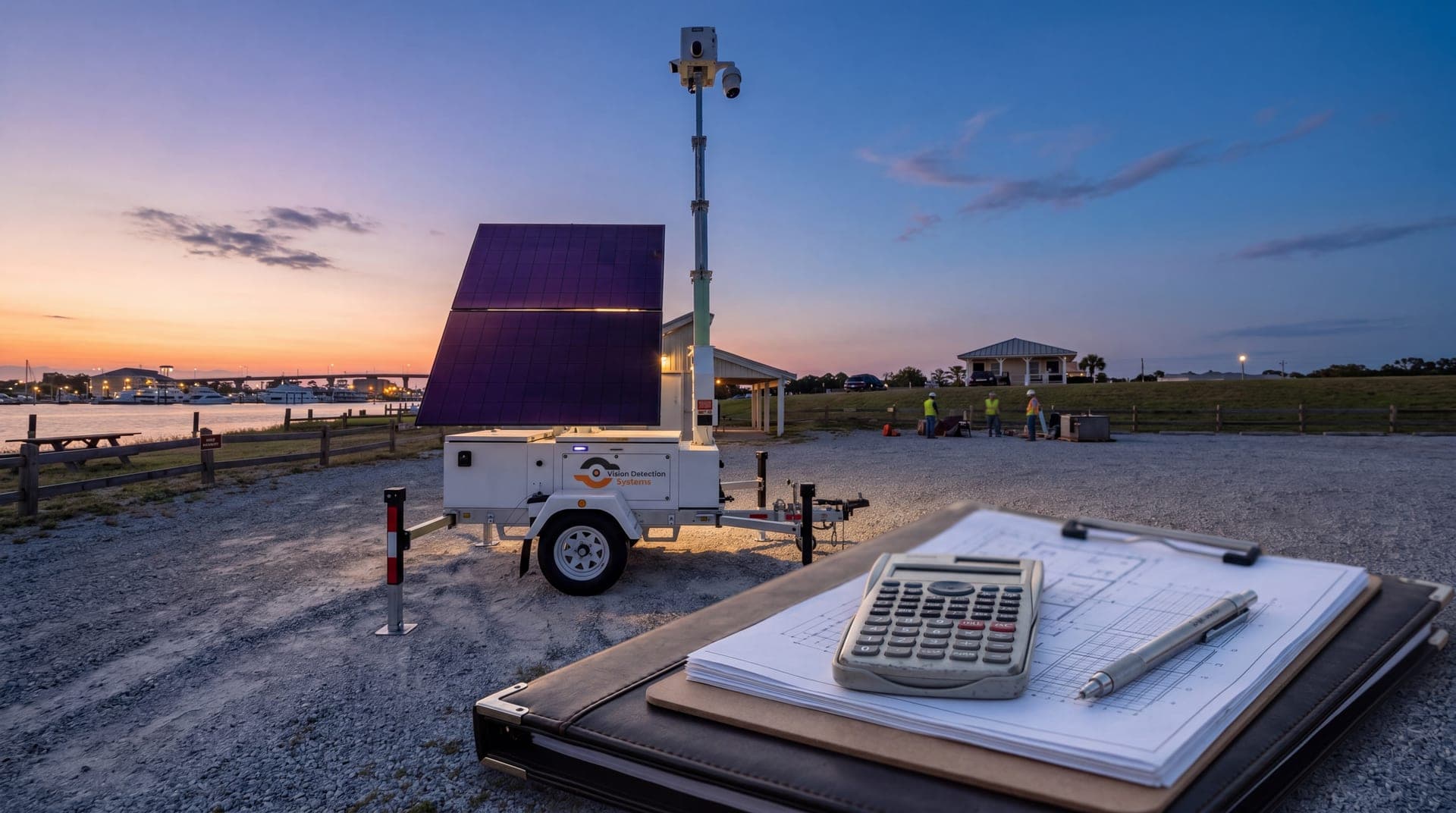
This is the most common approach for mid-size construction projects, and for good reason. A mobile surveillance trailer with integrated solar power, cellular connectivity, and remote monitoring provides genuine 24/7 active deterrence at a predictable monthly cost.
Monthly cost components:
- Trailer lease (includes equipment, maintenance): $1,200–$2,000
- Remote monitoring with live operators: $400–$800
- Cellular data (included in many packages): $0–$200
- Deployment and retrieval (amortized): $100–$200
- Total: approximately $1,800–$3,200/month
What drives cost variation in this range:
- Number of cameras (4-camera vs. 8-camera configurations)
- Monitoring intensity (alert-response only vs. continuous live monitoring)
- Contract length (month-to-month costs 15–25% more than 6-month terms)
- Site location relative to provider service area
Tip: The single most important upgrade from passive recording to active monitoring is the two-way audio capability. Sites with verified audio intervention typically see meaningfully higher deterrence than camera-only sites. Confirm this is included before signing any monitoring agreement.
For larger sites, multiple trailers may be needed. Each additional trailer adds roughly $1,500–$2,500/month, but many providers offer multi-unit discounts of 10–20%.
Part-Time Guards Plus Remote Monitoring
For sites with access control requirements or that want a visible deterrent during business hours, a hybrid model works well. A guard handles daytime access control, badge checking, and visitor management. Remote monitoring covers overnight hours, weekends, and any periods when the guard is off post.
Monthly cost components:
- Part-time guard (40 hrs/week, $25/hr fully loaded): $4,000–$5,000
- Remote monitoring (off-hours coverage): $1,500–$2,500
- Mobile surveillance trailer(s): $1,500–$2,500
- Total: approximately $7,000–$10,000/month
This hybrid model is common on large commercial construction projects in urban areas, where daytime foot traffic requires human judgment and the project generates enough value to justify higher security spending.
Full 24/7 Guard Staffing
Full guard staffing—three rotating shifts at a single post, plus management and relief coverage—is the most expensive model and is typically justified only for the highest-risk urban sites, projects with compliance requirements for on-site security personnel, or facilities storing extremely high-value equipment.
Monthly cost components:
- Guard wages, direct (3 shifts, 7 days): $12,000–$18,000
- Guard management and supervision: $1,000–$3,000
- Overtime, benefits, turnover, and relief overhead: varies widely
- Supplemental camera recording: $500–$1,000
- Total: $13,500–$22,000+/month at direct rates — commonly $25,000–$35,000/month fully loaded
At this cost level, the economics of remote monitoring become very compelling. For sites spending over $12,000/month on guard staffing, a hybrid that adds remote monitoring and reduces guard hours by 50–60% typically maintains equivalent or better protection at $6,000–$9,000/month. See a full VDS vs. security guards cost comparison for the side-by-side, or the pricing overview for what a monitored plan includes.
What Size Site Needs What Level of Security?
Project value and site size are the primary drivers. Here's a practical framework:
Small sites (under $2M project value, single trade): Basic camera monitoring, $1,500–$2,500/month. Focus on perimeter and material storage.
Medium sites ($2M–$20M, multiple trades, active phasing): Remote monitoring with mobile surveillance trailers, $2,500–$5,000/month. Multiple trailers may be needed as the site layout changes.
Large sites ($20M+, urban, high-value equipment): Hybrid monitoring and guard program, $6,000–$15,000/month. Access control, perimeter monitoring, and incident documentation capability all become critical.
Mega projects or critical infrastructure: Full security program with dedicated manager, multiple monitoring layers, $15,000+/month.
Factors That Drive Your Actual Monthly Cost Up or Down
Several site-specific factors affect where you land within these ranges:
Perimeter complexity: Sites with irregular shapes, multiple access points, or difficult terrain require more cameras and may need more surveillance units, driving cost up.
Theft history: Sites with documented theft history or in high-crime areas may require higher monitoring intensity. Some providers price by risk tier.
Phase-based risk: Material delivery weeks and equipment staging periods are higher risk than framing phases. Some projects ramp monitoring up during these periods.
Contract length: Month-to-month flexibility typically costs 15–25% more than six-month commitments. If you can project your timeline accurately, longer terms save meaningful money.
Connectivity environment: Sites in areas with poor cellular coverage may require signal boosters or satellite connectivity options, adding $200–$500/month.
Calculating the ROI on Construction Security
The math is usually straightforward. If your site has $500,000 in equipment and materials at risk, and the probability of a significant theft event without security is 10–15% over the project duration, your expected loss is $50,000–$75,000. Security at $2,500/month for six months costs $15,000 and can meaningfully reduce that probability.
Add insurance premium savings (often 5–15% on builder's risk policies with documented monitoring programs), and the net cost of security frequently approaches zero or goes negative when modeled correctly.
Remote monitoring solutions from VDS are designed for exactly this kind of cost-justified, active deterrence deployment. Contact the team for a site-specific quote that aligns coverage with your actual risk profile and project timeline.