
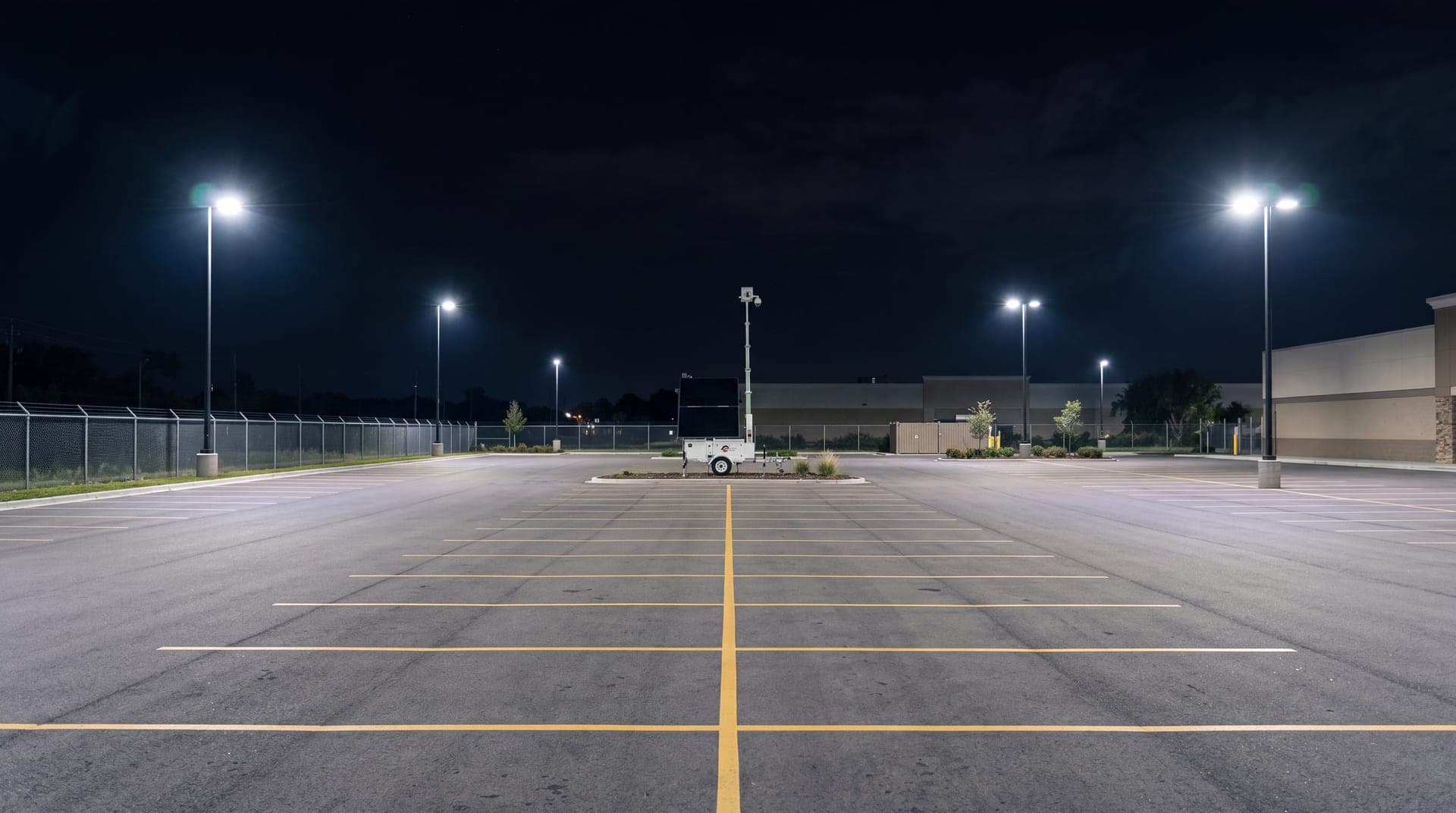
This guide covers 12 proven measures for property managers, retail and mall operators, apartment and HOA managers, dealerships, hospitals, and municipalities, with a comparison table and a plain look at what each one costs.
Key takeaways
- Parking lots are high-opportunity targets: lots of unattended property, few witnesses, and predictable empty hours.
- Research found CCTV was associated with about a 37% crime reduction in car parks, the largest effect of any setting studied.
- Actively monitored camera systems were associated with meaningful crime reductions; passive, record-only systems showed no significant effect.
- Low-cost design fixes (lighting, sightlines, signage) make every camera and patrol more effective.
- Mobile security towers cover hotspots, overflow lots, and areas with no power or network, without trenching.
Why parking lots are targets
A parking lot concentrates hundreds of unattended vehicles, each holding bags, electronics, tools, or catalytic converters, in a space where people come and go without drawing attention. Most lots have long stretches with little foot traffic: overnight, after store close, or during shift changes at hospitals and dealerships.
The numbers reflect that exposure. In the FBI's 2019 national larceny-theft data, 27.0% of larceny-thefts were thefts from motor vehicles and another 6.5% were thefts of motor vehicle accessories. Whole-vehicle theft has been falling: the National Insurance Crime Bureau reported 659,880 vehicles stolen in 2025, down 23.2% from 2024. That is still hundreds of thousands of vehicles, and many are taken from exactly the places this guide covers.
Vehicle crime is fast and opportunistic. Offenders look for dark corners, blind spots, easy exits, and a low chance of being seen. Every measure below either raises that chance or shortens the time between an incident and a response.
Design and deterrence
1. Upgrade lighting
Lighting is the cheapest security measure with the widest effect. Aim for even illumination with no dark pockets between poles, especially at entrances, pedestrian paths, stairwells, and perimeter rows. LED fixtures give better color rendering, which improves camera footage at night. Put lights on timers or photocells so they never depend on someone remembering to switch them on.
2. Post clear signage
Signs that state the lot is under video surveillance, that it is monitored, and that violators will be reported to police set expectations before anyone acts. Signage costs little and increases the deterrent value of cameras you already have. Pair it with posted hours, towing rules, and a number to call for help.
3. Maintain landscaping and sightlines
Overgrown shrubs, low tree canopies, and dumpster enclosures create hiding spots and block cameras. Keep shrubs low and tree canopies trimmed high, so staff, patrols, and cameras can see across the lot. Check sightlines again after seasonal growth or when a new structure goes in.
4. Control access with gates and barriers
Fewer entry points mean fewer escape routes. Close unused driveways after hours, add barrier arms or gates for staff or resident lots, and use bollards or planters to stop vehicles from cutting through landscaping. At apartment complexes and HOA communities, access-controlled gates combined with entrance cameras are often the core of the security plan.
5. Apply CPTED principles across the site
Crime Prevention Through Environmental Design (CPTED) ties the measures above together: natural surveillance (people can see and be seen), natural access control (layout guides people along intended routes), territorial reinforcement (the lot looks cared for and owned), and maintenance (broken lights and graffiti get fixed fast). A short CPTED walk-through at night, when problems show up, often finds the cheapest fixes on the property.
Technology
6. Cover entries, exits, and aisles with cameras
Good parking lot surveillance starts with coverage planning, not camera count. Place cameras at every vehicle entrance and exit first, since that is where every offender must pass. Then cover drive aisles, the building frontage, and perimeter edges. Use wide views for situational awareness and tighter views at chokepoints for identification. For budgeting, see our breakdown of parking lot security camera cost.
7. Add license plate recognition at entrances
License plate recognition (LPR) cameras read and log plates as vehicles enter and leave. That creates a searchable record that helps investigators tie a vehicle to an incident, flags repeat visitors after hours, and supports permit or resident parking enforcement. LPR works best at a controlled chokepoint where vehicles slow down. Check state and local rules on plate data retention and sharing before you deploy.
8. Use AI analytics for loitering and after-hours activity
Traditional motion detection triggers on headlights, wind-blown trash, and animals, which buries real events in false alarms. AI video analytics classify people and vehicles and can flag specific behavior, such as a person loitering between parked cars, someone walking row to row checking door handles, or a vehicle circling after close. That filtering is what makes live monitoring practical for a large lot.
9. Add live monitoring and talk-down
Detection only helps if someone acts on it. With 24/7 remote video monitoring, trained operators review AI alerts, verify what is happening, and issue a live audio warning through on-site speakers. If the person does not leave, the operator dispatches police with a verified description. We cover this model in detail in parking lot surveillance cameras with 24/7 monitoring.
10. Deploy mobile security towers for hotspots and overflow lots
Some areas are hard to cover with fixed cameras: an overflow lot with no power, a far corner where break-ins cluster, a seasonal event lot, or a new property still waiting on permanent infrastructure. A parking lot security tower (a mobile surveillance unit with cameras on a raised mast, solar power, and cellular connectivity) can be placed without trenching or wiring and moved when the problem moves. A tall, visible mast also adds deterrence on its own. For format differences, see mobile security towers vs. trailers.
People and process
11. Build a smarter patrol and guard strategy
Guards and patrols provide presence and a human response, but a single officer cannot watch a large lot all night. Many operators now use cameras and remote monitoring for continuous coverage and send patrols—their own or their security partner's—to verified incidents or scheduled high-risk windows, such as store close or shift change. Compare the trade-offs in VDS vs. security guards.
12. Standardize incident reporting, evidence retention, and hotspot reviews
Every incident is data. Log the time, location, what was taken, and which camera covered it, then review the log monthly to find patterns. Watch especially for catalytic converter theft from trucks, fleet vehicles, and high-clearance vehicles parked overnight, and for after-hours break-ins at the edges of the lot. Move cameras, lighting, or a mobile tower to where the incidents are.
Set a retention period long enough to cover delayed reports, since victims often discover a break-in hours or days later. Use a consistent incident reporting workflow, follow the guidance on how long security cameras should keep footage, and export clips with timestamps and chain of custody so they hold up as security camera footage evidence.
Parking lot security measures compared
| Measure | What it prevents | Cost level | Best for |
|---|---|---|---|
| 1. Lighting upgrades | Break-ins in dark areas, assaults, loitering | Low–Med | Every lot |
| 2. Surveillance signage | Opportunistic theft and vandalism | Low | Every lot |
| 3. Landscaping and sightlines | Hiding spots, camera blind spots | Low | Retail, HOA, hospitals |
| 4. Gates and barriers | Cut-through traffic, easy getaways, after-hours access | Med–High | Apartments, HOAs, staff and fleet lots |
| 5. CPTED review | Multiple risks at once through layout fixes | Low | New builds, redesigns, problem sites |
| 6. Entry/exit and aisle cameras | Theft from vehicles, vehicle theft, hit-and-run disputes | Med | Retail centers, garages, municipal lots |
| 7. License plate recognition | Repeat offenders, unauthorized vehicles | Med | Dealerships, gated communities, permit lots |
| 8. AI loitering analytics | Door-checking, casing, after-hours trespass | Med | Large lots with long empty hours |
| 9. Live monitoring and talk-down | In-progress break-ins, catalytic converter theft | Med | Any lot that needs a real-time response |
| 10. Mobile security tower | Hotspot crime, overflow and remote lot theft | Med | Overflow lots, events, sites without power |
| 11. Patrol/guard strategy | Crimes needing a physical response, disorder | High | Hospitals, malls, high-traffic venues |
| 12. Reporting, retention, hotspot review | Repeat incidents, lost evidence | Low | Every lot |
Cost levels are qualitative. Actual pricing varies by lot size, camera count, monitoring level, and contract term.
Monitored vs. record-only parking lot surveillance
Many lots already have cameras. The problem is that nobody looks at the footage until after a car has been broken into, and by then the offender is gone.
The research on this point is consistent. A 2019 meta-analysis in Criminology & Public Policy by Piza, Welsh, Farrington, and Thomas, covering four decades of CCTV evaluations, found cameras were associated with about a 13% reduction in crime overall and about 37% in car parks. Actively monitored systems were associated with roughly a 15% reduction, while passive systems showed no significant effect. Schemes that combined CCTV with other interventions saw about a 34% reduction.
| Factor | Record-only | Actively monitored |
|---|---|---|
| When you learn about an incident | After a victim reports it | While it is happening |
| Response | Review footage, file a report | Talk-down warning, then police dispatch |
| Deterrence | Signs and visible cameras | Signs, cameras, and a live voice on site |
| Evidence | Depends on someone finding the clip | Incident flagged, clipped, and time-stamped |
| Research finding | No significant crime effect | About a 15% crime reduction |
Record-only systems still have value for investigations and liability claims. If the goal is to stop break-ins, though, someone needs to be watching.
Parking lot security by property type
- Retail centers and malls: high daytime turnover and empty evenings. Focus on entrances, the building frontage, and the far rows where employees park. See retail security and our mall parking lot security guide.
- Apartments and HOAs: residents' vehicles sit overnight in the same spots. Gates, entrance LPR, and after-hours loitering detection matter most.
- Dealerships: high-value inventory and catalytic converters in open lots overnight. Perimeter coverage and live monitoring are the priority. See auto dealership security.
- Hospitals: 24-hour activity, staff walking to cars at shift change, and emergency access that can't be gated. See healthcare security.
- Municipal and public lots: many entry points and limited budgets. Mobile towers cover hotspots and park-and-ride or event lots without new infrastructure.
For more by vertical, visit our parking industry page.
How VDS helps secure parking lots
Vision Detection Systems provides solar-powered mobile surveillance units built for the monitored, layered approach described above:
- Visible deterrence: a 5MP PTZ and three 8MP wide-angle cameras on a 22 ft telescopic mast (30 ft available), placed where incidents cluster.
- AI detection: person and vehicle detection, loitering, and license plate recognition to cut false alarms.
- Verified response: a 24/7 US-based security operations center reviews alerts, issues a live talk-down, and escalates to police dispatch.
- No infrastructure: a 900W bifacial solar array and dual-SIM 4G/5G cellular mean no site power, internet, or trenching, with battery reserve for 3–5 consecutive cloudy days.
- Evidence-ready video: managed retention and time-stamped exports.
- Flexible terms: rental or month-to-month and term subscriptions, and NDAA Section 889 compliant hardware.
Most deployments go from signed quote to live monitoring in about a week, and on-site setup takes one person under 20 minutes. Learn more about VDS parking lot security solutions, or get a coverage plan for your lot.
Sources
- Piza, E. L., Welsh, B. C., Farrington, D. P., & Thomas, A. L. (2019). CCTV surveillance for crime prevention: A 40-year systematic review with meta-analysis. Criminology & Public Policy, 18(1). onlinelibrary.wiley.com (summary: ericpiza.net)
- National Insurance Crime Bureau. Partnerships in Theft Prevention Drive Continued Declines in U.S. Stolen Vehicles (2026). nicb.org
- Federal Bureau of Investigation. Crime in the United States, 2019: Larceny-theft. ucr.fbi.gov