
Key takeaways
- "Mobile security tower," "surveillance trailer," "mobile surveillance unit," and "lot camera" are often marketing names for the same thing. Compare the base, power, connectivity, and monitoring, not the label.
- There are three main form factors: towable trailer, skid or ballast tower, and fixed pole or wall mount.
- Towable trailers win on relocation speed; skid towers suit tight or long-term placements; fixed mounts suit permanent locations.
- Research on CCTV finds the largest, most consistent crime reductions in parking lots, and larger effects when cameras are actively monitored.
- Cost is driven more by monitoring level, term, and camera/analytics package than by whether the unit is called a tower or a trailer.
Tower, trailer, unit, lot camera: what the terms mean
Buyers search for a "security camera tower," read a page about a "surveillance trailer," and get a quote for a "mobile unit." That is confusing, but it rarely signals a different product. Here is how the terms are used in the market:
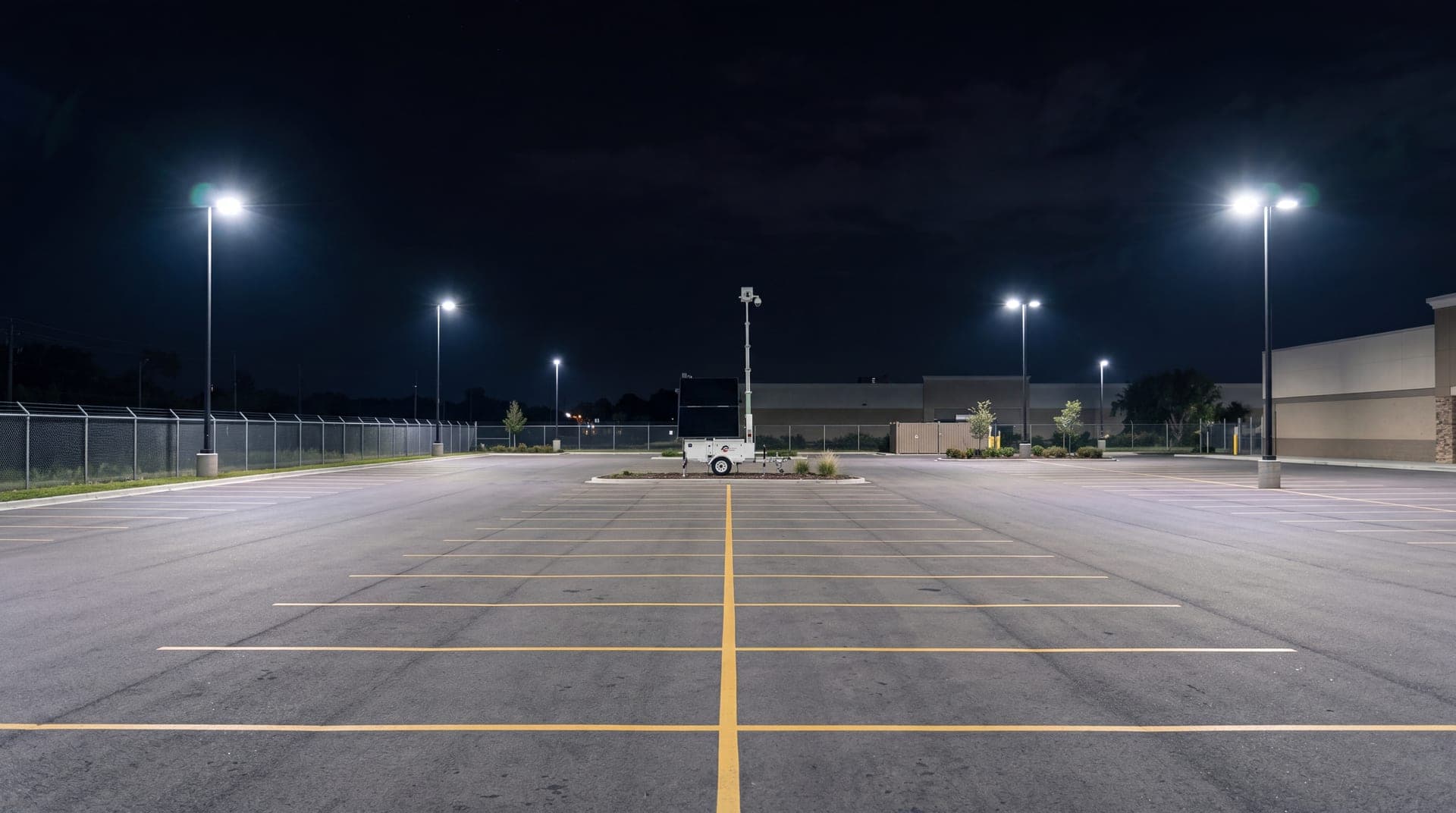
- Mobile surveillance trailer. A camera system built on a trailer chassis with an axle, hitch, and wheels. Cameras sit on a telescoping mast that raises for operation and lowers for transport. Power usually comes from solar panels and batteries; video goes out over cellular.
- Mobile security tower. Sometimes a trailer by another name. Other times it describes a unit on a skid or ballast base with no axle, set in place by forklift, crane, or flatbed. The mast and power system can be nearly identical to a trailer's.
- Mobile surveillance unit. A catch-all term covering both of the above. VDS uses it for its solar-powered mobile surveillance unit.
- Lot camera / parking lot surveillance tower. A use-case name. It describes where the unit goes, not how it is built.
- Security camera tower (fixed). Occasionally refers to a permanent pole with cameras, bolted to a footing. That is closer to a fixed installation than a mobile product.
The takeaway: ask how the unit is transported, powered, connected, and monitored. Those answers define what you are buying. For a deeper look at the trailer category itself, see our remote surveillance trailer guide.
Form factors compared
| Factor | Towable trailer | Skid / ballast tower | Fixed pole or wall mount |
|---|---|---|---|
| Base | Axle, wheels, hitch; leveling jacks or outriggers | Steel skid or weighted base; no axle | Bolted to a pole, footing, or building |
| How it moves | Towed by a pickup; repositioned without extra equipment | Forklift, crane, or flatbed truck | Not moved; reinstalled if needed |
| Setup | Fast; one person can typically deploy | Depends on lifting equipment and access | Installation project; may involve electrical, network, or permits |
| Power | Usually solar + battery; some offer generator or shore power | Solar + battery, or grid if available | Grid power, PoE, or a dedicated solar kit |
| Connectivity | Cellular is common | Cellular or site network | Site network or cellular |
| Footprint | Larger; needs a parking space or two plus tow access | Compact; fits tighter corners | Smallest; no ground footprint on a wall |
| Visible deterrence | High: tall mast, lights, signage | High | Moderate; blends into buildings |
| Theft/tamper considerations | Needs hitch locks and monitoring, since it can be towed | Heavier and harder to move without equipment | Hard to remove; cameras still need tamper alerts |
| Best for | Temporary, seasonal, or shifting problems | Semi-permanent placements with lift access | Permanent coverage at a fixed location |
VDS offers the towable form factor through the mobile surveillance unit and fixed coverage through a wall-mount system. If you are weighing mobile against permanent cameras in more depth, read remote surveillance trailers vs. fixed cameras.
Pros and cons of each form factor
Towable surveillance trailer
Pros
- Moves in minutes when the problem moves: a new phase of a job site, a different corner of a lot, the next event.
- No site power, trenching, or network needed when it runs on solar and cellular.
- Tall mast and lighting create strong visible deterrence.
- Easy to rent short-term and return.
Cons
- Takes up ground space and needs tow access to get in and out.
- Because it can be towed, it needs locks, tamper detection, and ideally live monitoring.
- Solar performance depends on sun exposure and battery reserve. Our solar camera battery life guide covers what to check.
Skid or ballast tower
Pros
- Compact base can fit corners, rooftops, or medians where a trailer will not.
- Heavier and harder to steal without equipment.
- Good for placements expected to last many months.
Cons
- Relocation requires a forklift, crane, or flatbed, which adds cost and scheduling.
- Delivery depends on site access for lifting equipment.
- Less practical when the coverage need changes often.
Fixed pole or wall mount
Pros
- Smallest footprint and no risk of the unit being towed away.
- Suits permanent coverage of entrances, loading docks, and perimeters.
- Can use existing building power and network, or a solar kit where there is none.
Cons
- Location is locked in; changing coverage means reinstalling.
- May require electrical work, network runs, landlord approval, or permits.
- A lower mounting height can mean less visible deterrence than a mast.
Which form factor fits which site
| Site type | Typical problem | Best-fit form factor | Why |
|---|---|---|---|
| Parking lots and garages | Vehicle break-ins, catalytic converter theft, loitering, after-hours activity | Towable trailer for open lots; wall mount for garages and entrances | Mast height covers wide lots; units move to the hot corner |
| Retail centers | Parking lot theft, loitering, holiday-season spikes | Towable trailer for seasonal peaks; wall mount for permanent entrance coverage | Rental matches seasonal demand; fixed mounts cover year-round needs |
| Construction sites | Tool, material, and equipment theft; after-hours trespass | Towable trailer | Site layout changes by phase; no power until late in the project |
| Events and temporary venues | Crowd management, vehicle access, overnight equipment security | Towable trailer | Deploys before load-in, leaves after strike |
| Remote utility and infrastructure | Copper and equipment theft, trespass at unstaffed sites | Towable trailer or skid tower | No site power or network; skid suits long-term placements with lift access |
See how each industry uses mobile coverage: parking lots, retail centers, construction sites, events, and utilities.
Parking lots deserve special attention. A 2019 systematic review covering 40 years of CCTV evaluations found that "the largest and most consistent effects of CCTV were observed in car parks," and that actively monitored schemes produced larger effects than passive systems. The same review recommended against deploying cameras as a stand-alone measure. That is the case for pairing a parking lot security tower with lighting, signage, and a live response workflow rather than recording alone.
Rental vs. purchase: what drives cost
Whether a vendor calls it a tower or a trailer, the price depends on the same variables. We do not publish a universal number here because the range is wide and depends on configuration. These are the drivers to compare line by line:
1. Monitoring level. This is usually the largest variable. A recording-only unit, a unit with self-monitored alerts sent to your phone, and a unit with 24/7 remote video monitoring and verified response are very different products at very different prices.
2. Camera and analytics package. The number of cameras, their resolution, PTZ versus fixed lenses, and AI analytics such as person/vehicle detection, loitering, or license plate recognition all affect cost.
3. Term length. Short rentals typically carry higher monthly rates than multi-month or annual terms. Month-to-month flexibility has value but is priced accordingly.
4. Delivery, setup, and pickup. Distance to the site, and whether relocation needs a tow vehicle or lifting equipment, change the total. Skid towers that need a forklift or crane often cost more to move.
5. Power and connectivity. Cellular data plans, generator fuel if a unit is not solar, and extra battery capacity for low-sun locations can add line items.
6. Data and retention. Cloud storage length, evidence exports, and managed retention may be bundled or billed separately.
7. Damage, insurance, and loss terms. Who is responsible if the unit is vandalized or struck by a vehicle? Read this section of the contract closely.
Rent when: the need is temporary, seasonal, or moves between sites; you want to prove placement before committing; or you prefer operating expense over capital expense. See rental options.
Buy or sign a long-term subscription when: you need coverage at the same property for years, you have a maintenance plan, and you have decided how monitoring will be handled.
For market context and worked examples, read our breakdowns of parking lot security camera cost and mobile surveillance trailer rental cost.
Questions to ask a vendor before you sign
Use these to cut through the naming and compare quotes on equal terms:
- How is the unit transported and set up? Towed, forklifted, or craned? How long does setup take, and how many people does it need?
- What powers it, and how long does it run without sun? Ask for the battery reserve in consecutive cloudy days, not just panel wattage.
- How does video get off the unit? Cellular, site Wi-Fi, or local recording only? What happens if the signal drops?
- Who watches the cameras? Is monitoring live and 24/7, alert-based, or recording only? Where is the monitoring center, and who staffs it?
- What happens when something is detected? Is there live talk-down? Do operators dispatch police? What is the escalation path?
- How are false alarms handled? What analytics filter out wind, animals, and headlights?
- How long is video retained, and how do I get evidence? Ask about export format, time-stamping, and retention periods.
- Is the hardware NDAA Section 889 compliant? This matters for any buyer using federal funds. See NDAA compliance.
- What is included in the price? Get delivery, pickup, relocation, monitoring, data, and damage terms itemized.
- What are the term and cancellation rules? Minimum term, notice period, and early termination fees.
How VDS approaches mobile security towers
VDS builds a towable, solar-powered mobile surveillance unit designed around monitoring rather than recording alone:
- Self-contained power and connectivity: a 5MP PTZ and three 8MP wide-angle cameras on a 22 ft telescopic mast (30 ft available), a 900W bifacial solar array, dual-SIM 4G/5G cellular, and battery reserve for 3–5 consecutive cloudy days. Temporary placements need no site power, internet, trenching, or permits.
- Detection and response: AI detection for people, vehicles, loitering, objects, and license plates, backed by a 24/7 US-based SOC that verifies events and escalates from live talk-down to police dispatch.
- Evidence: evidence-ready video with managed retention.
- Compliance: NDAA Section 889 compliant hardware.
- Flexible terms: rental or month-to-month/term subscription, plus a wall-mount option for fixed locations.
Most deployments go from signed quote to live monitoring in about a week, and on-site setup takes one person under 20 minutes. To compare form factors for your site, get a deployment plan or call (410) 401-1986.
Sources
- Piza, E. L., Welsh, B. C., Farrington, D. P., & Thomas, A. L. (2019). CCTV surveillance for crime prevention: A 40-year systematic review with meta-analysis. Criminology & Public Policy, 18(1). Abstract via the U.S. Office of Justice Programs: ojp.gov