
Why Subdivisions Are a Different Problem
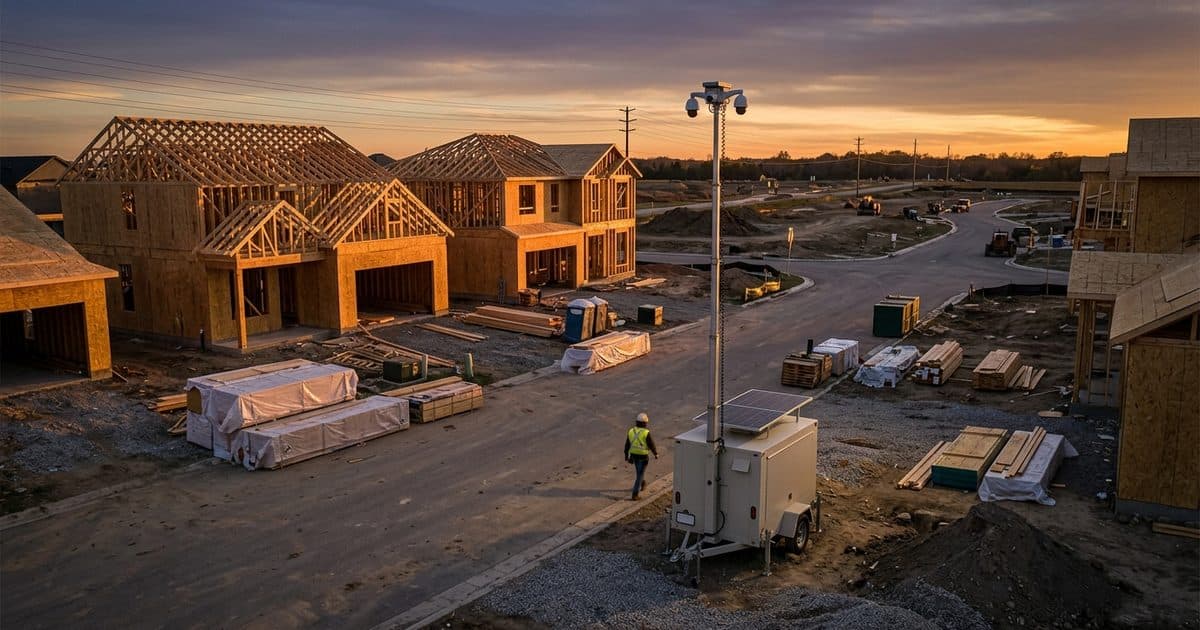
A single build has one perimeter. A tract community has dozens of lots at different stages, roads in progress and no real fence. Anyone can drive in, and from the road an open frame looks the same as an occupied one at night.
The site also changes quickly. A lot that is bare dirt in March holds a framed house by summer, and fixtures and appliances arrive late. The risk profile shifts with each phase, so a security plan that is fixed to one spot becomes outdated within weeks.
For general guidance on single-family work, see the overview of residential construction site security. This article focuses on the tract builder's three recurring exposures.
Exposure One: Material Drops
Deliveries are the most predictable moment of risk. Lumber, trusses, drywall, roofing and insulation arrive on a truck, get placed on a lot and wait for the crew. Until installation, those materials sit in the open with no one nearby.
Practical habits that help:
- Schedule drops close to installation so materials sit for the shortest time.
- Stage materials inside the active phase, in view of the entrance and any camera, not at the edge of the property.
- Count and sign for each delivery and photograph the staging area at the end of the day.
- Keep high-value items such as windows and fixtures in a locked container until needed.
The guide to lumber yard and building materials security covers how monitoring applies to stored materials, and the article on construction site theft prevention lists wider habits.
Exposure Two: The Model Home
The model is a different kind of target. It is furnished, often staged with electronics and decor, and open to the public during sales hours. After closing, it can be an empty, well-lit building in an otherwise dark community.
Security for a model has two parts. By day, staff need clear sign-in rules, locked back rooms for valuables and a plan for visitors who wander into active construction. After hours, the building and its parking area need coverage that does not depend on someone remembering to lock up.
Because the model sits next to active building, it also attracts curiosity. Visitors who walk into an open lot create a safety concern for the builder, not only a theft concern. Fencing and signage help, and camera coverage with talk-down gives a monitoring team the option to speak to a person who has crossed a line, as explained in the guide to live talk-down audio deterrence.
Exposure Three: The Entrance and Open Roads
Almost every vehicle that enters a subdivision passes one or two points. Watching those points tells you what came in and when, which is useful for investigations and for spotting patterns such as repeat after-hours visitors.
Lots near the entrance and along through-roads are easier for opportunists to reach. Lots deep inside the phase are harder, but once someone is in, they are out of sight of the road. That is why coverage at the entrance and over the active phase usually beats trying to watch every lot.
Matching Coverage to the Phase
The table below shows how coverage priorities change as a community builds out.
| Phase | Main exposure | Coverage priority |
|---|---|---|
| Site work and roads | Heavy equipment, fuel, utility materials | Equipment staging and entrance |
| Vertical framing | Lumber, trusses, hand tools | Active lots and material staging |
| Interior finish | Appliances, fixtures, cabinets, copper | Active lots, deliveries, model home |
| Sales and closings | Furnished model, punch-list access | Model, parking area, entrance |
Because the priorities shift, mobile coverage fits better than fixed installs. Think about where the unit will sit and what it can see before you deploy, using the checklist in surveillance trailer site selection.
Coordinating With Sales and the Association
A subdivision has more stakeholders than a typical job. Sales staff want an open, welcoming model. Early homeowners may move in beside active lots. If a homeowners association or similar group is forming, it may have its own views on cameras. The overview of HOA community security cameras covers the questions that tend to come up.
Recording rules and signage expectations vary by state and by municipality. Confirm your approach with counsel, and agree internally on who can request footage, how long it is kept and who handles police requests.
Closings and Early Residents
The security picture changes again when the first families move in. Occupied homes sit next to open lots, and residents notice anything unusual, which is helpful but can also create tension if cameras point toward their property. Decide early which areas the builder's cameras may cover and how residents will be told.
Closings and walkthroughs add visitor traffic to a community that still has active work. Give buyers a clear route that avoids open lots, keep crews and deliveries away from the model during appointments, and make sure the monitoring team knows when sales events or evening open houses are scheduled so planned activity is not mistaken for a problem.
Finally, set a handoff point. Once a phase is complete and the association or a management company takes over common areas, agree on who owns the cameras, who can request footage and what happens to the builder's monitoring plan. A written note at that stage saves arguments later.
How VDS Fits
VDS mobile surveillance units are solar-powered trailers, so they work in the early phases of a community where there is no site power, internet or trenching. Each carries a 5MP PTZ with 25x optical zoom and three 8MP wide-angle cameras on a 22 ft telescopic mast, with dual-SIM 4G/5G connectivity. AI detection covers people, vehicles, loitering, objects and license plates.
A 24/7 US-based security operations center verifies events and responds with live talk-down through a loudspeaker, then police dispatch with video if the situation calls for it. That means your superintendent or security partner handles verified incidents rather than raw alerts. Most deployments go from signed quote to live monitoring in about a week, and setup takes one person under 20 minutes. Rental, month-to-month and term subscriptions are available. See remote monitoring or talk to our team to plan coverage around your phasing.