
Why lumber yards are a hard target to protect
A materials yard is built for access. Forklifts, flatbeds and customer trucks move freely, stock is stored outdoors, and the fence line is long. During business hours that openness is the whole point. After hours it becomes the weakness.
Unlike a retail store, a yard has no front door to lock. Stock sits in the open or under covered racks, and a truck and a few people can load a lot in a short time. Pipe, wire, sheet goods, roofing and fixtures are all easy to resell, and the sheer volume of inventory means a loss can go unnoticed until the next count.
Yards also sit near the industries they serve. Contractors, builders and subcontractors know the layout and the schedule, which is a reminder that not all risk comes from strangers. Good access control and records protect against both.
What gets taken
The list varies by what a yard stocks, but a few categories are consistent:
- Lumber, plywood and engineered wood, taken by the load.
- Copper pipe, wire and fittings, which are easy to carry and easy to scrap.
- Roofing, siding, windows and doors.
- Power tools, hand tools and small equipment.
- Forklifts, trailers, skid steers and delivery trucks, along with their fuel.
Our guide to jobsite tool theft prevention covers many of the same dynamics from the customer side, and the article on warehouse security cameras is useful for covered storage and loading areas.
Fire is the other half of the problem
Stacked lumber, pallets, packaging and dry vegetation make a yard a fuel source. A fire that starts after hours can grow quickly because nobody is there to see it, and open storage means little to slow the spread.
Cameras do not replace fire alarms, sprinklers, hydrants or code-required systems. What they can add is an early visual warning. Analytics that detect visible flames or smoke can alert a monitoring team, who can verify the event on video and call the fire department with a clear view of what is happening. Our article on fire and smoke detection cameras explains how the technology works and where it struggles, for example in fog, steam or heavy dust.
Fire causes are not always theft or arson. Hot work, equipment faults and discarded material all play a part. Camera coverage of high-risk areas, such as the burn barrel zone, charging stations and fuel storage, gives you both warning and a record.
Fire codes and insurance requirements vary by location, so confirm obligations with your insurer and local authority.
Control after-hours access
Most thefts happen when the yard is closed. The goal is to know within moments when someone enters, rather than learning about it the next morning. A workable approach has four parts:
- A secure, lit gate that logs every vehicle in and out during working hours.
- Detection zones that alert on people and vehicles outside business hours, set per area of the yard.
- A monitoring team that verifies each alert on video.
- A way to act quickly, such as a spoken warning, then escalation to your security partner or police with video.
Our guide to after-hours security for businesses goes into the first steps, and the piece on video-verified alarm response explains why a verified event gets a better response than a bare alarm.
A spoken warning is often enough. When a person hears that they are being watched and asked to leave, many do. See the article on live talk-down audio for how that works.
Camera placement in an open yard
Open yards need a mix of views. A few that pay off:
- The gate and approach road. Capture vehicles and plates in and out. This is the best record you will have.
- The main stacks. Wide-angle views along the rows show who is walking where, and a PTZ camera can zoom to read a plate or identify a person.
- The back and side fences. Thieves often avoid the front. Cover the places they are most likely to cut in or back a truck up.
- Loading and shipping areas. Cover forklifts, trucks and staging for both theft and safety review.
- Fuel, charging and high-fire-risk zones.
Lighting and camera height both matter. Higher mounting widens the view but lowers detail, so combine wide coverage with a zoom camera. Our camera placement guidance explains the tradeoff.
Power, data and temporary coverage
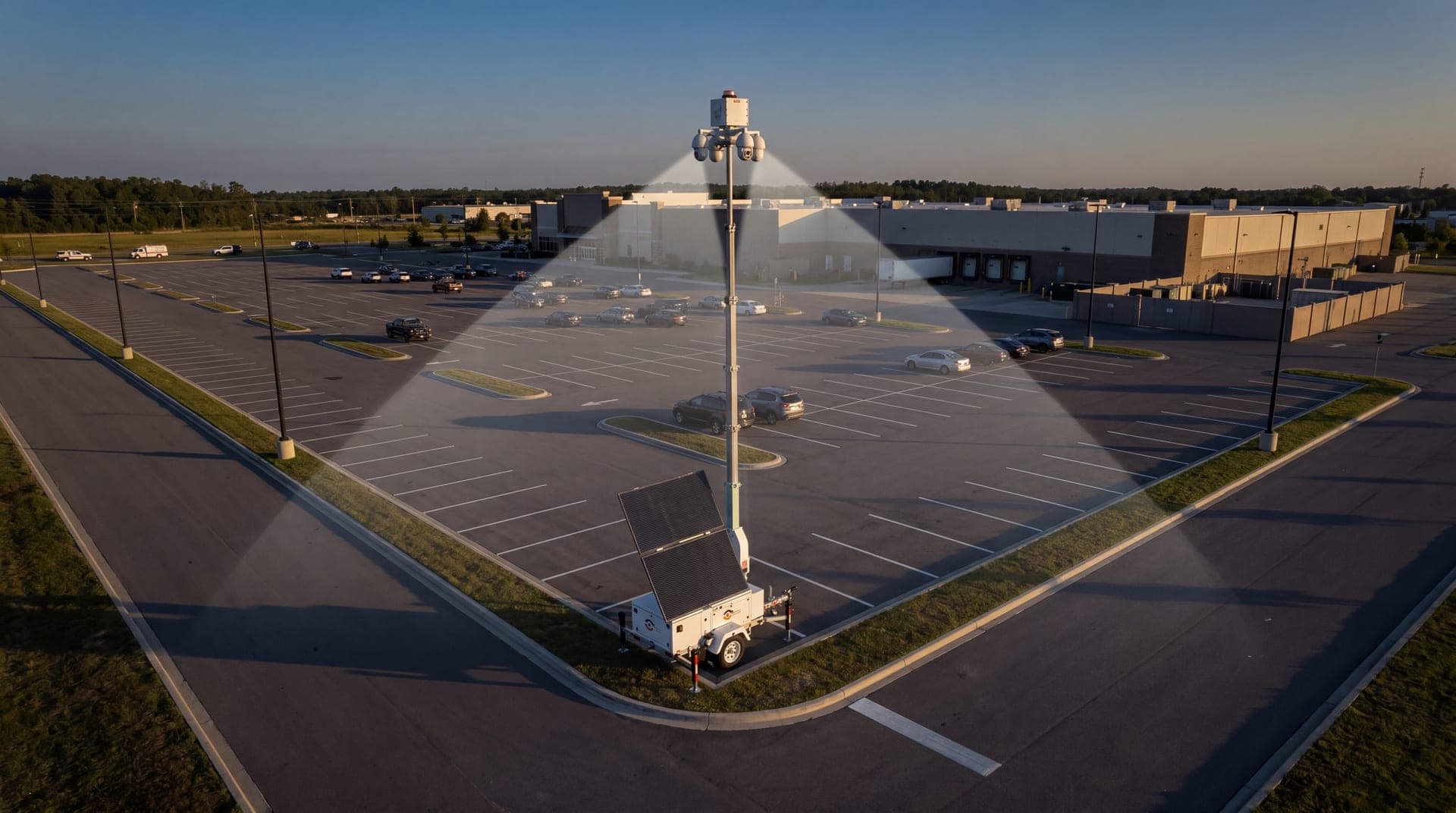
Yards often have power at the office and little at the far fence. Running cable across a large lot is slow and disruptive. Solar-powered cellular units sidestep that, and they can be moved as stock layout changes or when a project needs temporary extra coverage, such as a seasonal overflow area.
Plan for weather, dust and sawdust on lenses, and schedule routine cleaning and checks.
Quick reference
| Area | Main concern | What to set up |
|---|---|---|
| Gate and road | Unlogged entry and exit | Vehicle and plate capture, working-hours log |
| Lumber stacks | Theft by the load | Wide views along rows, after-hours detection |
| Back fence | Cut-in and truck access | Zone detection, PTZ follow-up |
| Loading area | Theft and safety | Forklift and truck coverage |
| Fuel and charging | Fire and fuel theft | Close view plus fire and smoke analytics |
How VDS fits
VDS builds solar-powered mobile surveillance trailers that need no site power, internet or trenching. Each unit has a 5MP PTZ camera with 25x optical zoom and three 8MP wide-angle cameras on a 22 ft telescopic mast (30 ft available). A 900W bifacial solar array charges an 11.8 kWh LiFePO4 battery bank with reserve for 3 to 5 consecutive cloudy days.
AI detects people, vehicles, loitering, objects and license plates, and platform analytics pages also cover fire and smoke. A 24/7 US-based security operations center verifies events, responds with live talk-down through a loudspeaker, then dispatches police with video. Most deployments go from signed quote to live monitoring in about a week. See the mobile surveillance unit or talk to our team.