
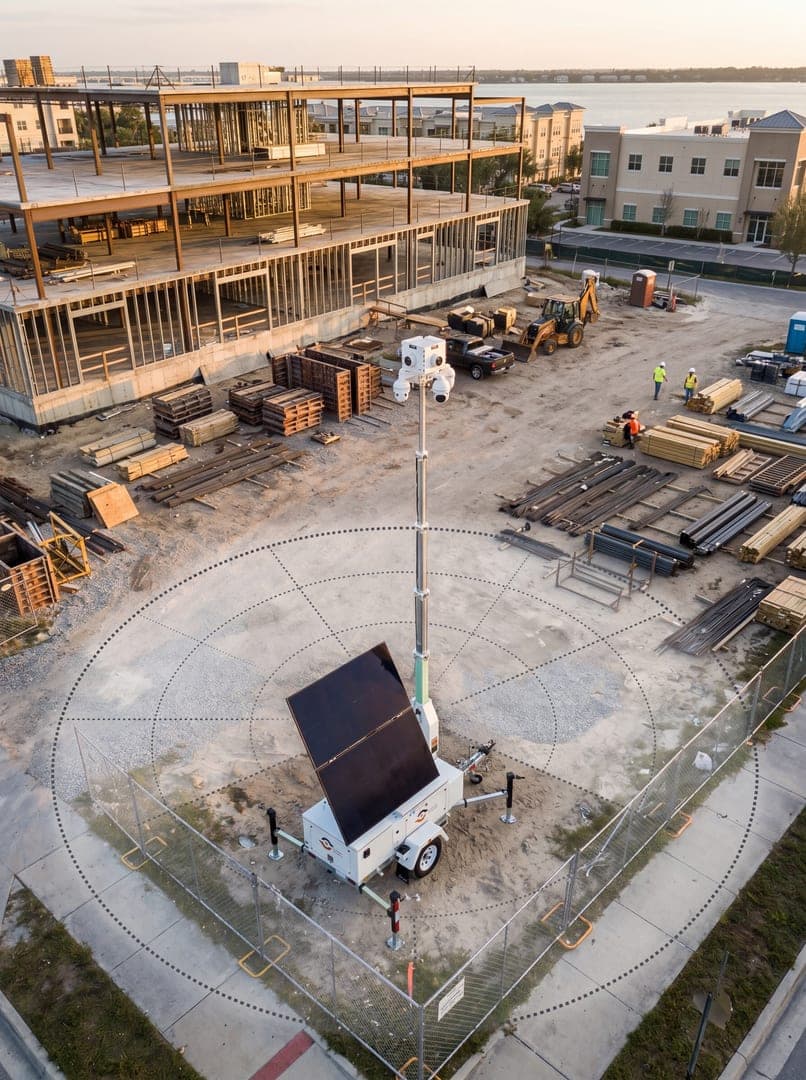
Start with what you are protecting
Site selection begins with a short list of what matters most. That might be a gate, a fence line, a material storage area, a parking field, a fuel tank or a building under construction. Mark these on a site plan, then ask which ones a single trailer can cover from one position.
Next, note how people and vehicles approach. Most incidents start at an entry point or along a predictable route. A trailer with a view of those approaches gives the earliest warning. If one position cannot cover everything, consider a second unit or a plan to relocate the trailer as work progresses. The construction site camera placement tips cover this reasoning for active build sites.
Sight lines and blind spots
A camera can only see what is not blocked. Walk the property and look for obstructions between the proposed position and each target, including parked vehicles, containers, stacked materials, trees, signs and structures that do not exist yet but will.
- Stand at the proposed spot and look at each area you want covered.
- Note anything that blocks the view now, and anything that might later.
- Look for long straight lines of sight, since they let the zoom camera do its job.
- Consider the angle. A camera looking straight along a fence sees intruders approach, while one looking across it sees them pass.
Mast height helps clear obstructions, but more height reduces facial and plate detail at the same distance. The security camera field of view guide and the guide to mounting height are useful companions here.
Sun exposure
A solar trailer depends on its array. Shade can sharply cut energy harvest, and a shadow across even part of a panel may reduce output more than its size suggests. Check where the sun will be across the day and across the season. Winter sun sits lower, so shadows from nearby buildings, trees and equipment grow longer.
Keep the array clear of obstacles that cast shade. Be especially careful of tall equipment that moves, such as cranes, stacked materials that will grow and trees that leaf out in spring. If a site has little open sky, ask the provider how that affects the power budget. Our solar security camera trailer article explains how the system charges and what limits it.
Entry points and deterrence
Whether the trailer should be conspicuous depends on your goal. Visible equipment, especially with lights and a speaker, can discourage people from trying anything. A less visible position can capture activity that a visible one would scare off. Most sites favor deterrence, because stopping an incident is better than recording one.
Position the trailer so that it covers entry points without making itself the easiest thing to reach. Placing it inside a fenced area or behind a barrier reduces exposure to vandalism and tampering. Leave room around it for a service vehicle to approach and for safe access to the stabilizers.
Ground conditions
Look at the surface under the trailer. It should be firm, reasonably level and free of standing water. Fresh fill, soft soil, mud, loose gravel and slopes all complicate setup, and wet ground can soften after rain. A trailer on soft ground may need pads under its stabilizers. If the site has a stable pad, a paved corner or compacted gravel, use it.
Also check overhead. Power lines, tree branches and structures can interfere with a mast when it is raised. Confirm clearance before deployment rather than discovering a conflict on delivery day. The full setup sequence is in our guide to deploying a surveillance trailer.
Cellular signal
A trailer sends video over cellular, so signal at the exact placement point matters. Signal can vary across a property because of terrain, buildings and metal structures. Test with phones on the carriers you intend to use, at the proposed position and at the mast height if you can. Look at both signal strength and actual data speed.
Ask the provider about carrier redundancy and what happens if the link drops. Dual-SIM units can use two carriers. For background on how the technology works, read about cellular security cameras on 4G and 5G.
Site selection scorecard
Score each candidate position from low to high on every factor. The totals make the tradeoffs visible and give you something to discuss with the provider.
| Factor | What to check | Questions |
|---|---|---|
| Sight lines | Obstructions now and later | Can it see entry points and key assets? |
| Sun | Shade across the day and season | Is the array clear of shadows in winter? |
| Entry points | Approach routes | Does it cover the way people arrive? |
| Ground | Firmness, slope, drainage | Can stabilizers sit solidly? |
| Overhead | Lines, branches, structures | Is there room for the raised mast? |
| Signal | Carrier strength and speed | Is the link reliable at this spot? |
| Access | Service vehicle route | Can it be reached for maintenance? |
Plan for change
Sites change. A construction project adds buildings, changes grades and moves materials. A yard reorganizes. A position that works in week one can be blocked by week ten. Build a review into your schedule, and treat relocation as a normal option. Many mobile units are designed for exactly this, with quick setup and teardown.
Walk the site at the right time
Visit the proposed spot at the times that matter. A position that looks open at noon may be in deep shadow by late afternoon, and a yard that is quiet on a weekend may be crowded with vehicles on a weekday. If your concern is after-hours theft, visit at dusk and look at lighting, reflections and glare from nearby fixtures.
Bring the person who knows the site best, whether that is the superintendent, the facility manager or the security lead. They know where people actually walk, which gate gets used when no one is watching and what is about to change. Take photos from the proposed mast position in each direction you care about. Those photos make the placement conversation with a provider much faster and catch obstructions before delivery.
How VDS fits
The VDS mobile surveillance unit is built for sites with no power or network. It uses a 900W bifacial solar array charging an 11.8 kWh LiFePO4 battery bank, with reserve for 3-5 consecutive cloudy days, and dual-SIM 4G/5G cellular. It raises a 5MP PTZ with 25x optical zoom and three 8MP wide-angle cameras on a 22 ft telescopic mast. Setup takes one person under 20 minutes, and no site power, internet or trenching is needed. See the mobile surveillance unit page, or send us your site details for a placement discussion.