
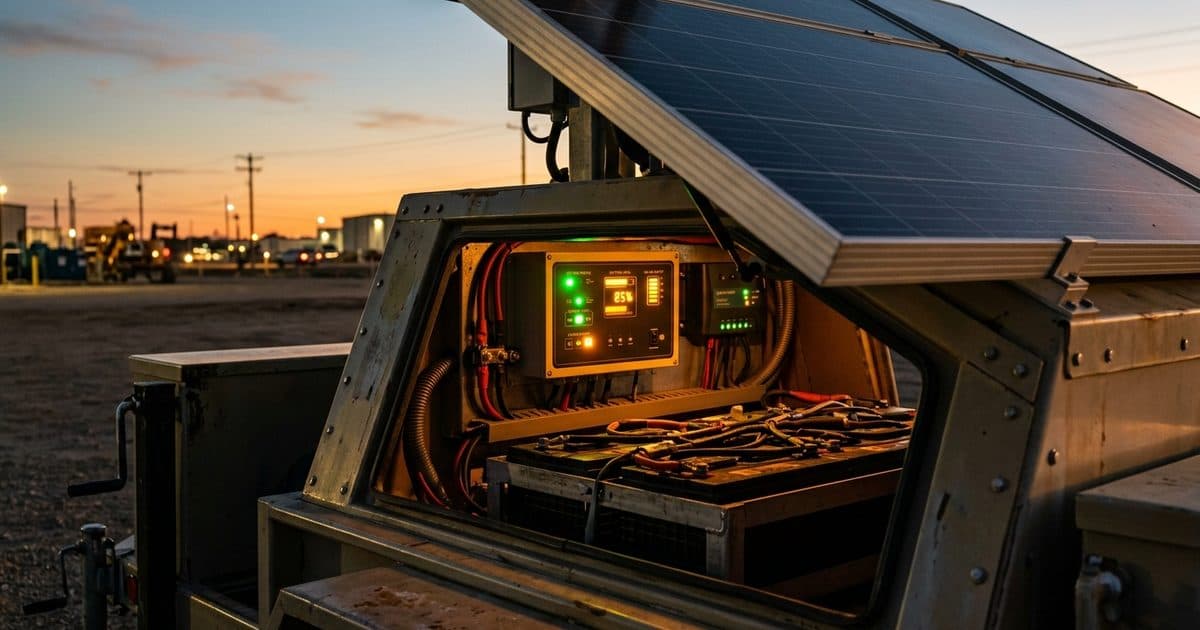
What does "always on" actually mean for a surveillance trailer?
Uptime is a chain, not a spec. A trailer is only protecting your site when the power system, the cameras, the network connection, the detection software, and the monitoring response are all working at the same time. A unit can be fully powered and still be effectively down because its modem lost signal, or fully connected and still useless because a fogged lens stopped the analytics from seeing anything.
That is why a bare uptime percentage tells you very little until the vendor defines it. Ask what is being measured (power, camera heartbeat, or verified end-to-end operation), over what period, whether the figure is fleet-wide or per unit, and whether degraded states count as up. A trailer running two of four cameras on a failing battery is "up" by some definitions and failing you by any practical one.
Detection reliability belongs in the same conversation, because an always-on trailer that cries wolf gets ignored. The DOJ COPS Office reported that 94–98% of alarm calls are false, a canonical but dated figure, and it explains why police deprioritize unverified alarms. Ask how alerts are filtered and verified before anyone is dispatched, not just whether the hardware stays powered. If you are still comparing vendors, our mobile surveillance trailer buyer's guide covers the full evaluation beyond uptime.
Is the solar array sized for your site or for the brochure?
Solar sizing claims are only meaningful relative to two numbers: the trailer's continuous power draw and the sun available at your location in its worst month. A vendor quoting "runs forever on solar" without asking where you are deploying has skipped the engineering. Since peak sun hours differ roughly 2× across the continental US per NREL's resource maps, an array that comfortably carries a load in the Southwest can run a steady daily deficit in the upper Midwest from November through February.
The load side matters just as much. Cameras, IR illuminators, cellular modems, analytics hardware, heaters, and strobes all draw power, and some vendors quote array size against a stripped-down configuration rather than the unit as actually shipped. Ask for the design load in watts with every feature you plan to use enabled, and ask whether the worst-month solar harvest at your latitude still exceeds it with margin.
Panel orientation and shading finish the picture. A jobsite trailer parked beside a building, a tree line, or a crane shadow harvests less than the datasheet assumes. Good vendors talk about placement guidance and seasonal tilt; weak ones just repeat the panel wattage. For a deeper walkthrough of how these systems are engineered, see our solar surveillance trailer guide.
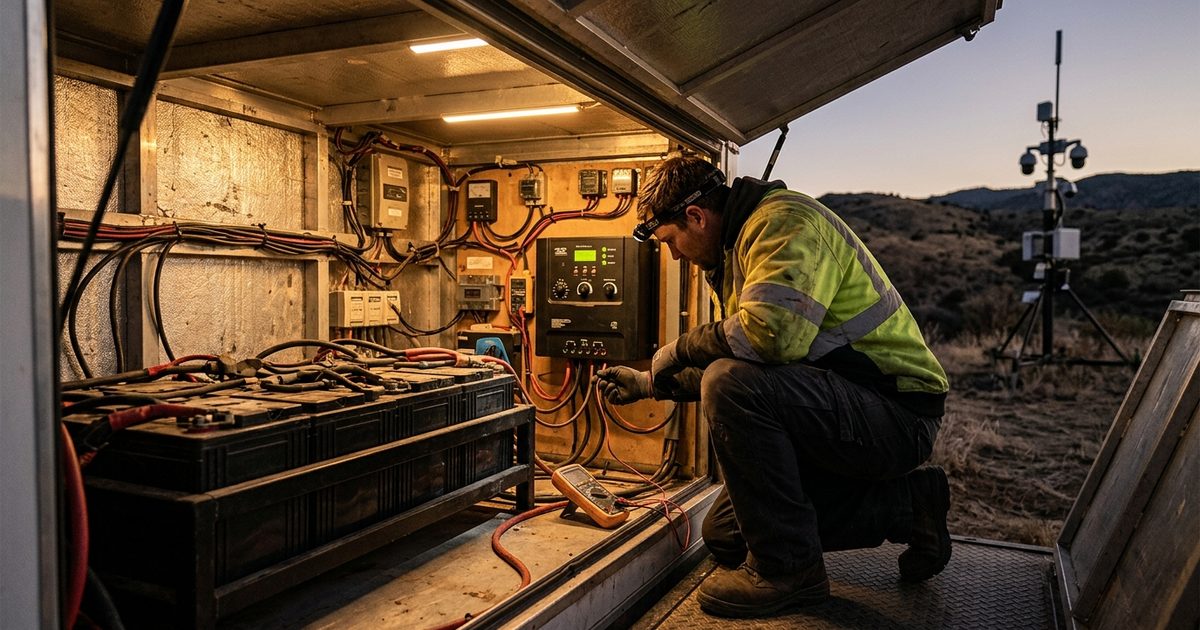
Do the "days without sun" claims survive the battery math?
Days-of-autonomy claims deserve simple arithmetic, and you should ask every vendor to show theirs. The honest version is usable battery capacity divided by daily load. As an illustration, a trailer drawing a continuous 100 watts consumes about 2.4 kWh per day, so a battery bank with 10 kWh of usable capacity delivers roughly four days with zero solar input. If a vendor's claimed autonomy implies a daily draw far below their own equipment list, the numbers were worked backward from the marketing.
"Usable" is the word to press on. Nameplate capacity is not usable capacity: lead-acid banks are typically cycled to only a fraction of their rating to preserve lifespan, lithium chemistries allow deeper discharge, and cold weather derates both. Ask which chemistry the trailer uses, what depth of discharge the autonomy figure assumes, and how capacity is derated for winter temperatures. We break down these battery variables, including chemistry trade-offs and cold-weather behavior, in our post on solar security camera battery life.
Also ask what happens at the end of those days. A controlled brownout that sheds IR illuminators before it sheds cameras, and cameras before it sheds the modem and telemetry, is very different from a hard shutdown that takes the whole unit dark without warning.
What backup takes over when solar and batteries fall short?
Hybrid power is how trailers stay up through the stretches solar math cannot cover. Common approaches include an on-board auto-start generator, a shore power connection where site power exists, and scheduled battery swaps. Each works; each fails differently. Generators need fuel logistics and cold-start reliability, shore power needs a live circuit that construction crews will not accidentally kill, and battery swaps need a vendor who actually shows up on schedule.
The questions that matter: Does the backup start automatically on a low-voltage threshold, or does someone have to notice first? Who monitors fuel level remotely, and what is the refuel interval at winter loads? Are there noise or emissions constraints at your site that limit generator runtime? If the answer to "what happens after five cloudy days" is "that almost never happens," you have found the gap in the uptime claim rather than an answer to it.
Will the connection stay up when the power does?
A powered trailer with no backhaul is a very expensive local video recorder. Cellular is the standard link, so ask which carriers the unit supports, whether it uses dual-SIM or multi-carrier failover, and whether the vendor performs a signal survey before deployment rather than discovering a dead zone afterward. On remote sites, ask whether satellite backhaul is available as a secondary path.
Two more layers separate resilient designs from fragile ones. First, on-board recording: when the network drops, the unit should keep capturing locally and backfill footage when the link returns, so an outage costs you live response but not evidence. Second, interference resilience: criminals increasingly attempt to jam or disrupt wireless links, and wired-free systems need detection and fallback behavior for that scenario. Our post on Wi-Fi jammers and security cameras covers how these attacks work and which design choices blunt them.
Does anyone know the trailer is down before you do?
Remote health telemetry is the difference between a maintenance program and an apology. A well-instrumented trailer reports battery voltage, solar charge current, camera heartbeats, modem signal, and enclosure temperature, and its vendor's operations team gets alerted on degradation trends before the unit fails outright. Ask to see the health dashboard, ask who watches it around the clock, and ask whether low-battery or offline events page a human or just write to a log.
Then ask about the response when telemetry finds a problem. What is the target response time for a truck roll? Are common spares (batteries, modems, cameras) stocked regionally? Is preventive maintenance, like panel cleaning and battery inspection, scheduled or purely reactive? A vendor who cannot describe this process concretely is telling you that uptime is your problem to discover, usually after an incident.
The uptime verification checklist
Use this table in vendor conversations. Any single red flag is worth probing; several together usually mean the uptime number is aspirational.
| Uptime Factor | What to Ask | Red Flag |
|---|---|---|
| Uptime definition | What exactly is measured, over what period, per unit or fleet-wide? | A percentage with no definition behind it |
| Solar sizing | Show the worst-month solar harvest vs full design load at my location | One nationwide claim regardless of geography or season |
| Battery autonomy | Show usable capacity, depth of discharge, and cold derating math | Autonomy quoted from nameplate capacity |
| Backup power | What takes over automatically after extended low sun? | "That almost never happens" |
| Connectivity | Multi-carrier failover? Signal survey? On-board recording during outages? | Single carrier, no local storage |
| Telemetry and maintenance | Who is alerted when a unit degrades, and how fast is response? | Customers report outages before the vendor sees them |
Why uptime gaps cost more than a few hours of footage
Downtime is not evenly costly, because theft is not evenly distributed. Roughly 80% of jobsite theft occurs outside working hours, a long-cited industry estimate attributed to NER and NICB reporting, which is exactly when a trailer that quietly ran out of charge overnight leaves you blind. And once equipment leaves the site, it rarely comes back: under 25% of stolen equipment is recovered, per a long-cited industry estimate from NICB and NER reporting. An uptime gap on the wrong night can cost more than the trailer's entire contract.
This is why Vision Detection Systems designs its solar-powered mobile surveillance units around the whole chain covered here: arrays and battery banks sized for regional conditions, connectivity failover, and health telemetry watched by our operations and monitoring teams, so verified incidents reach people, yours or your security partner's, while there is still something to respond to. We would rather answer the questions in this guide in writing than hide behind a single percentage, and we think you should hold every vendor, including us, to that standard.
The takeaway: never buy an uptime number. Buy the engineering behind it. Ask for the worst-month math for your site, the autonomy assumptions, the backup plan, the failover design, and the maintenance process, and let the quality of the answers, not the confidence of the claim, decide who protects your site.