
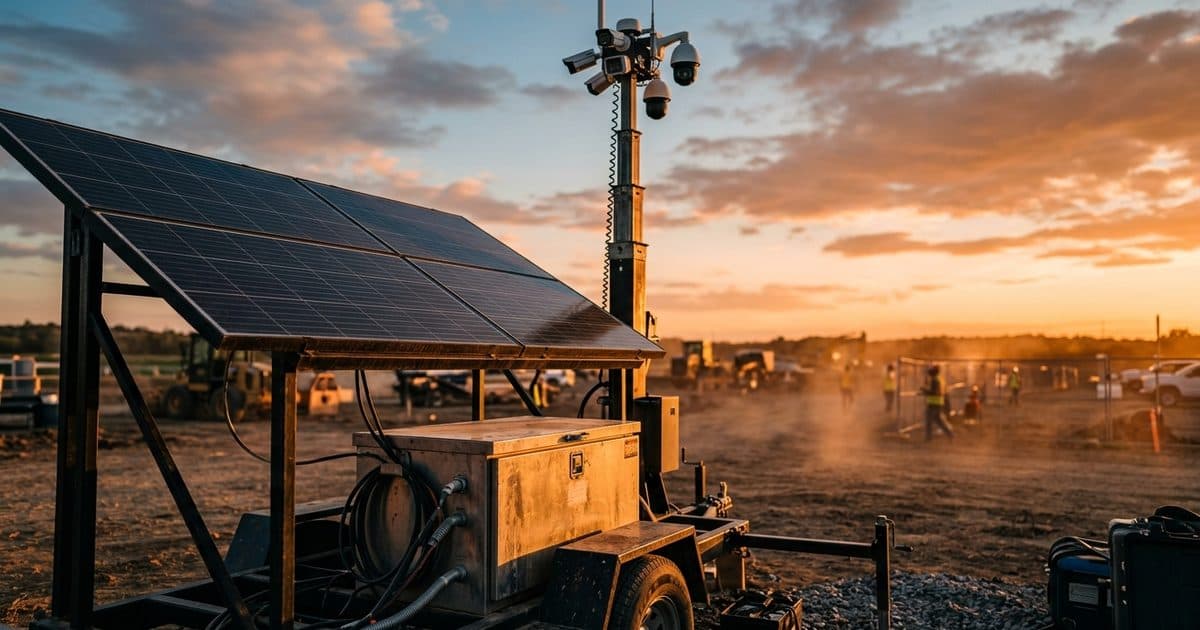
This is not a convenience feature. For sites without grid access — remote lots, early-phase construction, temporary perimeters, event venues — a solar surveillance trailer is often the only surveillance option that doesn't compromise on camera quality or runtime.
What Makes a Solar Surveillance Trailer Different
A standard grid-powered surveillance trailer needs a power source: a hardwire connection, a generator, or a fuel-dependent power unit. That creates two problems. First, it limits where you can deploy. Second, it adds ongoing dependencies — someone has to manage fuel, check connections, or coordinate with a utility.
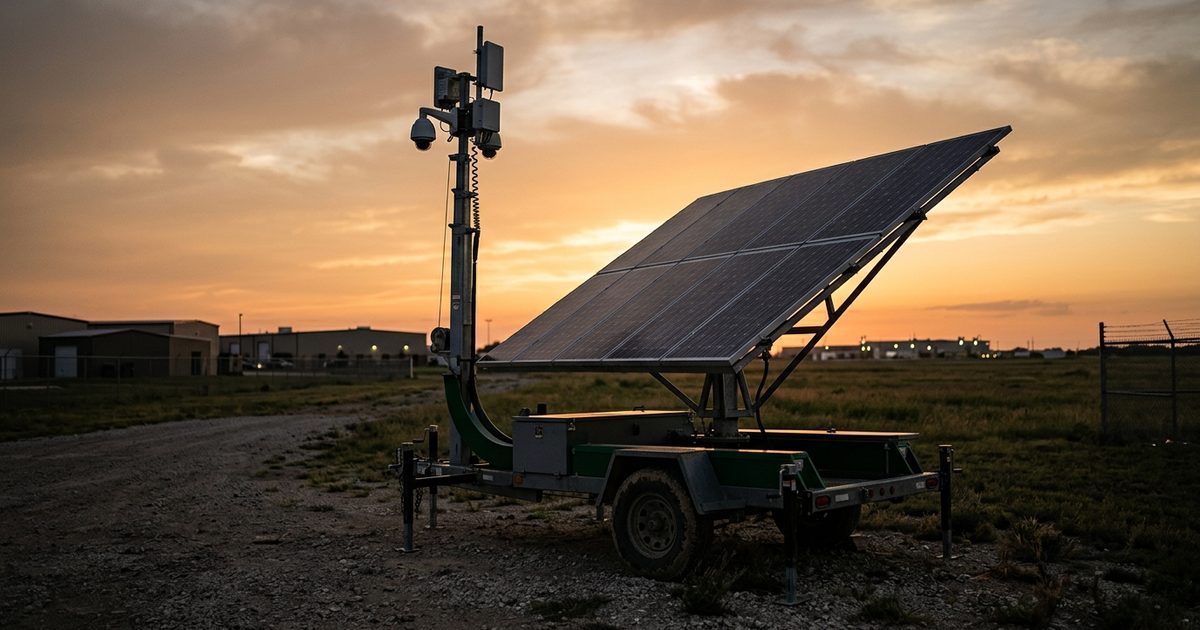
A solar surveillance trailer runs on a closed-loop power system. Solar panels charge an onboard battery bank during daylight hours. That stored energy powers the cameras, cellular uplink, and lighting through the night. On a properly sized panel array, a well-maintained battery bank handles 3–5 consecutive cloudy days before output degrades.
The operational difference is deployment speed. With no power hookup required, a solar-powered security camera trailer can be positioned in a new location in hours — not days. That matters when risk shifts mid-project or when an incident forces an emergency redeployment.
How the Power System Actually Works
Modern solar surveillance trailers use monocrystalline panels, which convert sunlight at roughly 20–22% efficiency under standard test conditions, according to NREL's photovoltaic research data. That efficiency rating matters because it determines how quickly your battery bank recovers after an overcast stretch.
The panels feed a charge controller, which regulates voltage into the battery bank — typically lithium iron phosphate (LFP) batteries at the commercial tier. LFP chemistry holds a charge longer in temperature extremes and has a longer cycle life than lead-acid alternatives. The system draws from the battery bank continuously, with solar recharge topping it off throughout the day.
The cellular uplink — 4G LTE or 5G depending on the unit — transmits footage and alerts to your monitoring team without relying on site Wi-Fi or local network infrastructure. That uplink stays active as long as battery power is above operational threshold, typically flagged by the system before it becomes a blind spot.
Tip: Runtime claims from vendors are almost always calculated under optimal solar conditions. For accurate planning, ask for the battery capacity in kilowatt-hours and the system's daily draw rate, then calculate your real buffer for a 48-hour low-sun period — that's your actual contingency window, not the headline spec.
Solar vs. Grid-Powered Trailer: Choosing the Right Tool
Both solar and grid-powered trailers deliver high-quality surveillance. The decision comes down to site conditions, deployment timeline, and how long the unit stays in one place.
| Factor | Solar Surveillance Trailer | Grid-Powered Trailer |
|---|---|---|
| Deployment time | Same day — no hookup required | 1–3 days pending power coordination |
| Power dependency | None — self-contained | Requires utility connection or generator |
| Ideal use case | Remote sites, temporary perimeters, early-phase construction, rapid redeployment | Long-term fixed deployments with established infrastructure |
| Cost profile | Higher upfront hardware; lower ongoing operational cost | Lower hardware cost; ongoing fuel or utility cost |
| Runtime (no sun) | 3–5 days on battery bank alone | Continuous while power source is maintained |
| Relocation flexibility | High — moves with the trailer, no disconnect process | Low — requires disconnection and re-hookup at new location |
The right answer depends on the site. For a 12-month construction project with a permanent site trailer and established utility service, a grid-powered unit often makes sense for high-density coverage zones. For perimeter coverage, parking areas, or any area where the risk profile shifts, a solar mobile surveillance unit gives you the flexibility to move coverage without rebuilding the deployment.
When to Deploy a Solar Surveillance Trailer
The clearest trigger is any site or situation where grid access is unavailable, unreliable, or logistically impractical. That covers most construction site security scenarios in the pre-utility phase — before permanent power is run but after high-value equipment starts arriving. That gap between first delivery and utility hookup is one of the highest-risk windows on any jobsite.
Beyond construction, the use cases include remote parking lots without infrastructure, events on private land, temporary perimeters during facility transitions, and municipal deployments in areas without convenient power access. Any situation where the risk is real, the timeline is immediate, and waiting on an electrician is not an option.
If you're evaluating options for an active site, the Mobile Surveillance Unit covers the full deployment spec — camera configuration, uplink options, and coverage radius by unit type. For sites where you already have infrastructure and just need to add coverage zones, the Solar Surveillance Kit is worth reviewing as a targeted expansion option.
What a Deployment Actually Looks Like
A typical solar surveillance trailer deployment starts with a coverage plan. That means identifying the highest-risk zones — entry points, equipment staging areas, perimeter blind spots — and positioning the trailer for maximum camera overlap. A single unit covers a defined radius. Multiple units create interlocking coverage with no dead zones between them.
Once positioned, the unit connects to your remote monitoring platform via cellular uplink. Your team defines the detection zones, alert thresholds, and escalation rules in advance. When a motion event triggers within a defined zone — not the whole frame, not the entire site — an alert fires. A trained monitoring operator verifies the alert against live footage before any escalation takes place.
That verified response step is what separates monitored surveillance from recorded surveillance. Recordings are useful after an incident. Verified response stops the incident or documents it in real time, producing evidence-ready footage with timestamped alert logs. When law enforcement responds or when an insurance claim goes to review, that documentation structure is what makes the difference.
For projects where construction site security cost is a key decision variable, a useful benchmark is available in the breakdown of construction site security cost per month — which covers monitoring tiers, equipment considerations, and how solar deployment affects the total.
Common Mistakes When Using a Solar Surveillance Trailer
- Positioning based on convenience, not coverage. Placing the trailer near the site entrance because it's easy to access — rather than where the actual risk is — is the single most common deployment error. Run a coverage plan before the unit arrives, not after.
- Relying on the default detection zone without tuning it. Out-of-box sensitivity settings generate high alert volume. Untested alert rules create alert fatigue, which means real events get missed. Define your zones, test your thresholds, and confirm escalation paths before you go live.
- Treating the solar trailer as a static asset. Risk on an active site changes as the project progresses. A coverage plan that made sense at foundation phase may miss entirely new exposure areas at framing or mechanical stage. Build redeployment into your security workflow, not just your initial setup.
- Ignoring the battery bank in winter deployments. Solar output drops in low-sun months and in northern climates. If you're deploying through winter without checking battery capacity against your average daily draw, you may find runtime gaps on consecutive overcast days. Get the specs, model the worst case.
- Skipping the escalation workflow review. A solar surveillance trailer with no defined escalation protocol is a recording device, not a security tool. Before deployment, confirm who gets alerted, at what threshold, and what response looks like — whether that's on-site guard dispatch, law enforcement notification, or site manager contact. The hardware is only as good as the process behind it.