
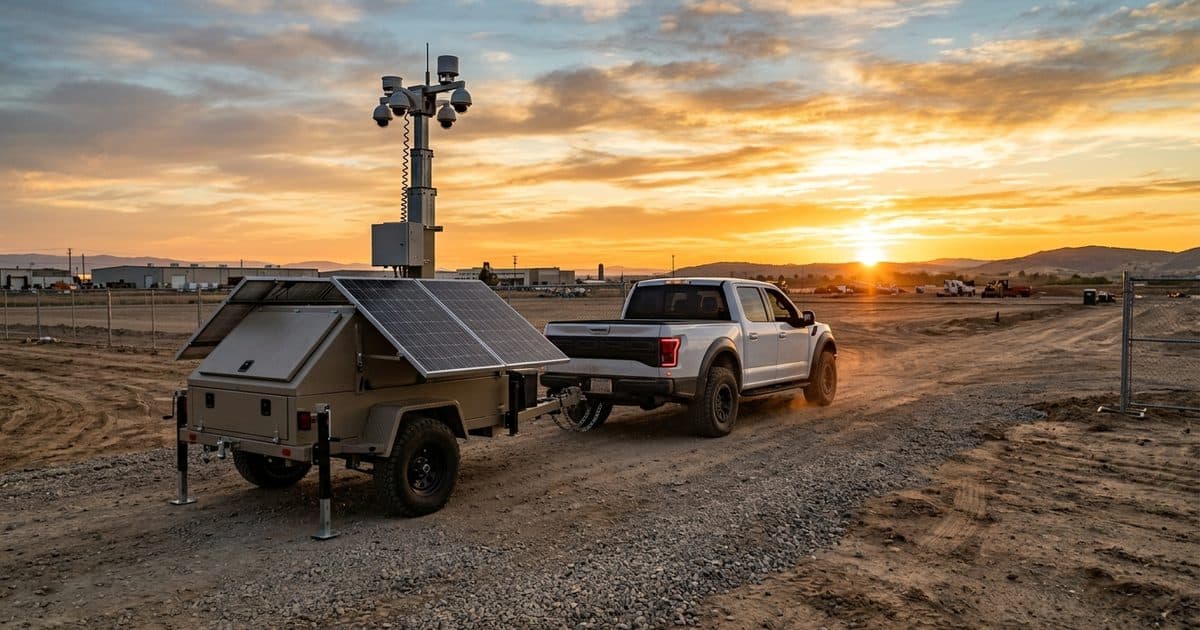
Mobile surveillance trailer pricing: the published market rates
Most vendors in this category quote privately, but enough publish rates — rental sites, online stores, and public procurement records — to assemble an honest market picture. The table below is built entirely from those published figures.
| Service tier | Typical monthly cost | What's included |
|---|---|---|
| Basic dry rental | $800–$1,200 | Trailer, cameras, local recording, solar/battery power — nobody watching |
| Full-featured unit | $1,500–$2,500 | Dry rental + cellular connectivity, cloud storage, alert notifications |
| With live monitoring | $1,800–$2,800 | Full-featured + 24/7 remote monitoring, verified response, incident reporting |
A few useful anchors from the ends of the market: budget-tier vendors advertise monitored units from roughly $799 per month, while at the premium end LVT — the category's best-known brand — publishes rates from about $2,395 per month on 12–24 month terms. The live-monitoring premium itself typically adds $300–$500 per month over an equivalent unmonitored unit.
On the purchase side, published prices run from roughly $12,000 at the budget end to $55,000 for premium units, and public-agency procurement records show annual per-unit service pricing near $45,000 for top-tier providers.
Deployment and retrieval typically add $200–$500 to initial setup depending on distance and site requirements; many providers waive deployment fees on contracts past 90 days.
What actually drives the price
Equipment level. PTZ cameras, thermal imaging, and license plate recognition command higher rates than fixed-camera builds. Solar array size and battery capacity matter more than they look on a spec sheet — an undersized power system is the difference between a unit that runs through winter and one that goes dark in December. Ask for the winter solar math, not the summer number.
Monitoring tier. The biggest single swing in the table above. A dry rental records a theft; a monitored unit interrupts one. Human operators verifying alerts and executing escalation is what turns a camera from documentation into deterrence — it's also what the $300–$500 premium buys.
Contract length. Month-to-month carries premium rates; longer commitments discount meaningfully. But read the fine print with the same attention as the rate: buyers in this category report multi-year lock-ins, narrow cancellation windows, and billing that continues after cancellation. A fair term and a plain cancellation clause are worth real money.
Geography and logistics. Remote sites needing signal boosters or long maintenance drives carry additional charges. Metro areas with fleet concentration usually see lower deployment costs.

What the sticker price leaves out
The gap between advertised rates and the all-in monthly number is where budgets go wrong. Before signing, get written answers on:
- Connectivity and data. Some plans throttle cellular data after monthly
- Deployment, retrieval, and relocation fees. Moving a unit mid-contract
- Service and repair. Who fixes a dead unit, and on what timeline? Buyers
- Storage and evidence retrieval. Video retrieval and incident
The guard-cost yardstick
The most common budgeting comparison is against staffed guards, at third-party market rates: guard services run $25–$45 per hour depending on region and certification. That works out to roughly $3,000–$6,000 per month for overnight-only coverage of a single post, and $10,000–$20,000 per month for true 24/7 coverage — before overtime, holiday premiums, and replacement staffing.
The honest comparison isn't "cameras instead of people." A monitored trailer covers wide perimeters continuously and documents everything; people — yours or your security partner's — handle verified incidents, access control, and response. Most cost-effective programs pair the two: continuous detection and verification from the trailer and monitoring floor, human response where a human is actually needed. See the full breakdown in our monitoring vs. guards comparison, or run your own numbers in the ROI calculator.
Rental vs. purchase: which makes sense when
Rent for defined windows — special events, construction phases, seasonal retail — and for testing coverage positions before permanent installation. Rental also keeps technology obsolescence and maintenance off your books.
Buy when the deployment is effectively permanent and you have the team to maintain the fleet. At published market prices, the crossover math typically lands between 18 and 30 months of equivalent rental — but only if the purchase includes the software, storage, and monitoring you'd otherwise rent.
Multi-site operators often get the best economics from a rental or lease fleet they can shift between properties as threat patterns move, rather than buying for peak demand across every site.
Why most vendors won't publish prices — and how VDS quotes
Two honest reasons: every site genuinely needs a different configuration (coverage area, unit count, analytics, monitoring tier), and most vendors sell through dealers who set their own margins.
VDS doesn't publish a rate card either — every quote is engineered from your actual site. What we can tell you: customers report landing 70–90% below their prior security spend, and you can see the drivers yourself. Design your site — trace your property, place coverage, pick a monitoring tier — and a specialist returns a complete deployment plan within 24 hours. No phone tree, no pressure, and you'll understand exactly what you're paying for before anyone asks for a signature.