
Key takeaways
- A remote surveillance trailer packages power, cameras, analytics, connectivity, and deterrence into one unit that runs without site utilities.
- The system only works as well as its weakest link. Battery reserve and cellular coverage matter as much as camera resolution.
- Monitored trailers outperform record-only units because someone can verify and respond in real time. Research on CCTV supports this.
- You can rent, subscribe, or buy. Monitoring level, camera count, analytics, and term length drive cost more than the trailer itself.
- Ask every provider the same checklist questions: response workflow, analytics accuracy, power autonomy, compliance, evidence handling, and contract terms.
What is a remote surveillance trailer?
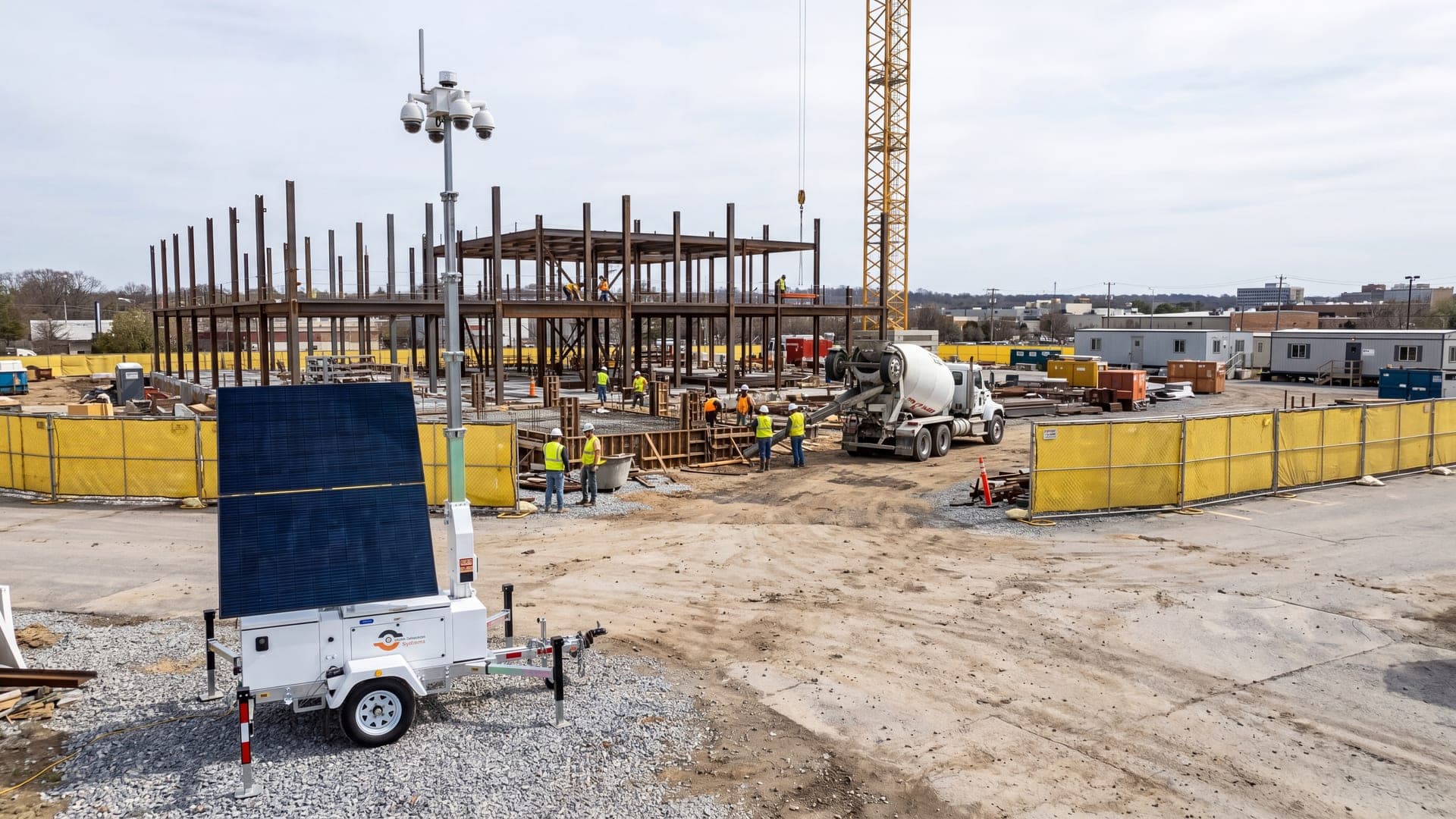
A remote surveillance trailer, also called a mobile security trailer, mobile surveillance unit, or camera trailer, is a portable security platform mounted on a towable chassis. It carries its own power supply and network connection, so it can be dropped at a construction site, parking lot, substation, or event footprint and start monitoring the same day without electricians, trenching, or network drops.
Fixed CCTV needs poles, power, cabling, and often permits, which makes it a poor fit for temporary sites. A guard can only be in one place at a time. A mobile security camera trailer gives elevated, continuous coverage that moves when the job moves, and gives the people on site—yours or your security partner's—verified incidents to act on. For a side-by-side look at when each approach wins, see our comparison of remote surveillance trailers vs. fixed cameras.
How a remote surveillance trailer works
Every unit follows the same chain, from power generation to a response on the ground.
1. Power. Solar panels on the roof or mast charge an onboard battery bank during the day. The batteries run the cameras, modem, and lights overnight and through stretches of cloudy weather. Well-designed units size the array and battery so the system stays online without a generator. Our solar surveillance trailer guide covers panel and battery sizing in more depth.
2. Cameras and analytics. Cameras on a telescoping mast look down over the site from height, which widens the field of view and puts the equipment out of reach. Onboard or cloud AI video analytics separate a person or vehicle from swaying branches, animals, and headlights, and decide what becomes an alert.
3. Connectivity. A cellular modem sends alerts, clips, and live video to the monitoring center and to the customer's app. Most units cache footage locally too, so recording continues if the signal drops.
4. Monitoring. When analytics flag an event, an operator in a remote monitoring center reviews the live feed, confirms whether it is a real threat, and follows the site's response plan. Record-only units skip this step and store footage for later review.
5. Response. Verified intruders typically hear a live voice warning through the trailer's speaker, often with strobes or floodlights. If they don't leave, the operator calls police with a confirmed description, which tends to get a faster response than an unverified alarm. The footage is then saved as evidence.
What's inside a mobile security trailer
Specs vary widely across the industry. The table below describes each component, what it does, and the questions worth asking about it.
| Component | What it does | What varies across the industry | What to ask |
|---|---|---|---|
| Chassis and trailer | Carries the system; tows behind a standard pickup | Size, axle count, leveling jacks, anti-tow and anti-theft hardware | How is it secured against theft or tampering? |
| Telescoping mast | Raises cameras for a wider, tamper-resistant view | Height, manual vs. powered raise, wind rating | What wind conditions require lowering? |
| Cameras | Capture the scene day and night | Resolution, fixed vs. PTZ, thermal options, IR range, number of cameras | Can the cameras identify a person or read a plate at the distances this site needs? |
| Analytics | Detects people, vehicles, loitering, objects, plates | Onboard vs. cloud, detection classes, false-alarm filtering | What share of alerts are real, and how is it tuned? |
| Solar and battery | Powers the system off-grid | Panel wattage, battery chemistry and capacity, generator backup | How many cloudy days can it run without sun? |
| Cellular modem | Sends video and alerts | Single vs. multi-carrier, antenna quality, data plan | What happens to recording if signal drops? |
| Lights and speaker | Deters and warns intruders | Strobes, floodlights, pre-recorded vs. live talk-down audio | Is audio live from an operator or automated? |
| Enclosure and storage | Protects electronics and stores footage locally | Weatherproofing, temperature management, onboard storage | How long is footage kept, and who controls it? |
Two components deserve extra attention. Power autonomy decides whether the trailer stays online during winter or a week of storms; ask for the cloudy-day reserve, not just panel size. Analytics quality decides whether operators chase wind-blown tarps all night or focus on real events. Our guide to reducing false alarms in video analytics explains what separates good detection from noisy detection.
For buyers using federal funds, component sourcing matters too. The FCC's Covered List includes video surveillance equipment from Hikvision, Dahua, and Hytera for certain public safety and security uses, so agencies should ask for written NDAA compliance documentation that covers cameras, recorders, and communications hardware.
Where surveillance trailers are used
Camera trailer security fits any site that is temporary, spread out, changing, or missing infrastructure.
- Construction. Jobsites change weekly and rarely have permanent power in the early phases. Trailers protect materials, tools, and equipment after hours and move as phases progress. See construction site security.
- Parking lots and garages. Vehicle break-ins and catalytic converter theft are fast, opportunistic crimes, and parking facilities showed the largest and most consistent CCTV effects in a major meta-analysis. See parking security.
- Public safety. Agencies deploy trailers to hot spots, investigations, and problem corridors, then relocate when patterns shift. See public safety solutions.
- Events and temporary venues. Festivals, fairs, and seasonal operations need coverage for days or weeks, not years. See event and temporary security.
- Utilities. Substations, laydown yards, and right-of-way projects face copper and equipment theft far from any network drop. See utility security.
- Retail. Shopping center lots, holiday overflow parking, and store remodels benefit from visible, elevated coverage. See retail security.
Adding license plate recognition at entrances is common in parking, retail, and public safety deployments, where knowing which vehicles entered matters as much as seeing people.
Monitored vs. record-only surveillance trailers
A record-only trailer captures footage that someone reviews after an incident. A monitored trailer routes alerts to trained operators who can intervene while it is happening.
| Factor | Record-only trailer | Monitored trailer |
|---|---|---|
| What happens during an intrusion | Footage is recorded; nobody may know until morning | Operator verifies, issues a live warning, calls police if needed |
| Deterrence | Visible cameras and lights only | Visible cameras plus live voice and escalation |
| Police response | Report filed after the fact | Verified, in-progress call with a description |
| Evidence | Available if someone finds and exports it | Incident clips flagged and saved as they happen |
| Relative cost | Lower recurring cost | Higher recurring cost; usually lower loss |
| Best for | Low-value sites, documentation, liability records | Theft-prone sites, high-value materials, open-ended risk |
The research supports paying for monitoring where losses are material. A 40-year systematic review of CCTV studies by Piza, Welsh, Farrington, and Thomas found that CCTV is associated with a significant, modest decrease in crime, and that schemes incorporating active monitoring generated larger effects than passive systems. The Urban Institute's evaluation of public camera programs reached a similar conclusion: where cameras were concentrated and routinely monitored by trained staff, the impact on crime was significant and cost-beneficial, with no evidence of displacement.
A 24/7 security operations center is what turns a camera trailer into an active defense rather than a recording device.
What remote surveillance trailers cost
There is no single price for a mobile surveillance unit because providers bundle hardware, monitoring, and service differently. Compare the model first, then the line items.
| Model | How it works | Best fit | Watch for |
|---|---|---|---|
| Rent | Short-term or project-based use, often with monitoring bundled | Construction phases, events, seasonal needs | Delivery and pickup fees, minimum terms, damage policies |
| Subscription | Month-to-month or term agreement covering hardware, monitoring, and service | Ongoing sites that want predictable monthly cost | Auto-renewals, early-termination terms, what service includes |
| Buy | Own the trailer outright; pay separately for monitoring, data, and maintenance | Organizations with long-term, multi-site needs and in-house staff | Maintenance, battery replacement, cellular plans, monitoring contracts |
What drives the cost:
- Monitoring level. Continuous live monitoring costs more than alert-based monitoring, which costs more than record-only. It is usually the largest recurring line.
- Camera count and type. More cameras, PTZ units, thermal, or LPR add hardware and data cost.
- Analytics. Advanced detection classes can be priced as add-ons.
- Term length. Longer commitments usually lower the monthly rate.
- Delivery distance and logistics. Remote or hard-to-access sites add transport time.
- Service and maintenance. Who handles battery health, cleaning, and repositioning, and whether that is included.
- Power configuration. Low-sunlight locations may need extra solar capacity or backup power.
For typical rental structures and the line items to expect on a quote, read our breakdown of mobile surveillance trailer rental cost. If you're weighing short-term options, see VDS rental plans.
How to choose a remote surveillance trailer provider
- Response workflow. Who watches the cameras, where are they located, and what exactly happens after an alert? Ask for the escalation path from warning to police dispatch.
- Analytics accuracy. Which detection types are included, and how does the provider keep false alarms down in wind, rain, and headlights?
- Power autonomy. How many consecutive cloudy days can the unit run? What is the plan in winter or shaded locations?
- Connectivity. How is cellular coverage checked before deployment, and does recording continue if the connection drops?
- Deployment time. How long from signed agreement to live monitoring, and how long does on-site setup take?
- Compliance. Is the hardware NDAA Section 889 compliant, with documentation?
- Evidence handling. How long is video retained, how are clips exported, and who owns the footage?
- Contract terms. Rental vs. subscription options, minimum term, relocation fees, and what service is included.
- Support and maintenance. Who responds if a unit goes offline, and how quickly?
How VDS delivers remote surveillance trailers
Vision Detection Systems builds its mobile surveillance unit around the monitored model:
- Self-contained power and connectivity. A 900W bifacial solar array charging an 11.8 kWh LiFePO4 battery bank, with reserve for 3–5 consecutive cloudy days, and dual-SIM 4G/5G cellular. No site power, internet, trenching, or permits for temporary placement. Existing sites can also add a solar kit.
- A 5MP PTZ with 25× optical zoom plus three 8MP wide-angle cameras on a 22 ft telescopic mast (30 ft available), with AI detection for people, vehicles, loitering, objects, and license plates.
- 24/7 US-based SOC that verifies events and responds with live talk-down, then police dispatch.
- Evidence-ready video with managed retention.
- NDAA Section 889 compliant hardware.
- Flexible terms: rental or month-to-month and term subscriptions.
Most deployments go from signed quote to live monitoring in about a week, and on-site setup takes one person under 20 minutes, with no crew. Review the remote surveillance trailer specs, call (410) 401-1986, or get a site-specific quote.
Sources
- Piza, E. L., Welsh, B. C., Farrington, D. P., & Thomas, A. L. (2019). CCTV surveillance for crime prevention: A 40-year systematic review with meta-analysis. Criminology & Public Policy, 18(1). Abstract via the Office of Justice Programs: ojp.gov
- La Vigne, N. G., Lowry, S. S., Markman, J. A., & Dwyer, A. M. (2011). Evaluating the Use of Public Surveillance Cameras for Crime Control and Prevention. Urban Institute. urban.org
- Federal Communications Commission. List of Equipment and Services Covered by Section 2 of the Secure Networks Act. fcc.gov