
What field of view means
Imagine standing at the camera and spreading your arms to show the span it can see. That span, measured as an angle from the lens outward, is the angle of view. At a given distance, a wider angle covers a wider strip of ground.
Two things follow. First, the coverage grows with distance, so a camera that sees a narrow strip near the pole sees a much wider strip at the far end. Second, the same sensor is stretched across whatever the lens takes in, which brings us to the trade-off at the center of this topic.
Focal length in plain terms
Focal length is a lens property, given in millimeters. You do not need the optics. You need the direction of the effect.
- Shorter focal length gives a wider angle of view. Objects look smaller and farther away.
- Longer focal length gives a narrower angle of view. Objects look larger and closer.
Many cameras come with a fixed lens. Others have a varifocal lens that you can adjust within a range during installation, which is handy when you are not sure of the final distance. A PTZ camera, covered in our guide to what a PTZ camera is, changes focal length by motor, so its field of view can be wide one moment and narrow the next.
Wide versus narrow
| Wide view | Narrow view | |
|---|---|---|
| Area covered | Large | Small |
| Detail on a subject | Low | High |
| Best for | Awareness, detecting activity, following movement | Identification, reading plates, close inspection |
| Risk | Subjects too small to identify | Missing what happens outside the frame |
| Typical placement | Corners, poles, elevated mounts | Gates, doors, choke points |
The trade-off comes from pixels. A sensor has a fixed number of them. A wide lens spreads those pixels over a large scene, so each person or vehicle gets few. A narrow lens spends them on a smaller area. This is why a high megapixel number does not rescue a view that is too wide, and why our resolution guide focuses on pixels on target rather than megapixels.
Choose the view by the task
Start from what you need to see, then pick the field of view.
- Awareness of an area. A wide view that shows who and what is in the space, and where they are moving.
- Detection by analytics. A wide to medium view where people and vehicles are large enough for software to find them reliably.
- Identification. A narrow view of the place people must pass, such as a gate or entrance.
- Plate reading. A tightly framed view of one lane, set up for the purpose. Our LPR camera settings guide explains how.
If a camera has to do two of these at once, it usually does neither well. Split the jobs between cameras.
Overlap between cameras
When you cover a site with several cameras, their views should overlap. Without overlap, a person can step out of one view before they appear in the next, and there is a seam where nothing is recorded.
Overlap helps in three ways.
- No gaps at the seams. Each camera's edge is covered by its neighbor.
- Continuity. An observer can follow a person from one view to the next without losing track.
- Backup. If a camera is blocked, damaged or pointed away, a neighbor still sees part of the area.
Image quality drops toward the edges of a very wide lens, so do not count on the outer edge for important detail. Plan for the important areas to fall in the center of a view.
Blind spots
A blind spot is any place in the area you meant to cover that no camera actually sees. They come from a few common causes.
- Obstructions. Poles, trees, signs, vehicles, stacked materials and building corners.
- Mounting position. A camera mounted close to a wall cannot see along it. A camera mounted high can lose the ground directly beneath it.
- Changing conditions. Seasonal foliage, parked trailers or equipment moved after the plan was made.
- Aiming drift. A camera that gets bumped, or one that settles over time, points somewhere new.
Find them by checking the live view from each camera, and by walking the area while someone watches the screen. Repeat the check whenever the site changes. Our camera placement tips cover the placement side, and how many security cameras a business needs helps with quantity.
Mounting height and field of view
Height changes what a camera sees. A higher mount widens the area the view covers and reduces blind spots caused by obstructions, since it looks over them. It also changes the angle at which faces and plates are seen, and a steep downward angle can show the tops of heads instead of faces. Height buys coverage, and it costs facial detail. Pick the mount height to match the job, and use a narrower, closer camera where identification matters.
Combining wide cameras with a zoom camera
One camera cannot be wide and narrow at once, so many sites use two kinds. Fixed wide-angle cameras provide continuous coverage and give analytics something to watch across the whole area. A zoom camera, usually a PTZ, then goes to a specific spot for a closer look when something happens. It is the arrangement we describe in our comparison of PTZ versus fixed cameras.
The limit is that the zoom camera can only look at one place at a time, so the wide cameras remain the safety net.
How VDS uses wide cameras and zoom
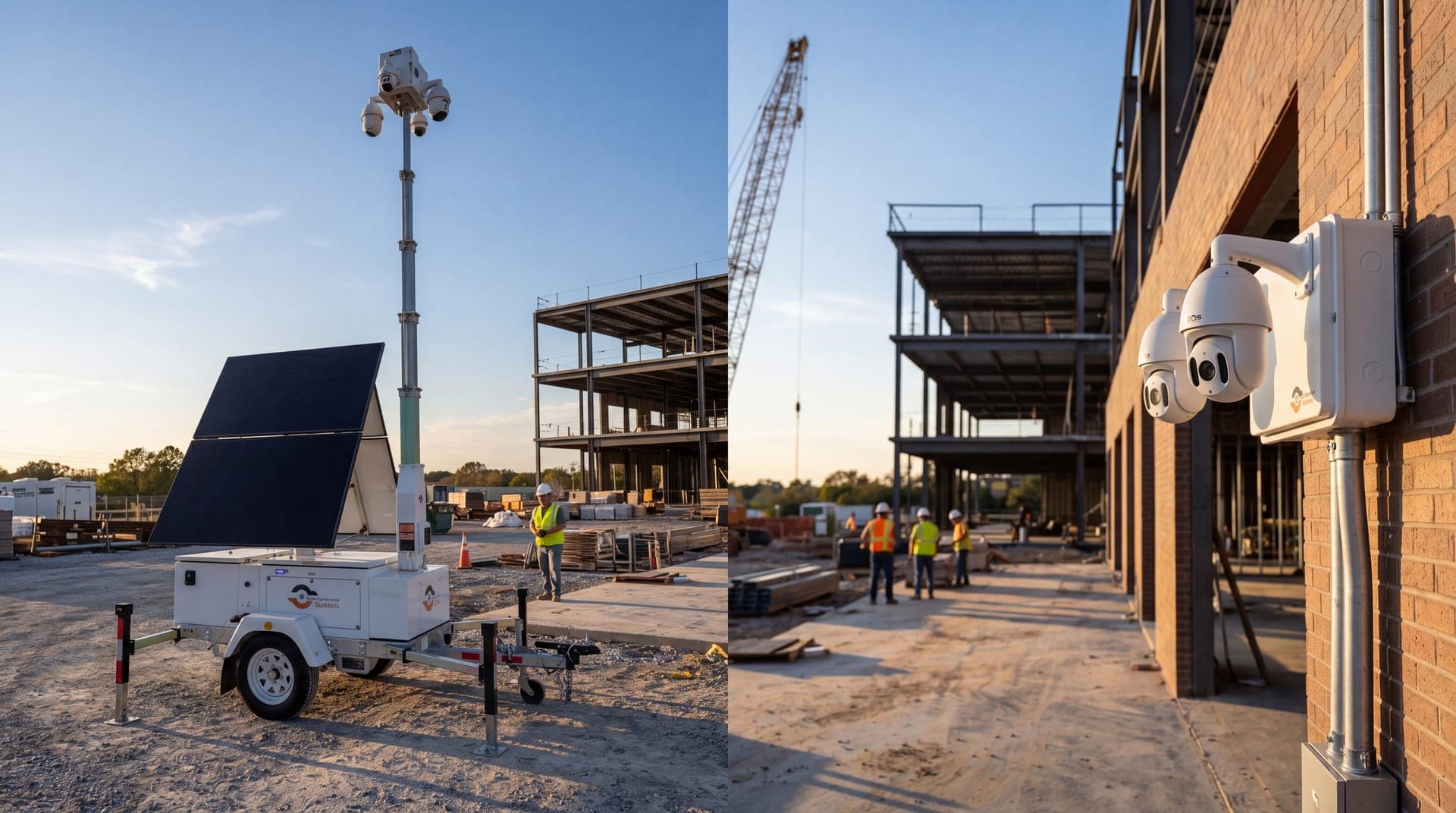
The VDS mobile surveillance unit uses this layout. A solar-powered trailer raises three 8MP wide-angle cameras and a 5MP PTZ with 25x optical zoom on a 22 ft telescopic mast (30 ft available). The wide-angle cameras cover the site, AI detection flags people, vehicles and loitering, and the PTZ closes in on what was flagged. A 24/7 US-based security operations center verifies events and responds, so people, yours or your security partner's, handle verified incidents. To plan coverage for your site, talk to our team.