
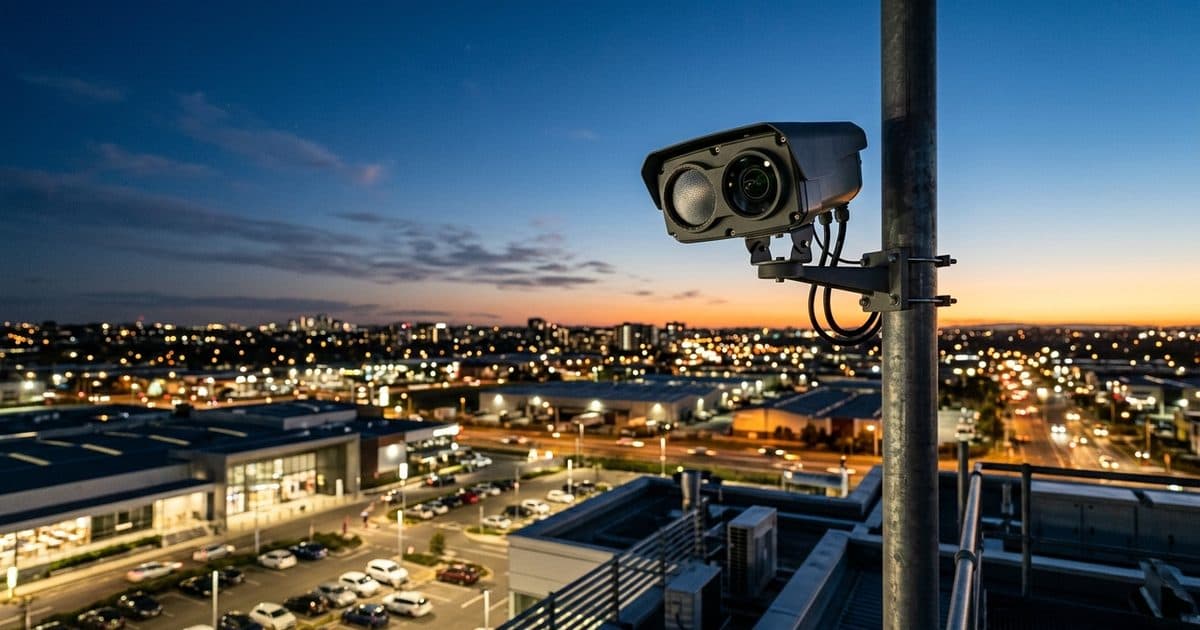
How do thermal security cameras work?
Thermal cameras form images from heat, not light. Every object warmer than absolute zero emits infrared radiation, and a thermal sensor reads those emissions and converts temperature differences into image contrast. A person's body heat stands out sharply against a cool fence line, a dark field, or a parked equipment fleet, which is why a human figure that would be invisible to an optical camera at extreme distance appears as a bright, unmistakable shape on a thermal feed.
That approach is fully passive. A thermal camera needs no visible light, no streetlamps, and no infrared illuminator. It cannot be blinded by total darkness, and it does not bloom or wash out when headlights sweep across the scene the way a low-light optical sensor can.
Passivity also explains the range advantage. An IR-illuminated optical camera depends on its own infrared floodlight, and that illumination fades with distance. Past the illuminator's reach, the camera records mostly noise. A thermal sensor has no illuminator to outrun; it simply reads the heat the scene already emits, so its practical limits come from lens focal length, sensor resolution, and atmospheric conditions rather than from lighting.
Thermal vs. optical: what the spec sheets actually say
On paper the range difference is roughly an order of magnitude. Thermal manufacturer data sheets commonly specify human detection beyond 1,000 meters with appropriate lenses (IP Security Depot), while IR-illuminated optical cameras typically top out around 100 meters or less, per vendor-educational guidance from LightPath Technologies. Treat both figures as spec-sheet values: rain, humidity, lens selection, and mounting height all pull real-world performance downward.
| Capability | Thermal | IR-illuminated optical |
|---|---|---|
| Human detection at night | 1,000 m+ on manufacturer spec sheets, conditions-dependent | Typically about 100 m or less |
| Works in total darkness | Yes, fully passive | Yes, but only within illuminator range |
| Smoke, dust, light fog | Usually still functional | Often severely degraded |
| Face and plate identification | No | Yes, within range and resolution limits |
| Hot-spot and fire detection | Yes | No |
| Relative hardware cost | High | Low to moderate |
Read that table carefully, though, before concluding thermal is the upgrade. The two rows that decide most real-world security outcomes, identification and cost, both favor optical. The range row only matters if your site actually has thousand-meter sight lines to watch, and the overwhelming majority of commercial properties do not.
One more spec-sheet caution. "Detection" in manufacturer literature means the target occupies enough pixels for an observer or an analytic to notice that something is there. It does not mean you can tell who, or sometimes even what, the target is. That distinction drives everything below.
Why thermal detects but cannot identify
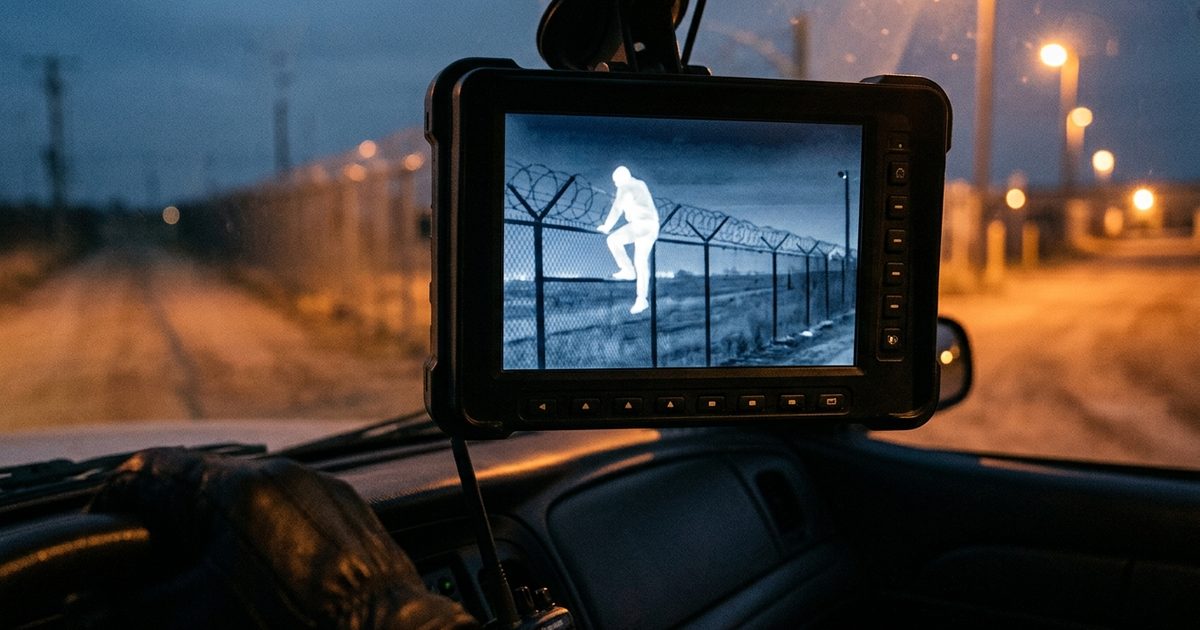
A thermal image of an intruder shows a human-shaped heat source and nothing more: no facial features, no clothing color, no license plate. Standard industry guidance, reflected in vendor-educational material such as the Thermal Radar deployment guide, is that thermal output is actionable for detection while identification and prosecution require a paired visible-light camera.
That limitation matters at three moments. During an incident, operators need to distinguish a trespasser from an employee working late, and a heat blob alone rarely settles it. After an incident, police need identifiable imagery to pursue a suspect. And in court or an insurance claim, a white silhouette on a black background is weak evidence compared to a clear optical frame of a face, a vehicle, and a plate.
So a thermal-only perimeter is an early-warning system without an evidence system. It will tell you someone crossed your fence line at 2 a.m.; it will not help anyone hold that person accountable afterward. Any site that specifies thermal still needs monitored optical cameras doing the verification and evidence work, which is one more reason most sites simply start, and finish, with optical.
Why regular cameras do the job for most sites
The honest starting point is a geometry question, not a technology question: how far, and how dark, are the approaches to your property? For the typical commercial site, the answers put thermal's one advantage out of play.
- Short sight lines. If no approach on your site exceeds roughly 100 meters, well-placed IR optical cameras already cover the whole detection envelope, and they identify while they detect. Most yards, lots, jobsites, and building perimeters fall in this category.
- Ambient light exists. Retail centers, dealerships, urban lots, and active jobsites with even modest lighting give modern low-light optical sensors everything they need at night.
- AI analytics close the detection gap. The detection job thermal was historically bought for, noticing a person entering the property after hours, is now handled by AI video analytics running on ordinary optical feeds, with a human operator verifying each alert before anyone responds.
- Evidence decides outcomes. If your main risks are theft, vandalism, break-ins, or vehicle incidents, the footage that matters is the identifiable kind. Budget spent on optical resolution and coverage pays out; budget spent on heat sensing does not.
- The budget math. Thermal sensors cost several times what comparable optical hardware costs. Two extra monitored optical cameras usually beat one thermal camera for total security outcome on a normal perimeter.
The test is simple: if your problem is "we cannot see far enough in the dark," thermal belongs in the conversation. If your problem is "we cannot prove who did it," or any of the ordinary theft-and-trespass problems most sites actually have, it does not.
The specific sites where thermal is worth specifying
Thermal earns its premium in a recognizable pattern: very long sight lines, no lighting, valuable or hazardous targets, and conditions that defeat optical imaging. These are spec-driven exceptions, engineered case by case, not a default layer for commercial security.
Substations and critical infrastructure
Electrical substations can combine everything thermal is good at: large dark perimeters, high-value copper, energized equipment that makes casual trespass dangerous, and regulatory pressure to detect intrusions early. On the largest rural sites with approaches far beyond optical range, a thermal detection layer can buy operators minutes of warning instead of seconds. Our guide to substation physical security covers where cameras fit alongside fencing, lighting, and access control, and why most substations are still covered primarily by monitored optical analytics.
Very long unlit fence lines and remote energy sites
The same logic applies to sprawling scrap yards, rail corridors, and oil and gas facilities where well pads, laydown yards, and tank batteries sit unlit and unstaffed across distances no illuminator reaches; our guides to scrap yard security cameras and oil and gas security cameras cover those deployments. Even there, thermal is a detection supplement on the longest approaches, while monitored optical cameras remain the verification and evidence layer everywhere on the site.
After-hours fire watch at waste and recycling facilities
Thermal's temperature reading makes it dual-purpose in industries where fire is a bigger financial threat than theft. Reported fires at waste and recycling facilities hit a record 430 incidents in 2024, according to Resource Recycling, and a hot spot developing in a material pile overnight is exactly the kind of target a thermal sensor sees hours before visible flame appears. For facilities with this specific risk profile, hot-spot detection is often a stronger justification for thermal than security is.
How thermal is deployed when a spec genuinely calls for it
On the sites that do justify thermal, the deployment pattern follows a simple chain: thermal detects on the long dark approaches, optical verifies, a human operator confirms, and only then does a response begin.
When analytics flag a human-shaped heat signature, a pan-tilt-zoom optical camera slews to the location to put identifiable pixels on the target; the trade-offs behind that pairing are covered in our guide to PTZ versus fixed cameras. A monitoring operator then reviews both feeds, confirms whether the detection is a genuine intrusion or a deer, a windblown tarp, or a worker on an approved night shift, and escalates only verified events, so people, yours or your security partner's, handle confirmed incidents instead of chasing false alarms.
Notice that the chain's last three links, optical verification, human confirmation, live response, are the same layers that protect a site with no thermal at all. That layered detect-verify-respond structure is the architecture we describe in our overview of perimeter intrusion detection systems; thermal is simply the longest-reach detection option in that stack, used when the geometry demands it.
The bottom line: spec for your geometry, not the spec sheet
For the overwhelming majority of commercial sites, the full detect-verify-respond chain runs on optical hardware: AI analytics watching ordinary camera feeds, trained operators verifying each alert, and live audio and dispatch on confirmed incidents. Solar-powered mobile surveillance units deliver that entire chain with cellular connectivity and onboard power, positioned exactly where the sight lines are, with no trenching or construction, and they relocate as the site or the threat changes.
Thermal remains what it has always been: a range-and-conditions specialist. If your property has kilometer-scale unlit approaches, obscurant-heavy air, or a genuine hot-spot fire risk, it belongs in the engineering conversation for those specific locations. For everyone else, regular monitored cameras do the job, and they do it while producing the evidence that actually resolves incidents. Tell us about your perimeter and we'll spec to your geometry, not to a data sheet.