
What makes an industrial park different
A warehouse district looks simple from the road, but the security picture is mixed. A park may hold distribution centers, light manufacturing, contractor yards, storage lots and small shops, each with its own hours and its own idea of risk. Some tenants run three shifts. Others lock up at five and leave the lot empty.
Several features make the property attractive to thieves:
- Large fenced areas with long stretches that nobody watches.
- Trailers and containers parked outdoors overnight or over weekends.
- Metal, including copper wire, pipe and fittings, stored or installed in accessible places.
- Mixed vehicle traffic, so a stranger in a truck does not look out of place.
- Remote corners with little lighting and no foot traffic.
These conditions are why a single guard on patrol rarely covers the property. There is simply too much area to see at once, and a patrol that passes every hour leaves long gaps between visits.
The mix of tenants adds another layer. A cold storage operator, a trucking company and a machine shop have different assets and different fears. One may worry about cargo, another about copper wire and a third about forklifts left outside. A park-wide plan should set a baseline for the shared perimeter and let each tenant add what its own operation requires.
The usual targets
What gets stolen depends on who is in the park, but the pattern is familiar.
| Target | Typical exposure | What helps |
|---|---|---|
| Parked trailers and cargo | Left in yards overnight and on weekends | Entrance coverage, yard views, live monitoring |
| Copper and scrap metal | Wiring, HVAC parts, stored material | Coverage of exterior equipment and fence gaps |
| Catalytic converters and vehicle parts | Fleet vehicles parked in lots | Overlapping lot views, lighting |
| Tools and equipment | Contractor yards, open storage | Detection near storage, access control |
| Building contents | Forced entry at docks and doors | Camera views of docks and rear doors |
For yard-specific guidance, our articles on truck yard cargo theft security and copper theft in 2026 go deeper on how these thefts happen and how to reduce them.
Start with the fence line and entrances
Because intrusions usually begin at the edge, the perimeter is the first place to focus. A camera that sees only a patch of fence leaves gaps, while detection that flags a person approaching a fence at night gives someone time to act.
When planning, walk the full boundary and note:
- Where the fence is broken, low or shielded by vegetation.
- Where lighting stops and darkness begins.
- Where access roads and gates let vehicles in.
- Where adjacent property, rail lines or open land offers a route to the fence.
Our guide to perimeter intrusion detection systems explains the main technologies and what to ask providers about them. Whatever technology is used, test it at night and in bad weather, since wind, rain, animals and blowing debris are common causes of false alerts along a long fence. Entrances matter just as much, because every vehicle that comes in or goes out should be visible, ideally with a view suited to reading license plates.
Divide responsibilities between owner and tenants
Multi-tenant parks work better when everyone knows what is covered. A reasonable split looks like this.
- Owner or manager: perimeter, main gates, shared roads, common lots and any shared lighting.
- Tenant: its own building, dock doors, interior and fenced yard.
- Shared: cameras on one tenant's building that view common space, and any footage requests that cross tenant lines.
Write the policy down. Include who can view live video, how long recordings are kept and how requests are handled after an incident. Some states have rules on recording and notice, so confirm the details with counsel. Our warehouse security cameras guide covers what tenants should look for inside and around their own buildings.
Why live monitoring matters at night
Most industrial theft happens when the park is quiet. Weekends, holidays and overnight hours leave a lot of valuable material with nobody around. A recording of an event can help an investigation, but it comes after the loss.
Live monitoring changes the timing. Detection flags a person or vehicle in the wrong place, an operator checks the video, and a verified event leads to a response, such as a spoken warning through a loudspeaker and then a call to police with video. A 2019 systematic review of 76 studies found actively monitored CCTV systems were associated with about a 15% reduction in crime, while passive recording-only systems showed no significant effect.
The model works best when cameras do the watching so people, yours or your security partner's, handle verified incidents. See our guide to after-hours security for businesses for how to build the response side.
Covering remote corners without trenching
Industrial parks are big, and the areas most in need of coverage are often the ones farthest from power and network. Running cable across acres of pavement or gravel takes time and money, and it often requires permission from several parties.
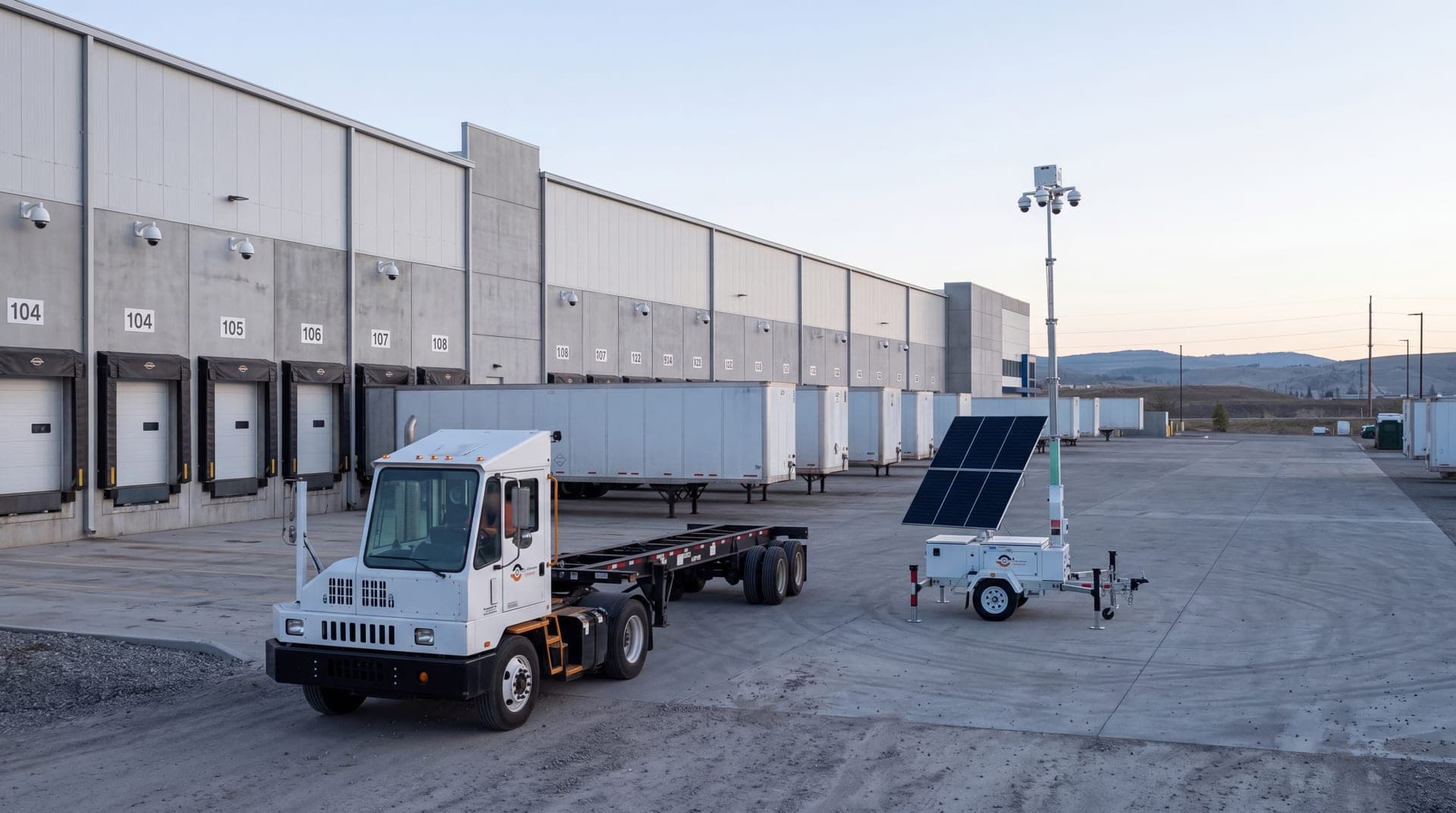
A solar-powered mobile unit avoids that work. It carries its own power, connects over cellular and can be placed where the risk is highest. If trouble shifts, the unit can be moved. That makes it useful for a back corner, a yard with recent thefts or a stretch of fence that keeps getting cut.
How VDS fits an industrial park
The VDS mobile surveillance unit is a solar-powered trailer with a 5MP PTZ camera with 25x optical zoom and three 8MP wide-angle cameras on a 22 ft telescopic mast, with a 30 ft mast available. A 900W bifacial solar array charges an 11.8 kWh LiFePO4 battery bank, with reserve for 3-5 consecutive cloudy days. Dual-SIM 4G/5G cellular carries video, so no site power, internet or trenching is needed.
AI detection looks for people, vehicles, loitering, objects and license plates. Our 24/7 US-based security operations center verifies events, uses live talk-down through a loudspeaker, then dispatches police with video. Most deployments go from signed quote to live monitoring in about a week, and on-site setup takes one person under 20 minutes. See the mobile surveillance unit or talk to our team.
Sources
- Piza, E. L., Welsh, B. C., Farrington, D. P., & Thomas, A. L. (2019). CCTV surveillance for crime prevention: A 40-year systematic review with meta-analysis. Criminology & Public Policy, 18(1). onlinelibrary.wiley.com