
Why buildouts are targeted
A fiber or telecom buildout is long, spread out and temporary. Crews work one segment at a time, and material is dropped ahead of them or kept in a yard. Anyone driving by can see a reel of cable, a trailer of equipment or a row of vehicles, and they can see that nobody is there at night.
Copper and cable are the classic targets because they are easy to sell. Equipment cabinets, generators, fuel and hand tools are also common. Our article on cell tower security and copper theft describes how thieves pick sites, and the current picture in copper theft in 2026 shows why the problem has not gone away.
A buildout also suffers a particular kind of loss. When material disappears, the crew stops. The cost of delay on a schedule-driven project can exceed the value of what was taken.
The three zones to think about
Treat a buildout as three separate security problems.
- The staging yard. The main concentration of material, equipment and vehicles. It usually has a fence, a gate and a fixed footprint.
- The work zone. Where the crew is currently working. It moves every day or week and may be a roadside, an easement or an open trench.
- Fixed sites along the route. Huts, cabinets, handholes and towers that remain after the build and need continuing protection.
Each zone needs a different tool. The yard suits a fixed or semi-fixed monitored system. The work zone needs something that can be relocated quickly. The permanent sites eventually need a long-term plan.
Staging yard essentials
The yard is where most losses concentrate, so make it hard and visible.
- One controlled gate. A single entry lets you log who comes and goes. Plate capture at the gate gives a record. See the license plate recognition camera guide for setup values.
- Lighting. Good lighting helps both people and cameras. Our security camera lighting guide explains the tradeoffs with infrared.
- Organized storage. Keep reels and equipment in defined rows. Gaps are easier to see than clutter.
- Camera coverage of the fence line and high-value areas. Use wide views for detection and a PTZ camera to zoom in on what the wide view finds.
- Clear signage. A visible notice that the yard is monitored can discourage opportunists. See the signage guide.
Following the work zone
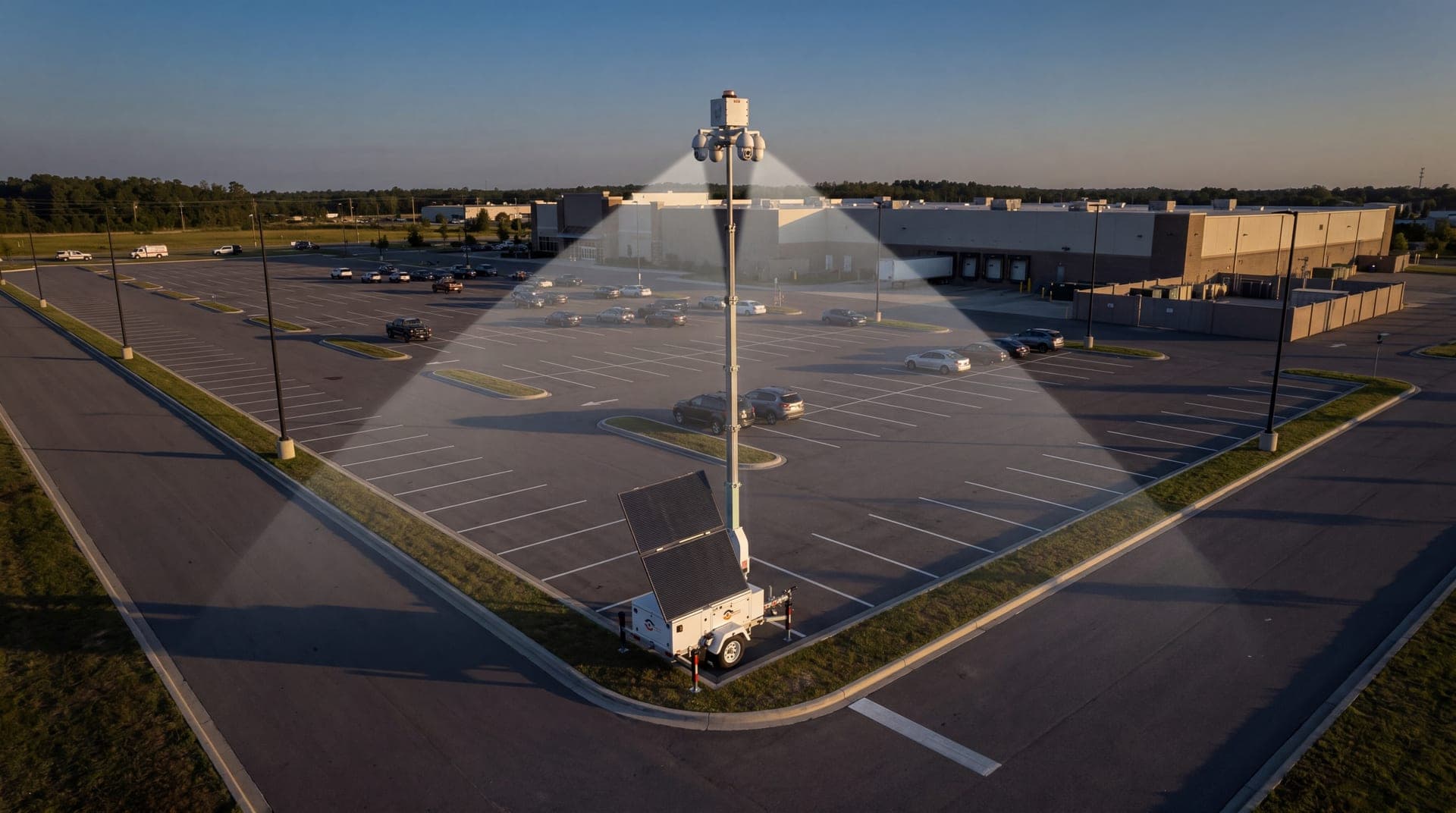
On a linear project, the crew moves and the risk moves with it. A relocatable trailer with its own power and cellular connectivity can sit at the active segment, then be moved when the segment is complete. Choose positions with a clear line of sight to the material and the access point. The article on surveillance trailer site selection explains how to read a site before placing a unit.
Where there is no power and no internet, which is common on rural routes, self-powered units remove that obstacle. The guide to security cameras without Wi-Fi or power covers the options and limits.
Quick reference
| Zone | Main risk | Practical coverage |
|---|---|---|
| Staging yard | Cable, equipment, fuel and vehicle theft | Gate capture, fence line and storage rows |
| Active work zone | Tool and material theft at the job | Relocatable monitored trailer |
| Route huts and cabinets | Copper, equipment and vandalism | Permanent plan after the build |
| Equipment trailers | Whole-unit theft | Camera view of the hitch and approach |
Respond while it is happening
Recording a theft tells you what you lost. Responding to it can keep you from losing it. A systematic review of closed-circuit television studies found that actively monitored systems were associated with a larger crime reduction than passive recording-only systems, which showed no significant effect.
A monitored response works in steps. The camera detects a person or vehicle. A monitoring team confirms the event on live video. The team speaks to the person through a loudspeaker. If the person does not leave, the team dispatches police with video. That lets your superintendent or your security partner handle verified incidents instead of reacting to every motion alert. For more on tool and material theft prevention, see jobsite tool theft prevention and the construction site security plan.
Plan for the quiet hours and holidays
Thefts on buildouts cluster when crews are away: overnight, on weekends and over holidays. Match coverage to the schedule rather than to the calendar year. If a segment sits idle for a week while a permit clears, material left in the open is still a target. Note which segments will be idle, and move monitoring to wherever material is stored or equipment is parked.
Put responsibilities in writing
Telecom projects often involve a prime contractor, subcontractors, a carrier and sometimes a municipality. Security gaps appear when each party assumes someone else has the yard. Before the first reel arrives, agree on:
- Who owns the yard and the gate.
- Who pays for monitoring and who receives alerts.
- Who responds on site and who is called first.
- Who owns the footage and how it is shared with police.
Requirements and obligations vary by state and by contract, so confirm them with counsel.
How VDS fits
VDS builds solar-powered mobile surveillance trailers. Each unit carries a 5MP PTZ camera with 25x optical zoom and three 8MP wide-angle cameras on a 22 ft telescopic mast (30 ft available). A 900W bifacial solar array charges an 11.8 kWh LiFePO4 battery bank with reserve for 3 to 5 consecutive cloudy days, and dual-SIM 4G/5G cellular carries the video. No site power, internet or trenching is needed.
AI detection covers people, vehicles, loitering, objects and license plates. Our 24/7 US-based security operations center verifies events, uses live talk-down through a loudspeaker, then dispatches police with video. Hardware is NDAA Section 889 compliant. Most deployments go from signed quote to live monitoring in about a week, and on-site setup takes one person under 20 minutes. Rental, month-to-month and term subscriptions are available. Review the mobile surveillance unit, talk to our team, or call (410) 401-1986.
Sources
- Piza, E. L., Welsh, B. C., Farrington, D. P., & Thomas, A. L. (2019). CCTV surveillance for crime prevention: A 40-year systematic review with meta-analysis. Criminology & Public Policy, 18(1). onlinelibrary.wiley.com