
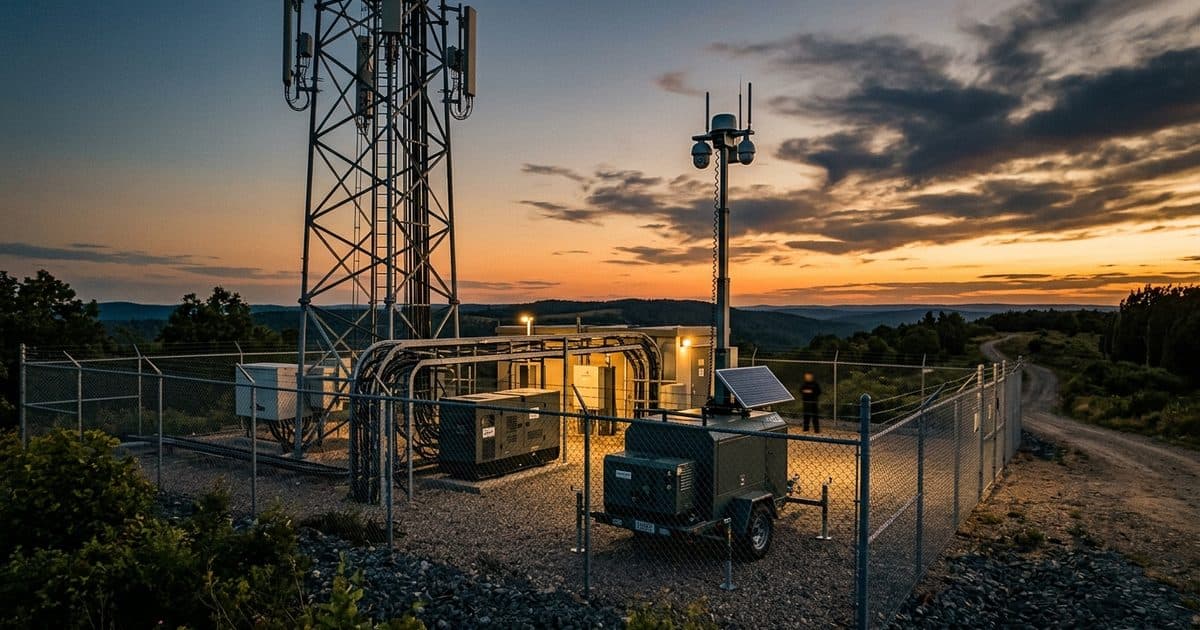
Wireless carriers and tower companies run portfolios of thousands of these compounds, and the vast majority are unstaffed all day, every day, visited by a technician only when something needs servicing. That combination — genuine scrap value in the grounding copper and backup batteries, real isolation on a rural service road, and effectively zero on-site presence — makes a tower compound one of the purest theft targets in industrial infrastructure, arguably second only to an unmanned oil and gas pad. This post covers the threats specific to telecom and tower sites, why fixed CCTV so rarely gets installed at these compounds at all, what an effective coverage plan looks like, and how live remote monitoring turns detection into an actual response before the loss happens.
The Threat Landscape at Cell Tower and Broadcast Sites
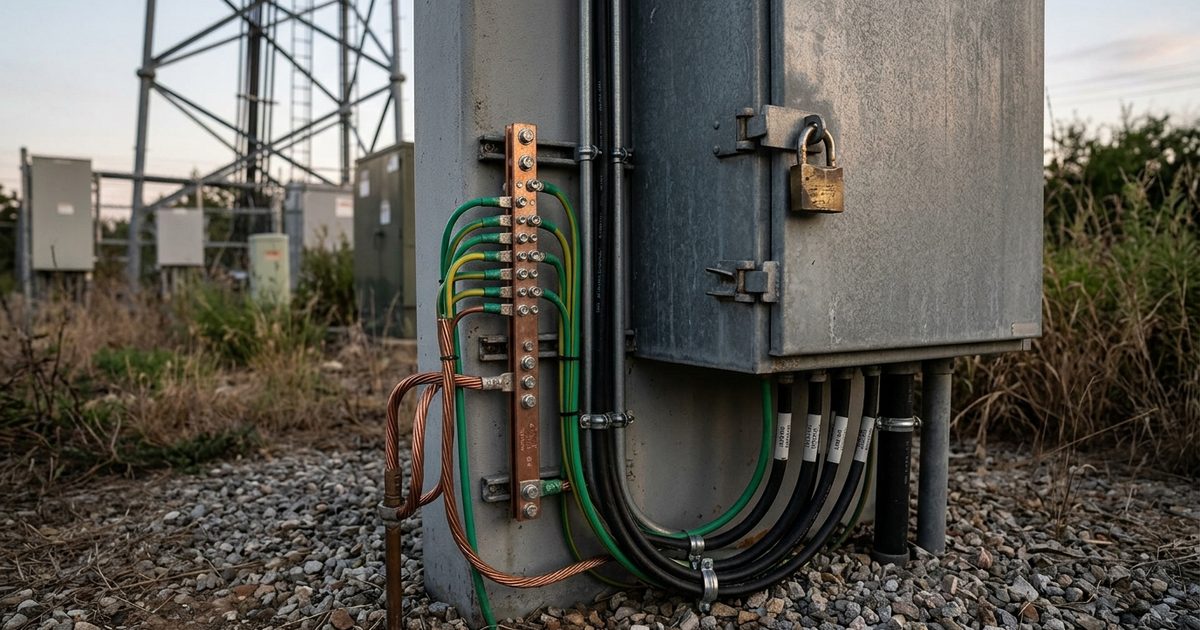
The signature loss at a tower compound is copper. Grounding conductors, feeder cable, and busbar copper inside the fence line can be stripped in minutes with a pair of cutters and no specialized tools, and because a technician may not visit for weeks, the theft often isn't discovered until it causes a secondary failure — a lightning strike with no functioning ground, or an outage traced back to a severed run. The direct cost of replacement copper is almost always the smallest part of the bill once emergency labor, code compliance, and any resulting downtime are added in.
Backup power is the second major target. Battery strings, generators, and diesel fuel tanks sit in the compound specifically to keep a site alive if grid power fails — which makes them valuable on their own terms and doubly damaging to lose, since a site stripped of backup power is one storm away from actually going dark. Diesel theft in particular tends to recur once a site is identified as an easy pull, with thieves returning to siphon a refueled tank within days.
Beyond power and copper, equipment shelters and cabinets are targets in their own right once the fence line is breached, holding radio and switching equipment that's both valuable and disruptive to lose. And towers carry a threat that has nothing to do with theft: unauthorized climbing. A trespasser scaling the structure — for a dare, for a view, to strip something from higher up — creates a safety and liability exposure that has nothing to do with the value of anything stolen and everything to do with what happens if that person falls.
The through-line across every one of these threats is the same: a compound with real assets and zero routine human presence, sitting far enough off the beaten path that a theft can run its course with nobody around to notice, let alone intervene, in the moment.
Why Fixed CCTV Rarely Protects a Tower Compound
Fixed CCTV struggles at self-storage facilities and rental yards because of gaps in coverage. At tower sites, the problem is often more basic: fixed CCTV frequently isn't installed at all, because the site has no grid power and no hardwired internet to run it on. A rural compound miles from the nearest utility drop and outside any broadband footprint simply doesn't have the infrastructure a traditional camera system depends on, so operators either skip coverage entirely or install a passive camera that records to a local drive nobody reviews until after a loss is already reported.
| Capability | Fixed CCTV | Solar Mobile Surveillance |
|---|---|---|
| Power | Requires a grid connection most rural compounds don't have | Solar-autonomous — deploys with no utility tie-in |
| Connectivity | Needs hardwired internet, often unavailable off the grid | 4G/5G cellular backhaul from anywhere with signal |
| Install timeline | Permitting, trenching, and utility coordination — weeks to months | Trailer arrives and is live in under 20 minutes |
| Response | Passive local recording reviewed after a loss is reported | Live SOC verification and audio warning in real time |
| Portfolio flexibility | Fixed per site; every compound needs its own install | Relocatable to whichever sites are being hit |
Even where a fixed camera does exist, it's usually recording, not responding — and a recording of grounding copper being stripped at 3am does nothing to stop the theft, it only documents it after the fact. Nighttime is the other blind spot: most tower compounds have no site lighting, and a standard visible-light camera is functionally useless against a thief who waits for full dark, which is most nights on an unlit rural site.
Tip: Weight coverage toward the backup power cabinets and the grounding runs specifically, not just a wide shot of the compound. These are the two highest-frequency loss points at a tower site, and a camera angle that clearly frames the battery bank and the ground bus does more to prevent a theft than a single wide-area view of the whole fence line.
What a Coverage Plan Looks Like for a Tower Compound
An effective plan treats the compound as a small, high-value site with one access point and a handful of theft-prone assets concentrated inside a tight fence line. For a typical macro tower or broadcast compound, that means:
- The access road, with LPR: The one route into most compounds. License plate recognition ties every vehicle to a time and a plate, exposes repeat visits from the same vehicle across a theft wave, and flags hotlisted plates on approach.
- The fence line and compound interior: Elevated coverage from a raised mast, with object detection classifying people versus vehicles and flagging anyone inside the fence line who isn't a scheduled technician.
- Backup power and cabinets: The highest-loss assets on the property. Dedicated framing on the battery bank, generator, and fuel tank with loitering detection on anyone lingering near them.
- Thermal detection for zero-light approach: Most compounds have no site lighting, and thermal imaging detects a body heat signature approaching well before a visible-light camera would register anything at all — closing the exact window copper and battery thieves count on.
The piece that turns this from a recording system into an actual deterrent is a physical, visible presence: a Mobile Surveillance Unit with a raised mast and a speaker changes how the compound reads to anyone scoping it, and because the whole system runs on solar and cellular, it goes onto sites a permanent fixed system never could — no utility coordination, no waiting on a broadband build-out. For compounds where even the mast presence needs supplementing, a standalone solar light or lighting trailer adds visible deterrence to the darkest sites in a cluster.
Remote Monitoring: A Technician Isn't Coming Tonight
A tower compound doesn't get a guard, and it usually doesn't get a technician until something is already broken. Live remote monitoring is what stands in for both.
Remote video monitoring routes every camera and thermal alert to a SOC operator who verifies it in real time — distinguishing a technician's scheduled visit from someone who shouldn't be there. When it's a genuine threat, the operator issues a live audio warning through the unit's speaker, which on its own clears most opportunistic thieves off an isolated site with no other reason to stay, and escalates to law enforcement with time-stamped footage and the access road's LPR record of what drove in. Someone counting on an unmanned compound with no chance of interruption instead gets an immediate, human response from hundreds of miles away.
That model matters more at scale than at any single site. A carrier or tower company with thousands of compounds can't staff any of them, but a single SOC can monitor an unlimited number to the same standard, with every alert, verification, and escalation logged. When a theft wave hits a regional cluster, that log is also what tells the security team exactly which sites are being targeted — which is the input that decides where to physically deploy next.
Deployment That Follows the Theft, Not the Org Chart
Tower portfolios don't lose assets evenly. A theft wave typically concentrates on a handful of sites — often the ones nearest a highway on-ramp, the ones with the least site lighting, or the ones a thief has already hit once and knows are undefended. Installing permanent fixed coverage at every compound in a portfolio to catch that pattern is neither affordable nor fast enough to matter.
A relocatable, solar-autonomous unit solves the actual problem: it moves to the cluster under active threat, sits there through the wave, and relocates once the pattern shifts or the sites are otherwise hardened. A site under construction gets the same treatment, since exposed materials and unfinished fencing during a build are often the softest target of all. This is the same portfolio logic that applies across critical infrastructure, utility, and oil and gas sites — coverage that tracks where the risk actually is this month, not where a camera happened to get bolted on five years ago.
Common Mistakes in Telecom and Tower Site Security
- Assuming remote means safe. Isolation removes witnesses, it doesn't remove value. A rural compound with no neighbors is often the easiest target in the portfolio, not the safest.
- Skipping coverage because there's no grid power. The absence of utility and broadband infrastructure is why many compounds go unprotected at all — but it's exactly the gap a solar-autonomous, cellular-backed unit is built to close.
- Framing the whole compound instead of the theft-prone assets. A wide shot of the fence line looks like coverage but often fails to clearly identify someone at the battery bank or ground bus specifically. Frame the highest-loss assets directly.
- Recording without responding. Footage of copper being cut at 3am prevents nothing on its own. Detection needs to be tied to live verification and a real-time audio warning to actually stop the loss in progress.
- Installing fixed cameras at every site instead of moving coverage to the threat. Theft concentrates on a subset of sites at any given time. A relocatable unit that follows the pattern outperforms a thin, permanent installation spread evenly across a portfolio that was never being hit evenly in the first place.
Telecom and tower compounds sit alongside oil and gas pads, substations, and remote utility infrastructure as some of the purest-fit environments for solar-autonomous surveillance — unmanned, off-grid, and carrying assets thieves already know how to find. For more on the copper theft pattern specifically, see how it plays out at electrical substations, and for the isolation problem at its most extreme, see how the same model applies along border and perimeter sites. If your compounds run under NDAA-compliant procurement requirements, see our case studies or get in touch to start with a site assessment.