
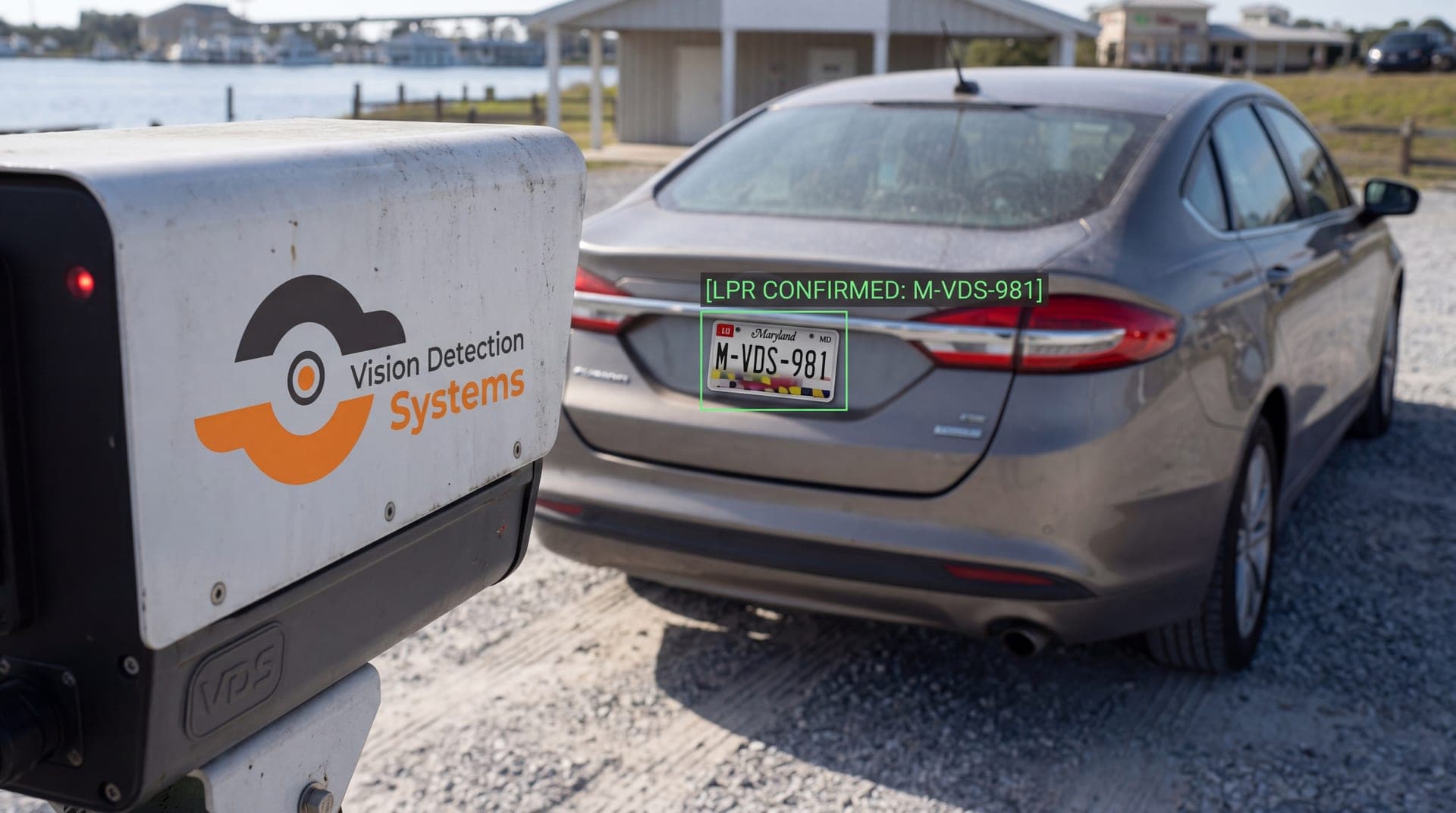
Most of the confusion around LPR comes from mismatched expectations. Buyers assume any camera with "AI" in the spec sheet will read plates reliably at any distance, in any light, at any vehicle speed. It won't. The gap between a working license plate recognition camera deployment and a disappointing one almost always comes down to hardware selection, mounting geometry, and watchlist configuration—not the underlying algorithm.
How ALPR Technology Actually Works
An automatic license plate recognition system doesn't "read" a plate the way a person does. It runs the image through a five-stage pipeline:
- Detection: The camera identifies a region in the frame that matches the shape, contrast, and aspect ratio of a plate.
- Segmentation: That region gets extracted and normalized—contrast corrected, angle adjusted.
- Character recognition: OCR software identifies each character using models trained on thousands of plate formats across states and provinces.
- Jurisdiction matching: The character string is checked against known state/provincial formats to validate the read.
- Database lookup: The confirmed plate is checked against configured watchlists, and an action—alert, gate trigger, log entry—fires accordingly.
The full sequence runs in 200–500 milliseconds. At a controlled gate, that's fast enough to operate without perceptible delay. At a 45 mph roadway, it's a different problem entirely—one that general-purpose cameras rarely solve well.
Camera Hardware Requirements for Accurate LPR
General security cameras make poor LPR cameras. A license plate character stands roughly 4–5 inches tall, and OCR needs at least 20–30 pixels of height per character to read it reliably. That pixel requirement drives everything else about the hardware spec.
| Spec | Requirement for Reliable Reads | Why It Matters |
|---|---|---|
| Resolution / focal length | Lens matched to distance so plate characters hit 20–30px minimum height | Wide-angle security lenses spread resolution too thin at range |
| Shutter speed | 1/1000s or faster for vehicles over 10 mph | A car at 20 mph moves 3 feet per second—slower shutters blur the plate |
| Illumination | Dedicated IR illuminator, synced to shutter | Ambient or visible-light IR causes glare on reflective plates at night |
| Dynamic range | WDR (wide dynamic range) sensor | Headlights at dusk/dawn blow out standard sensors |
| Frame rate | 15–30 fps minimum at the capture zone | Lower frame rates miss the plate's optimal read window entirely |
This is also where consumer products fall short. Devices like a Tapo camera with license plate recognition marketing claims can detect motion and even trigger a "vehicle" label, but they lack synced IR shutter timing and the focal-length precision needed for consistent OCR beyond 15–20 feet. They're fine for a driveway notification. They are not an automatic license plate recognition system suited for a commercial access point, and treating them as one leads to missed reads exactly when they matter—after dark, at speed, or at range.
Watchlists: Whitelists, Blacklists, and Hot Lists
The camera is only half the system. The database logic behind it decides what happens when a plate is read:
- Whitelist: Known, approved plates—employees, contractors, approved vendors. A match triggers gate-open or a silent log entry, no alert.
- Blacklist: Plates explicitly barred from the site—former employees, prior trespass incidents, banned vendors. A match triggers an immediate alert to the monitoring team.
- Hot list: Externally sourced flagged plates (stolen vehicle reports, law enforcement bulletins where applicable). A match triggers escalation per your site's response protocol.
Most sites run all three simultaneously. The LPR analytics layer in a monitored system cross-references reads against all configured lists in real time, so a single camera read can simultaneously clear an approved vendor and flag a vehicle from an unrelated incident report.
Access Control Integration
LPR earns its value when it's tied into an actual access control action, not just logging plates for after-the-fact review. Common integration patterns include:
- Gate automation: Whitelist match triggers gate-open directly, eliminating badge swipes or call-box delays for routine traffic.
- Parking management: Entry/exit reads calculate dwell time and flag overstays automatically.
- Visitor logging: Unrecognized plates get logged with timestamp and photo, creating an automatic visitor record without manual sign-in.
- Incident correlation: When an alert fires elsewhere on-site, LPR logs provide a vehicle-level timeline of who was on the property.
This integration work is where generic camera installs tend to stall—the hardware captures a clean read, but nothing downstream acts on it. A monitored LPR deployment routes that read into a rule engine that actually does something with it.
Deployment Geometry: Getting the Camera Position Right
Camera placement determines read rates more than any single spec on the datasheet. The core rules:
- Mounting angle: Keep the camera within 15–30 degrees of the plate's plane. Steeper angles distort character shape and tank OCR confidence.
- Mounting height: 3–8 feet works for most passenger vehicles and light trucks. Higher mounts introduce angle distortion; lower mounts get blocked by bumpers on larger vehicles.
- Capture distance: Match the lens to the actual approach distance. A lane designed for 20-foot captures needs different glass than one built for 60-foot captures.
- Lane discipline: Single-lane chokepoints read far more reliably than open lots where vehicles can approach at variable angles.
Most of the LPR-capable camera hardware deployed on commercial sites is purpose-built for exactly this geometry—fixed focal length, synced IR, and a housing designed for a specific distance range rather than general scene coverage.
Field Setup Workflow: Six Steps to Reliable Plate Reads
- Measure the capture zone—exact distance from camera to the point where plates will be read.
- Select the lens—match focal length to that distance using a pixel-per-foot calculation, not a default wide lens.
- Set shutter speed—fast enough for the fastest expected vehicle speed at that point, typically 1/1000s or faster.
- Configure IR sync—illuminator timed to the shutter, not running continuously, to avoid glare from reflective plate coatings.
- Test at operating hours—run captures at the actual times vehicles will pass, including night and dawn/dusk transitions.
- Tune watchlist rules—load whitelist/blacklist data and confirm match logic before going live, not after the first false alert.
Skipping step five is the most common field mistake. A camera that reads perfectly at noon can miss 40% of plates at 6 a.m. if the IR sync wasn't tested against actual dawn glare conditions.
Realistic Performance Expectations
Vendors routinely advertise "99% accuracy" without specifying conditions. Real-world read rates vary by scenario:
| Scenario | Typical Read Rate | Primary Limiting Factor |
|---|---|---|
| Controlled gate, under 10 mph, good lighting | 95–99% | Plate condition, dirt, bent frames |
| Open lot, 15–25 mph, mixed lighting | 80-90% | Approach angle variability |
| Roadway, 45+ mph, long range | 50-70% | Motion blur, distance, frame rate limits |
| Night, no dedicated IR | Under 50% | Glare, insufficient illumination |
The National Conference of State Legislatures tracks how states regulate automated license plate readers, including retention limits that affect how long your system can legally store read data—a factor worth checking before finalizing a deployment in a new state. The International Association of Chiefs of Police also publishes operational guidance on LPR program policy that applies to private-sector deployments working alongside law enforcement watchlists.
LPR in Mobile Surveillance Deployments
Fixed LPR installs make sense for permanent chokepoints—a single gated entrance, a loading dock, a dealership lot with a defined perimeter. Mobile surveillance trailers extend LPR to sites that don't have that permanence: active construction phases, temporary event perimeters, or a parking lot with a theft pattern that needs documentation before you commit to fixed infrastructure.
The trade-off is capture consistency. A trailer repositioned weekly needs its geometry re-verified each time—distance, angle, and IR sync all shift with placement. Sites running LPR on mobile units get the most value when deployment includes a setup check each time the unit moves, not a one-time calibration treated as permanent.