
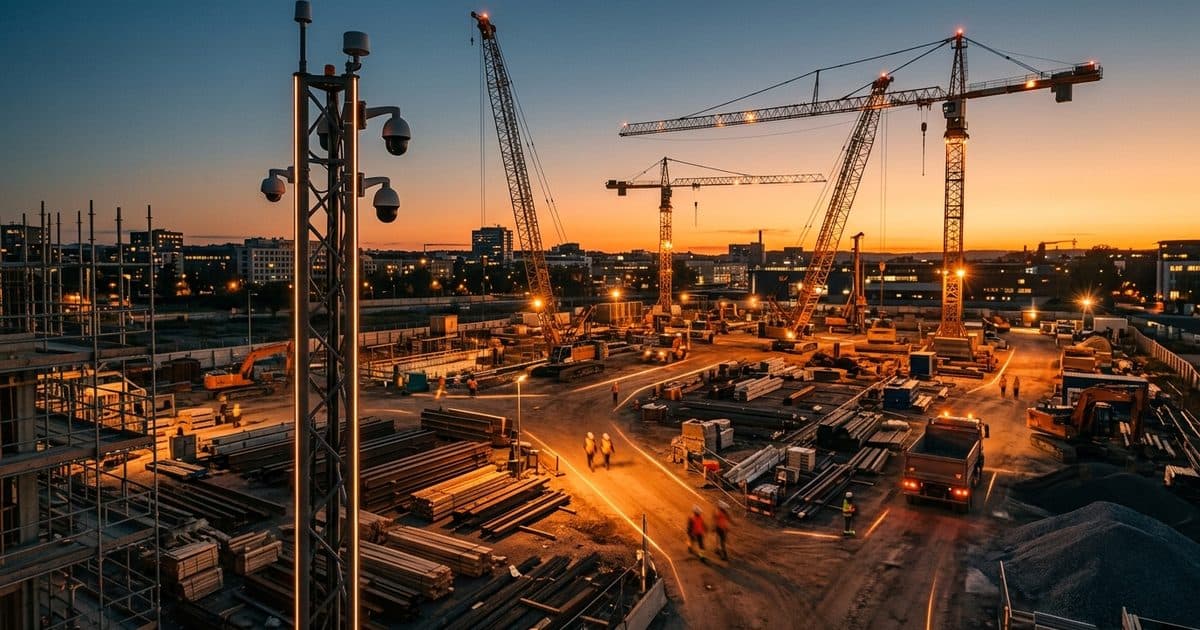
What does site intelligence mean?
Site intelligence describes a camera platform that understands what it sees and routes that understanding to the people who need it, in real time and after the fact. A traditional jobsite camera is a passive witness. It records everything, understands nothing, and only becomes useful when someone scrubs through footage after something has already gone wrong.
A site intelligence platform inverts that model. AI running on or near the camera classifies what is happening as it happens: a person entering a laydown yard at 2 a.m., a worker moving through an exclusion zone, a concrete pour starting on schedule. The platform decides which events need a human right now, which need to be logged for a compliance report, and which simply become part of the searchable visual record of the project.
The important shift is not the hardware. Cameras, cellular modems, and solar trailers have existed for years. The shift is that one video feed now serves four different stakeholders: the security manager, the safety officer, the project executive, and eventually the attorney or claims adjuster. That consolidation is what earns the word "intelligence."
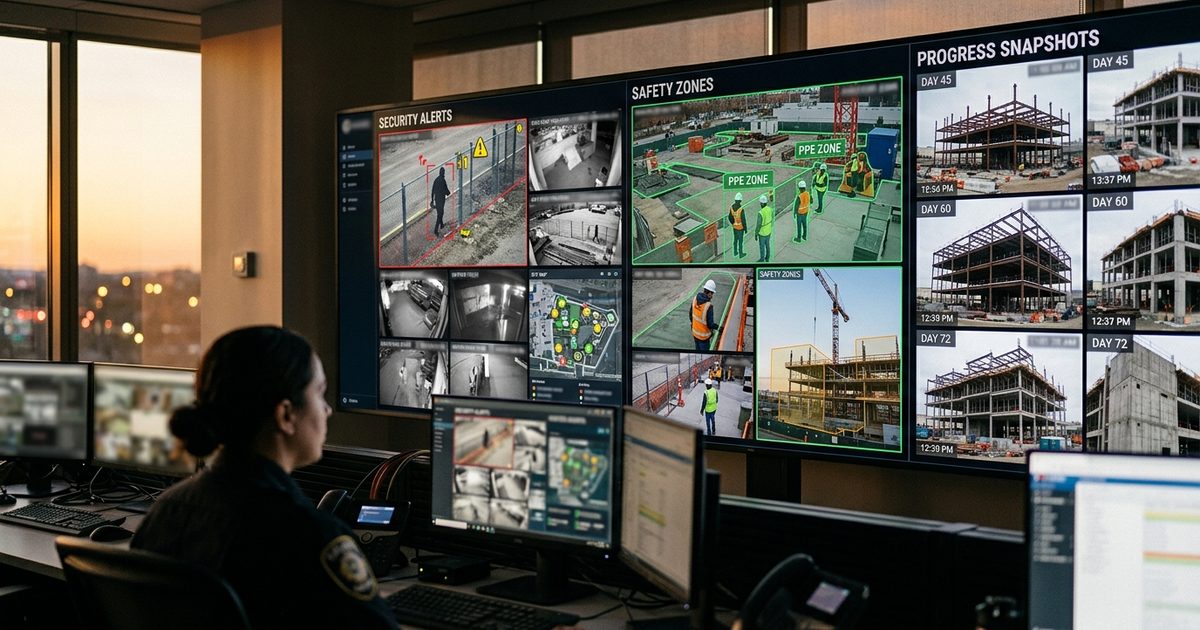
The four jobs of a site intelligence platform
Each job existed before as a separate purchase: a security vendor, a safety consultant, a photographer, a document archive. Site intelligence collapses them into one platform fed by the same cameras.
Job 1: Security with verified response
Security remains the anchor job, and the scale of the problem explains why. The same NICB dataset recorded roughly 11,000 equipment-theft incidents reported per year, and that figure only counts heavy equipment, not copper, tools, or lumber walking off site.
What changes under a site intelligence model is what happens after detection. Instead of a motion alert firing into an unwatched inbox, AI video analytics filter out headlights, animals, and blowing debris, and a human verifies the genuine intrusions. Verified incidents then go to people, yours or your security partner's, so officers and supervisors respond to confirmed events rather than patrolling on guesswork. The intelligence layer is a force multiplier for the humans in the loop, not a substitute for them.
Job 2: Safety and compliance analytics
The second job uses the same cameras during working hours. The stakes are not abstract: the BLS Census of Fatal Occupational Injuries recorded 1,075 construction fatalities in 2023, more than any other industry sector.
Safety analytics apply detection models to daytime activity: hard hat and high-visibility vest presence, workers inside designated exclusion zones, proximity between people and operating equipment. The output is not punishment footage. It is trend data a safety officer can act on, which crews skip PPE at which gates, which zones get breached during which phases. Our guide to AI jobsite safety monitoring covers how these analytics work and where their limits are.
Job 3: Progress documentation
The third job is the quiet one: the camera as project historian. Because the platform is already capturing the site continuously, it can produce scheduled snapshots, milestone records, and construction time-lapse footage as a byproduct of security coverage.
Project teams use that record to verify subcontractor progress claims, brief owners and lenders without a site visit, and settle "when was that wall actually closed up" questions in minutes. On distributed portfolios, remote progress visibility often justifies the platform on its own, with security effectively riding along free.
Job 4: Incident and dispute evidence
The fourth job matters most when things go wrong. Construction disputes are slow and expensive: the average North American construction dispute is valued at $60.1 million and takes about 12.5 months to resolve, according to the Arcadis Global Construction Disputes Report.
A continuous, time-stamped visual record changes the posture of those disputes. Delay claims, differing-site-condition arguments, damage attribution, and injury investigations all turn on establishing what happened and when. A platform that preserves footage with clear retention rules and exportable records turns "my superintendent remembers" into "here is the video." Our breakdown of using security camera footage as evidence covers retention, admissibility, and handling practices in detail.
Site intelligence vs. a traditional jobsite camera
The difference is easiest to see side by side:
| Dimension | Traditional jobsite camera | Site intelligence platform |
|---|---|---|
| Primary job | Record for after-the-fact review | Detect, verify, route, and document |
| When video is analyzed | After an incident, manually | Continuously, by edge AI plus human verification |
| Who responds | Whoever checks the footage | People, yours or your security partner's, on verified incidents |
| Safety role | None | PPE and zone analytics during working hours |
| Progress role | Occasional manual screenshots | Scheduled documentation and time-lapse as a byproduct |
| Evidence value | Depends on someone saving the clip | Retention policies and exportable, time-stamped records |
The hardware in both columns can look identical from the street. The difference is software, monitoring, and process.
What the site intelligence stack needs
Three layers separate a camera that watches from a platform that understands. When any one is missing, the "intelligence" claim usually falls apart in practice.
Edge AI processing
Analytics need to run on or near the camera, not solely in a distant data center. Edge processing means detection keeps working when connectivity dips, alert latency stays low, and the system is not streaming every frame of a quiet site over a cellular link. It also enables privacy-conscious configurations, since raw footage can stay local while only events and clips leave the device.
Connectivity and power
Jobsites rarely offer stable power or wired internet, so the stack has to bring its own. That typically means cellular connectivity with local storage as a buffer for outages, and autonomous power, most often solar with battery reserves, so coverage does not depend on generator refueling or temporary utility timelines. A platform that dies when the site loses power fails at exactly the moment it is needed.
A human monitoring layer
The layer that most defines real site intelligence is the least technical: trained people who review what the AI flags. Analytics narrow thousands of hours of video down to a handful of candidate events; humans confirm which ones are real, talk down trespassers over audio where appropriate, and escalate verified incidents to site contacts, responding officers, or police. This is what keeps the platform a force multiplier: detection technology does the watching, and people handle the incidents that matter. The VDS platform page shows how these three layers fit together in one deployment.
How to evaluate a site intelligence platform
Because the term is new, vendors apply it loosely. Six questions separate substance from labeling:
- Where do the analytics run? Ask whether detection happens at the edge or only in the cloud, and what happens to alerting during a connectivity outage.
- Who verifies alerts, and how fast? An unwatched notification feed is not intelligence. Ask who reviews detections, around the clock or business hours only, and what the escalation path is.
- What are the safety analytics, specifically? "AI safety features" should resolve into named capabilities, PPE detection, zone monitoring, proximity alerts, with honest accuracy caveats.
- How is footage retained and exported? Get retention periods, export formats, and access terms in writing before you need footage for a claim or dispute.
- Does it run without site power and internet? Confirm solar autonomy in your region's winter conditions and cellular performance at your actual location, not a spec sheet average.
- How does it fit your existing response plan? The platform should route verified incidents to the responders you already trust, your supervisors, your security partner's officers, local police, rather than forcing a new process on them.
Weight these against your project profile. A nine-month suburban build and a three-year infrastructure program need the same four jobs done, but in very different proportions.
The bottom line: one platform, four jobs
Site intelligence is best understood as a consolidation, not an invention. The camera you were already going to rent for theft prevention can also watch for safety exposures, document progress, and preserve the evidence that shortens disputes, if the platform behind it has edge AI, autonomous power, and humans verifying what the AI finds.
This is the model VDS builds around: solar-powered mobile surveillance units with edge analytics and a 24/7 monitoring team, deployed heavily on construction sites where all four jobs show up on the same fence line. However you source it, the evaluation standard is the same. If a platform only does the security job, it is a camera. When it does all four, it is site intelligence.