
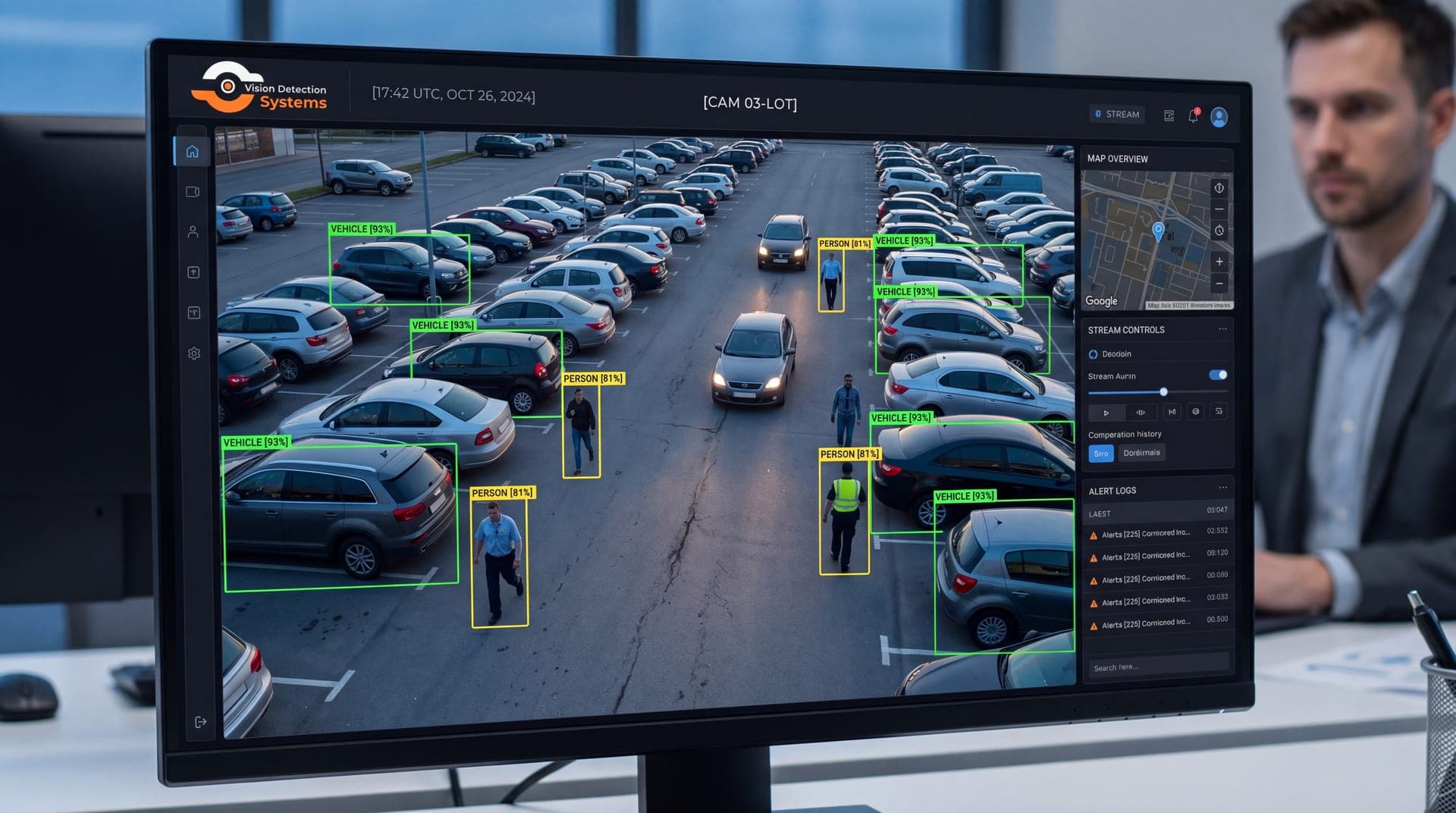
Understanding what AI video analytics actually does—its genuine capabilities and genuine limitations—helps you make better purchasing decisions and set realistic expectations for what surveillance technology can accomplish.
What AI Video Analytics Actually Is
At its core, AI video analytics is software that classifies objects and events in video footage using trained machine learning models. The model analyzes each frame, identifies elements it's been trained to recognize, and decides whether a configured detection threshold has been met.
Unlike traditional video motion detection (which simply measures pixel change between frames), AI analytics distinguishes between different types of movement and different types of objects. A dog walking across a parking lot triggers motion detection but doesn't trigger a well-configured AI human detection alert. Rain creates massive pixel change but doesn't meet the object classification criteria for a person or vehicle.
This is the fundamental value proposition: AI analytics focus the security system's attention on events that warrant human review, filtering out the noise that causes alert fatigue in passive monitoring setups.
What AI Analytics Does Well
Person detection and classification. Current AI models detect people in camera footage with high accuracy across a wide range of lighting conditions, distances, and camera angles. This is the most mature and reliable AI detection capability in commercial security systems.
Person detection can be further classified:
- Distinguishing people from animals and vehicles
- Detecting people carrying objects
- Identifying groups (crowd detection)
- Counting people passing through a zone
- Detecting people running (potential distress or threat indicator)
Vehicle detection and classification. AI models accurately detect and classify vehicles by type—car, truck, motorcycle, bicycle—with current accuracy rates around 95% under normal conditions. Classification enables use cases like detecting a delivery truck in a no-truck zone or a motorcycle in a restricted lot.
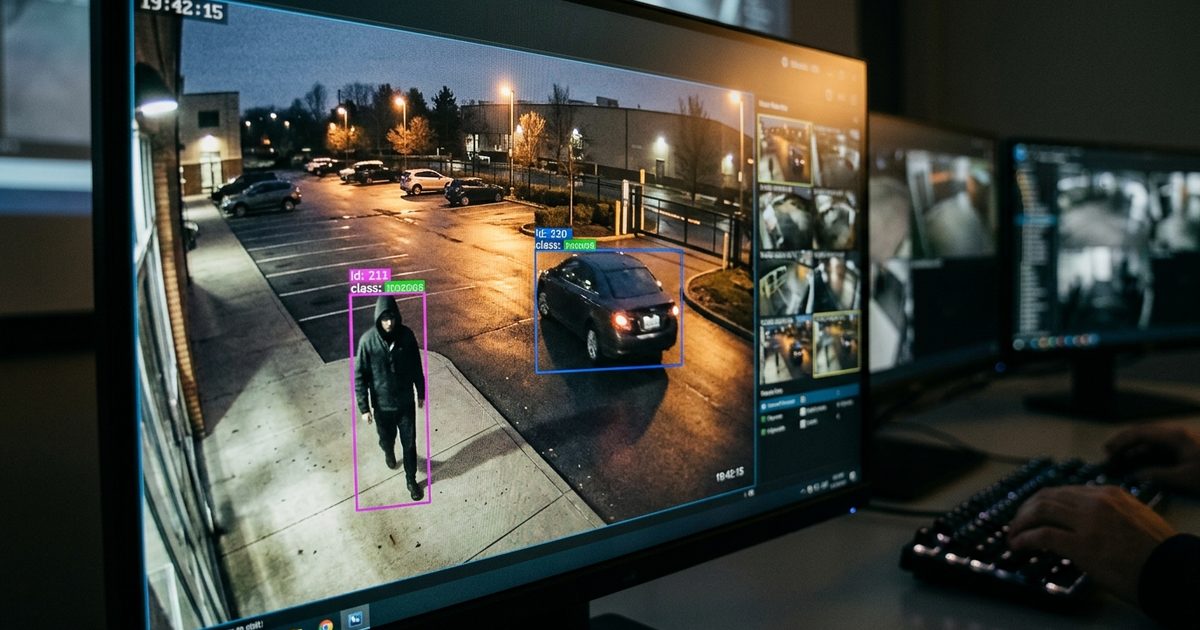
Zone-based intrusion detection. Virtual perimeters can be drawn in the analytics software. Anyone crossing the virtual line—entering a restricted zone, approaching a protected asset—triggers an alert. This is more precise and informative than simple motion detection in the same zone, because the alert carries object classification information (person, vehicle, unknown object).
Loitering detection. AI analytics can flag subjects who remain in a monitored zone longer than a configured threshold—a valuable capability for identifying casing behavior that precedes theft.
Object detection (abandoned and removed objects). Analytics can detect when an object is left in a zone where it shouldn't be, or when an object disappears from a zone where it should remain. These detections are particularly useful for asset tracking and perimeter security.
What AI Analytics Does Less Well
Distinguishing intent. AI can detect that a person is present in a restricted zone. It can't determine why they're there or whether they're a threat. A lost delivery driver entering through the wrong gate looks identical to a trespasser in AI detection terms. Human operator verification remains essential for accurate threat assessment.
Complex behavioral analysis. Vendor demonstrations often showcase impressive behavioral analytics—detecting fighting, identifying specific threat postures, recognizing distress behaviors. In real-world deployments, these capabilities have much higher false positive and false negative rates than simpler detection types. Treat complex behavioral analytics as supplemental evidence for human operators, not as reliable primary detection.
Occlusion and crowded scenes. When people or objects overlap in camera footage, AI detection accuracy drops. In crowded scenes, a person partially behind another person may not be detected. Objects partially hidden by equipment or vegetation challenge AI models trained primarily on unobstructed targets.
Unusual environments and edge cases. AI models are trained on specific datasets. Environments or scenarios not well-represented in training data produce lower accuracy. Extreme weather, unusual lighting, non-standard camera angles, or novel object types that weren't in training data create detection uncertainty.
Facial recognition at security distances. While facial recognition technology has advanced significantly, its commercial deployment in site security contexts faces accuracy limitations at realistic security camera distances (30–100+ feet), compounding with angle, lighting, and partial occlusion challenges. Jurisdiction-specific legal restrictions on facial recognition in commercial contexts are also expanding.
| AI Capability | Real-World Accuracy | Deployment Maturity |
|---|---|---|
| Person detection | 92–98% | High—widely deployed |
| Vehicle detection and classification | 94–98% | High |
| Zone intrusion detection | 90–97% | High |
| Loitering detection | 85–93% | Moderate |
| Crowd density estimation | 80–90% | Moderate |
| Behavior analysis (fighting, falls) | 70–85% | Low—use with caution |
| Facial recognition (outdoor, range) | 60–80% | Low—significant limitations |
False Alarm Reduction: The Primary Operational Value
For most commercial sites, the most immediately impactful benefit of AI analytics isn't detection accuracy—it's false alarm reduction. Simple motion detection systems generate hundreds of alerts per night on active construction sites or outdoor facilities. Operators reviewing this volume quickly experience alert fatigue, and real events get lost in noise.
AI analytics reduce this noise to a manageable volume—typically 5–20 events per shift requiring operator review rather than hundreds. Each of those events has already been pre-screened by AI to meet the threshold for likely security relevance, so operators spend their time on real potential incidents.
Tip: When evaluating an AI analytics system, ask for documented false positive rates from live deployments, not controlled demonstrations. Vendors can tune demonstration environments to minimize false positives. Real-world performance on sites similar to yours is the only meaningful benchmark.
The Human-AI Monitoring Model
The most effective approach to AI analytics in commercial security combines AI pre-filtering with human verification before any intervention. This is the model VDS uses with its AI VisionStream platform:
- AI analytics process all camera feeds continuously
- Events meeting detection thresholds are queued for operator review
- Human operators verify events before responding
- Confirmed events receive audio challenge or law enforcement escalation
- All events are logged with AI classification and operator disposition
This hybrid model captures the efficiency benefit of AI (filtering up to 85–95% of events without human review) while maintaining the accuracy benefit of human judgment (avoiding false dispatch and alert fatigue from AI errors).
Fully automated AI response—where AI alerts directly trigger law enforcement calls or physical access control responses without human review—has serious practical problems: false dispatch rates that damage law enforcement relationships, liability exposure for automated responses to misidentified events, and the inability of AI to exercise contextual judgment.
Evaluating AI Analytics Claims
When evaluating AI video analytics products, ask these specific questions:
- What datasets was the model trained on? Are they representative of my site environment?
- What is the documented false positive rate under conditions similar to my site?
- Is human verification in the loop before law enforcement is contacted?
- Does the system perform differently day vs. night? In rain or fog?
- How are models updated as the environment changes?
- What analytics capabilities are actually deployed vs. in development?
VDS's AI VisionStream platform is designed around the human-AI collaboration model—using machine intelligence to scale monitoring capability while keeping humans in the decision loop for all interventions. Contact the team to see a demonstration configured for your site type.