
What "agent" actually means
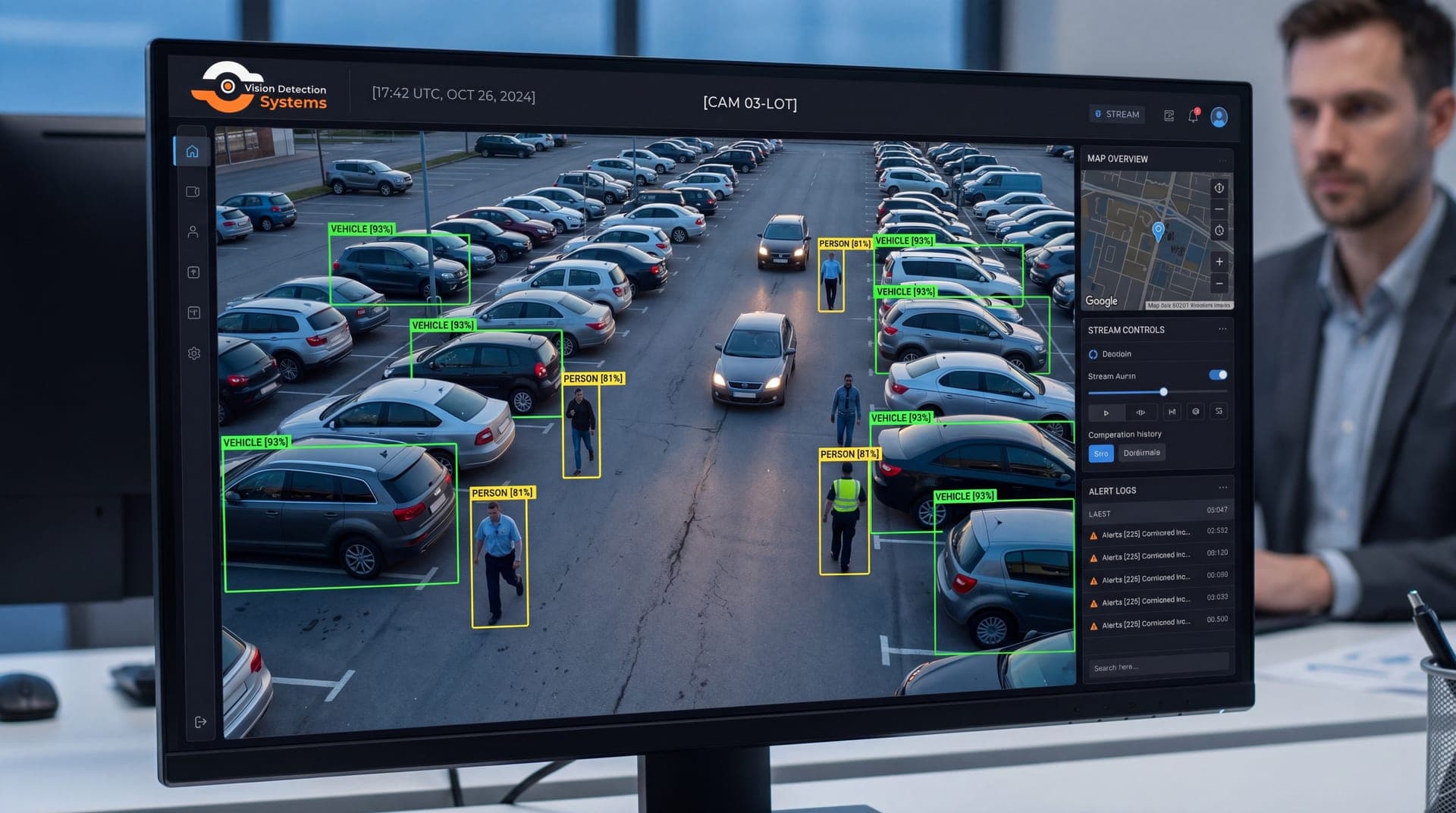
The word is applied loosely. In plain terms, traditional video analytics detect something, such as a person or a vehicle, and raise an alert. An agent-style system goes a step further. It can chain several tasks toward a goal: look at an alert, check recent video from nearby cameras, compare against site rules, write a short summary and suggest what to do next.
That is a real shift in workflow, but it is not a new kind of camera. The agent sits on top of the same detections, the same video and the same site rules. If those inputs are weak, the agent's output is weak. Our overview of AI video analytics for security cameras covers the detection layer that agents depend on.
What agent-style AI can do well today
Several tasks fit current technology because they are repetitive, bounded and easy for a person to check:
- Triage. Grouping alerts that belong to the same event, ranking them by site rules and filtering obvious nuisance triggers so operators see fewer, better alerts.
- Summarizing. Turning a sequence of detections into a short description, such as "a person entered the lot at 1:12 a.m. and walked along the fence for four minutes."
- Searching. Finding clips by object type, time range or camera so a reviewer does not scrub through hours of footage.
- Drafting reports. Producing a first draft of an incident note that a person edits and approves.
- Routing. Sending the right information to the right contact based on a written escalation plan.
Each of these saves time. None of them removes the need for someone to look at the video and decide.
What it cannot do reliably
Be skeptical of claims that go beyond the list above. Current AI has known limits:
- It can misread a scene, especially in poor light, bad weather or at long distance.
- It can be confidently wrong, which makes errors harder to spot than an obvious false alarm.
- It does not understand intent. A person walking along a fence might be a trespasser, an employee or a contractor, and video alone often does not settle it.
- It cannot take responsibility for a decision. Dispatching police or confronting a person carries consequences that belong with trained people.
- It cannot fix a bad camera setup. Placement, lighting and field of view decide what the system can see.
The article on video analytics accuracy explains why these limits exist, and how to reduce false alarms covers what you can do on your side.
Why human verification stays in the loop
A false dispatch wastes police time and can damage a site's standing with local responders. A missed event can mean a loss that video could have prevented. The way to manage both is a verification step: a trained operator sees the video, confirms what is happening and chooses the response.
Research on cameras points the same way. A 2019 systematic review found actively monitored camera systems were associated with about a 15% reduction in crime, while passive recording-only systems showed no significant effect. That review looked at public-area CCTV, not AI agents, but it supports the idea that watching and responding matter more than recording alone. Our piece on video verified alarm response describes how verification fits into a response plan.
A realistic example of the workflow
Consider a person entering a closed yard at night. Detection flags the person. An agent-style layer groups the alert with earlier detections from the same camera, sees that no one is scheduled, and writes a short summary for the operator. The operator watches the clip, confirms the person is not an employee, and uses a loudspeaker to tell them they are being recorded and must leave. If they do not, the operator escalates according to the site plan.
Every step the AI took saved time. Every step that mattered, confirming, speaking and escalating, was done by a person.
Where the work is split
| Task | AI agent role | Person role |
|---|---|---|
| Detect people and vehicles | Primary | Tune rules and review misses |
| Group and rank alerts | Primary | Spot-check results |
| Summarize an event | Draft | Confirm against video |
| Verify a real incident | Assist | Decide |
| Speak to a person on site | None or assist | Lead |
| Dispatch police | None | Decide and communicate |
| Review video after an incident | Search and filter | Confirm and export |
Questions to ask any vendor
Marketing language around agents is inconsistent, so use specifics:
- What exactly does the agent do, and what can it do without a person approving?
- Which detections feed it, and how are they tested on sites like mine?
- Who reviews alerts, how quickly, and in what hours?
- How are errors found and corrected?
- Where does processing happen, on the device or in the cloud? See edge vs cloud analytics.
- What data is stored, for how long, and who can see it?
A vendor with clear answers is usually further along than one with large claims.
Speed matters, but so does accuracy
A fast alert that is wrong is worse than a slightly slower alert that is right. The goal is a pipeline where AI narrows the field and people confirm. See the 60-second SOC article for how fast verification can work in practice without skipping the human step.
Where VDS fits
VDS uses AI detection for people, vehicles, loitering, objects and license plates, and our platform also has analytics pages for fire and smoke, PPE compliance and people counting. Detections go to our 24/7 US-based security operations center, where operators verify events, respond with live talk-down through a loudspeaker and dispatch police with video when warranted. The design is simple: cameras and AI do the watching so people, yours or your security partner's, handle verified incidents. Our mobile surveillance unit is a solar-powered trailer with a 5MP PTZ camera with 25x optical zoom and three 8MP wide-angle cameras, and no site power or internet is needed. To discuss your site, talk to our team.
Sources
- Piza, E. L., Welsh, B. C., Farrington, D. P., & Thomas, A. L. (2019). CCTV surveillance for crime prevention: A 40-year systematic review with meta-analysis. Criminology & Public Policy, 18(1). onlinelibrary.wiley.com