
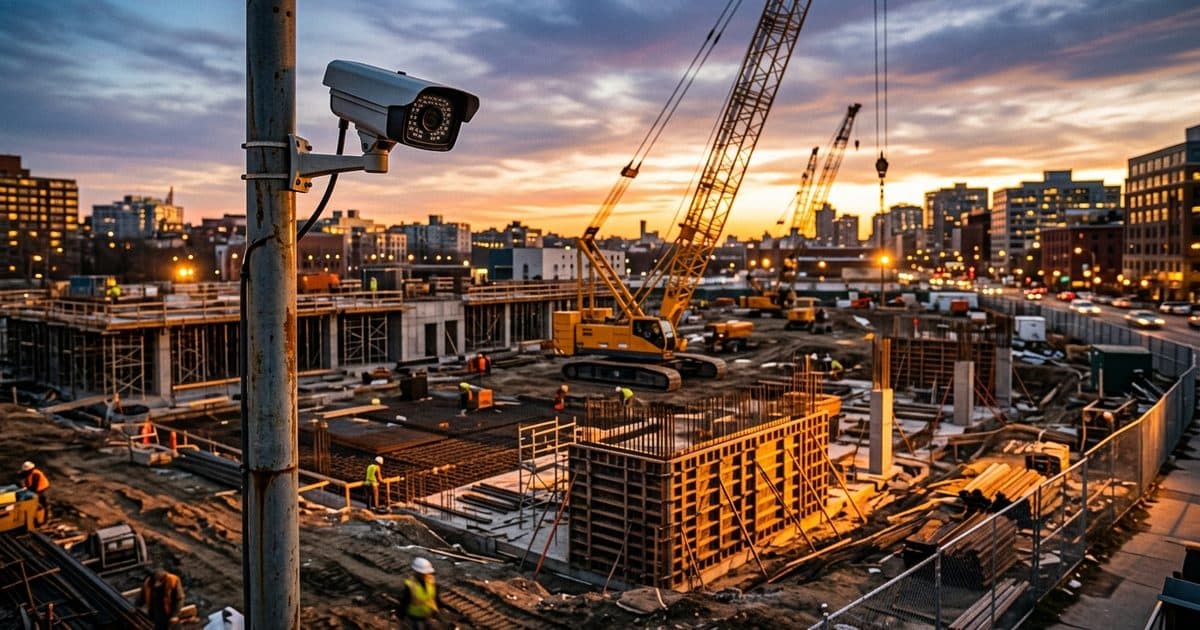
Construction teams often assume that because a camera is visible on a pole or trailer, it must be capturing everything that happens. It isn't, unless the system was built for continuous or motion-triggered recording with retention and remote monitoring behind it. Below is what each camera type actually records, where the gaps show up, and how to build a building jobsite security camera plan that actually covers you after hours.
What time-lapse construction cameras actually record
A time-lapse camera is a documentation tool, not a security tool. It is typically a fixed, high-resolution unit mounted on a pole, crane, or adjacent structure that captures still photos on a schedule, often one frame every 10 to 15 minutes during working hours. Software compiles those stills into the familiar sped-up video of a building rising from the ground.
That output is built for owners, lenders, and marketing teams who need visual proof the schedule is real, not for catching an intrusion in progress. There is no continuous stream, no night-optimized sensor tuned for low light, and no live monitoring behind the lens. If someone cuts a fence between frame captures, the camera simply never saw it happen.
Note: A 10-minute capture interval means a five-minute theft has roughly a 50% chance of occurring entirely between frames, with nothing recorded at all.
What monitored security cameras record
Monitored construction site security cameras work differently. These systems record continuously or on motion-triggered activation, stream footage to a monitoring center or cloud platform, and retain that footage on a defined schedule, often 30 to 90 days depending on the package. Night-vision sensors, infrared illumination, and audio talk-down speakers are standard on units built for after-hours coverage.
Because the footage is monitored in near real time, a verified break-in at 2 a.m. can trigger an alert, a live audio warning, and a call to local law enforcement before the crew arrives the next morning. That is the functional definition of continuous video: not just recorded, but watched, escalated, and retained.
| Camera type | Recording method | Night coverage | Live response |
|---|---|---|---|
| Time-lapse progress camera | Scheduled still frames (every 10-15 min) | Limited or none | No |
| Standalone security camera | Continuous or motion-triggered recording | Infrared/low-light sensor | No, recording only |
| Monitored mobile surveillance trailer | Continuous recording + live monitoring | Infrared, floodlight, talk-down audio | Yes, verified escalation |
Why continuous recording matters more than camera count
Most project managers who feel "we already have cameras" are thinking about camera count, not recording behavior. A jobsite can have six fixed cameras and still have zero usable footage of an overnight theft if none of them record continuously, retain long enough, or get reviewed before the clip is overwritten.
The National Insurance Crime Bureau has repeatedly flagged construction equipment theft as a persistent, costly problem precisely because job sites are unattended for long stretches and evidence is often missing when it matters. A camera that only captured a still frame every 10 minutes, or one that recorded but overwrote the clip after 24 hours, produces the same result as no camera at all: an incident with no evidence trail.
This is also why construction site security cameras and insurance conversations keep coming up during claims review. Insurers increasingly ask not just whether a camera existed, but whether it was recording continuously, retained footage long enough to be pulled, and was monitored in a way that supports a documented incident report.
Where documentation and security overlap
Time-lapse and security cameras serve different primary jobs, but they overlap on one point that matters to nearly every active jobsite: evidence. Disputes over delays, defective work, and theft claims are common and expensive on large projects, and a continuous, timestamped video record can end up being worth more than either camera's headline function.
"The jobsites that come out ahead after an incident aren't the ones with the most cameras. They're the ones that can produce a continuous, timestamped clip within minutes of a request." — VDS Field Operations
A dated still-frame record answers "when did the slab get poured." A continuous, monitored feed answers "who was on site at 2:47 a.m. and what did they do." Most active jobsites eventually need both answers, though not necessarily from two separate, disconnected systems.
Mobile security cameras for construction sites: the practical answer
For most active jobsites, the fastest way to get continuous recording without waiting on permanent infrastructure is a mobile surveillance trailer. These units run on solar or battery power, deploy without trenching or hardwired electricity, and relocate as the site's risk areas shift, material laydown one month, finished units the next.
A properly configured mobile unit records continuously, streams to a monitoring center, and retains footage on a defined schedule, not just during business hours. That combination directly answers the original question for construction teams evaluating options: standalone time-lapse cameras do not record continuous video, and most basic fixed cameras without a monitoring and retention plan behind them don't either. Monitored mobile and fixed systems built for security do.
Construction site security camera rentals have become common specifically because they solve the gap between "we need coverage now" and "we don't have permanent power or mounting infrastructure yet." A rented trailer can be on site within days, covering a jobsite's highest-risk period, the first few weeks after material delivery, without waiting on a capital project for cameras.
Documentation vs. security: which does your jobsite need?
The honest answer for most active construction sites is both, serving different stakeholders. Owners and lenders want progress documentation. Superintendents and insurers want continuous overnight coverage with a response plan behind it.
- If your main concern is stakeholder updates and marketing assets: a time-lapse camera covers that job well and cheaply.
- If your main concern is theft, vandalism, or after-hours liability: you need a monitored system that records continuously, retains footage, and escalates verified alerts.
- If you're facing a potential delay claim or dispute: continuous, timestamped footage with a clear chain of custody matters more than polished progress video.
- If your site changes phases often: a mobile unit that relocates as risk areas shift beats a fixed camera locked to one vantage point.
Can one system do both jobs?
Some platforms attempt to bridge the gap: a security-grade camera that also produces a compiled progress video from its continuously recorded footage, rather than running two separate camera systems side by side. This avoids paying for two mounts, two data plans, and two vendor relationships, while still producing the polished progress output stakeholders expect.
The key question to ask any vendor pitching a combined system is simple: does the camera record continuously and retain that footage on a defined schedule, or does it only capture scheduled stills that happen to look good compiled into a video? The comparison between time-lapse and continuous security recording is worth reviewing in full before signing a contract, since the marketing language for both categories can sound nearly identical.
How to plan jobsite camera coverage that serves both needs
Start with the risk calendar, not the camera spec sheet. Material deliveries, equipment staging, and periods with no crew on site are the windows where continuous recording and monitoring earn their cost. According to the Associated General Contractors of America, jobsite theft and vandalism remain a persistent cost driver across the industry, and unattended hours are consistently where losses concentrate.
A practical coverage plan usually includes a mobile surveillance trailer positioned to cover the active risk zone, continuous recording with a defined retention window, written escalation rules for after-hours alerts, and a straightforward video retrieval process so footage can be exported quickly for an insurance claim or dispute. Progress documentation can run alongside that system rather than instead of it.
Tip: Confirm retention length before signing a contract. A system that records continuously but only retains footage for 24 to 48 hours can still lose the exact clip you need if nobody reviews it in time.